The Reading Ripple Effect

Recently I’ve been astounded by the number of conversations I’ve both had and heard about reading in my school. Staff are talking with students about what they’re reading; kids are asking their teachers for recommendations; our teens are discussing and sharing their current reads.

My long-term library goal is to build a culture in our school community where people feel comfortable talking about books in the same way that they’d discuss their favourite movies or the latest NRL game. Reading is often seen as an isolated, solitary activity, but I’ve been working hard over the past few years to reframe it as a social activity. I know I personally read more when I’ve got people to talk with about the things I’m reading, and the teens I teach, who are at that crucial developmental phase where they see their peers as sources of authority, are no different.

One person talks to another about what they’re reading or is visibly reading during their free time; another person is then more incentivised to pick up a book and discuss it. Each new conversation ripples out and normalises reading, causing new conversations which ripple further and build a community of readers.

Emphasising the social elements of reading and providing opportunities for socialising around books encourages these conversations.

I’ve got a few initiatives aiming to reframe reading as a social activity, including the Wide Reading Program (which is now in its 5th year!). We start every lesson with a Book Talk where we share what we’re currently reading and give a brief rating for our books. Not only does this position reading as a fun, valued activity, it also models different reading behaviours and provides peer recommendations, which is much more powerful than if it was just coming from an adult teacher. It also gives me an interesting insight into our students as well as their interests and needs – some of the kids we’d least expect are actually readers and love being able to share and influence their peers in a positive way! I’ve seen a number of students picking up books based on these Book Talk recommendations, which will eventually ripple out into more conversations and behaviours around reading. One girl in Year 8 inspired another struggling reader to try reading ebooks, while another has borrowed picture books to read with her younger brother at night. Each of these interactions has had a positive impact which in turn ripple into future positive interactions with reading.

I also celebrate our top readers through our Readerboard. Each month once I do our overdues I run a report through our LMS to generate a list of our Top Borrowers for both the month and the whole year so far. I write their names and their current loan tally on our Readerboard in whiteboard marker. This year I’ve also worked with our House Points committee to align the Readerboard with our House Points scheme so that each loan contributes a house point to the total tally. Our current Top Borrower has read an amazing 194 books so far this year! Our Top Readers have a real sense of pride and achievement when their names make it onto the board, and there’s a definite competition to see who can outread the others!

This year I’ve added a few new initiatives to the mix, such as the CBCA Shadow Judging program and a revamped Staff Book Club. Both rely on a social element to encourage continued engagement with books. I’ve got 12 students who have signed up for the Shadow Judging program and we are meeting twice a term to keep on track and discuss what we’re enjoying or not enjoying about the shortlisted Older Readers books. Our Staff Book Club has a choice of four books from a variety of genres to read across the term, and the 14 of us are meeting twice a term to catch up and share our thoughts on the four books we can choose from. One key factor in the success of this revamp so far has been the efforts of one of my colleagues in English, proving that you go further when working as a team!

I’ve got a number of future actions that I’d eventually like to implement too, such as:

  • Shelf talker reviews
  • Increased social media presence advertising books and showcasing students and teachers reading through ‘Caught Reading’ and ‘Shelfies’ posts
  • Student-created reels advertising their current reads or favourite books
  • ‘Currently Reading’ integrated into staff email signatures
  • Integrating a 10 minute DEAR into classrooms as part of our school’s lesson framework
  • A ‘Battle of the Books’ bracket-style tournament
  • Involving parents and students in our Book Club
  • ‘Book Trails’ and ‘Read Off Battles’ between staff
  • Buddy Reads activities in the Wide Reading Program lessons
  • Student-made ‘How I Find Time to Read’ videos
  • Targetting specific students with high influence to help them achieve their reading goals in the Wide Reading Program

Staff Meeting Showcase: The Wide Reading Program’s Book Talks Activity

This week I had the opportunity to showcase the Wide Reading Program at a whole school staff meeting. It’s always nerve-wracking presenting to a group of tired staff who’d rather be using the time to complete their impending reports or mark their pile of exam papers! My first instinct was to cry a firm “hell no!” at my Head Teacher when he asked, but after a moment’s thought I realised what a huge advocacy opportunity I’d be throwing away if I did.

So, heart thumping, I accepted.

I kept it short and sweet, choosing to highlight the aims of the program and the ‘positive primer’ Book Talk I use with each class.

This simple starter activity aims to help normalise and model reading behaviours, encourage a social element to what is often perceived as an isolated activity, and build motivation through peer recommendations. It’s super easy to run, requiring only the teacher asking “what are you reading at the moment?” and prompting further discussion from student and staff responses. Some classes with fewer readers might only take 5 minutes to complete a Book Talk, but others with more students wanting to participate can take up to 15 to 20 minutes! I love seeing the variety of things the kids are interested in reading, and encourage their classroom teachers to participate in the discussion too. It’s always interesting seeing what different things people are reading!

As far as I could tell, my presentation seemed to go well. I feared that when I asked the golden question “what are you reading at the moment?” I’d be met with a room full of crickets, but luckily several staff jumped on board with the chance to share their most recent reads with the group. I didn’t want to take up a huge amount of time with this discussion so I ended it after three volunteers shared their experiences, but I reckon we could have easily spent the rest of the staff meeting talking about books if we’d had the time!

And speaking in front of my colleagues, as terrifying as it was, not only allowed me to increase the visibility of the work I do to support our students’ developing literacy skills and reader identities, but let me showcase my professionalism and the research behind my work. The rewards were immediate: straight after my presentation, the Deputy of Inclusion and Support emailed me to request that the Support Unit classes are involved in the program next year. From humble beginnings supporting only two classes in 2022 and three classes in 2023, the Wide Reading Program will soon benefit all eleven Stage 4 classes as well as the seven (or more) Support Unit classes.

Methinks 2026 is going to be a very busy year in the library!

CBCA Book Week 2025: Taking Our School On An Adventure!

The end of Term 3 is always a hectic time, with assessments, exams, reports, year 12 graduation, and other end of term extra-curricular happenings, so it’s no surprise that my post for our 2025 Book Week celebrations has been sitting in my drafts for over a month!

This year was only my second year running Book Week activities and, similar to last year, I ran a couple of competitions aiming to boost the visibility of reading for fun alongside some activities in my Wide Reading Program. The 2025 theme was Book an Adventure, which provided a lot of fodder for creativity amongst my students and colleagues!

Wide Reading Program

Last year I did a word cloud activity, but this year I planned ahead and bought a couple of book packs for the CBCA’s shortlisted titles in the Picture Books and Older Readers categories. Using these books, I was able to send my students on a Blind Date with a Book.

This activity was supported by the PowerPoint above along with the worksheet below to help students organise their thoughts about each book. Students rotated through a few books in the course of the lesson and at the end we discussed what they thought about each text and which were their favourites. Our Book Week was held a week after the official event, so the winners for each category had already been announced. I therefore asked each class which book they thought was the winner in each category; interestingly, while a few successfully identified The Truck Cat as the winner for the Picture Book category, no class picked the winner from the Older Readers books!

Overall, I feel like this was a fairly successful activity, though it did require a few tweaks to work for different classes. A number of the Older Readers books ended up being borrowed and having a few reservations placed for them, indicating that there was a bit of interest in these titles from our students.

Door Decorating Competition

Our most visible Book Week activity is our Door Decorating Competition. Last year our Office Staff had a controversial win, and this year the competition was intense between a number of different faculties who were intent on taking on the top honours.

Our Office Staff this year did a fully interactive, multi-day spectacular where they dressed as flight attendants and made in-flight announcements at the start of each period. The English staff were inspired by The Wizard of Oz and decorated every door in their block to take students on an adventure through the story. However, the HSIE faculty were the winners at the end of the day with their immersive Jurassic Park experience, complete with printed book chapters, dino-paws, music and lollies for our student judges. They even let the dinosaurs loose on the playground! Such chaos!

Cosplay Competition

Without a doubt, the highlight of our Book Week celebrations for the students is our Cosplay Competition. I was once again able to organise it as a mufti day, with all funds raised going towards the Indigenous Literacy Foundation. This year our winning cosplayers were a group of mischief-making Gryffindors whose magical performance involved a floating feather and wowed the crowd.

It was wonderful throughout the week to see such enthusiastic discussion around books and reading. Our various activities also give me an opportunity to showcase the library’s value to our school community. Book Week tends to be viewed as a more primary activity, but I highly recommend High School TLs give it a go too! There’s so much potential value that it can add to our work and gives our students and colleagues a chance to celebrate the wonder of picking up a book.

Understanding Australian Readers: Summarising the Australia Reads Report

Recently several researchers from Australia Reads released their Understanding Australian Readers report. This report aimed to identify what influences when and how people read, to map out thier reading journey and to uncover drivers and barriers for these reading behaviours across different demographics. While it focused on people aged 16 and over rather than children or teenagers, this was invaluable research which provided some key insights that can apply to my own work in a high school setting.

The researchers also launched the report with an accompanying webinar:

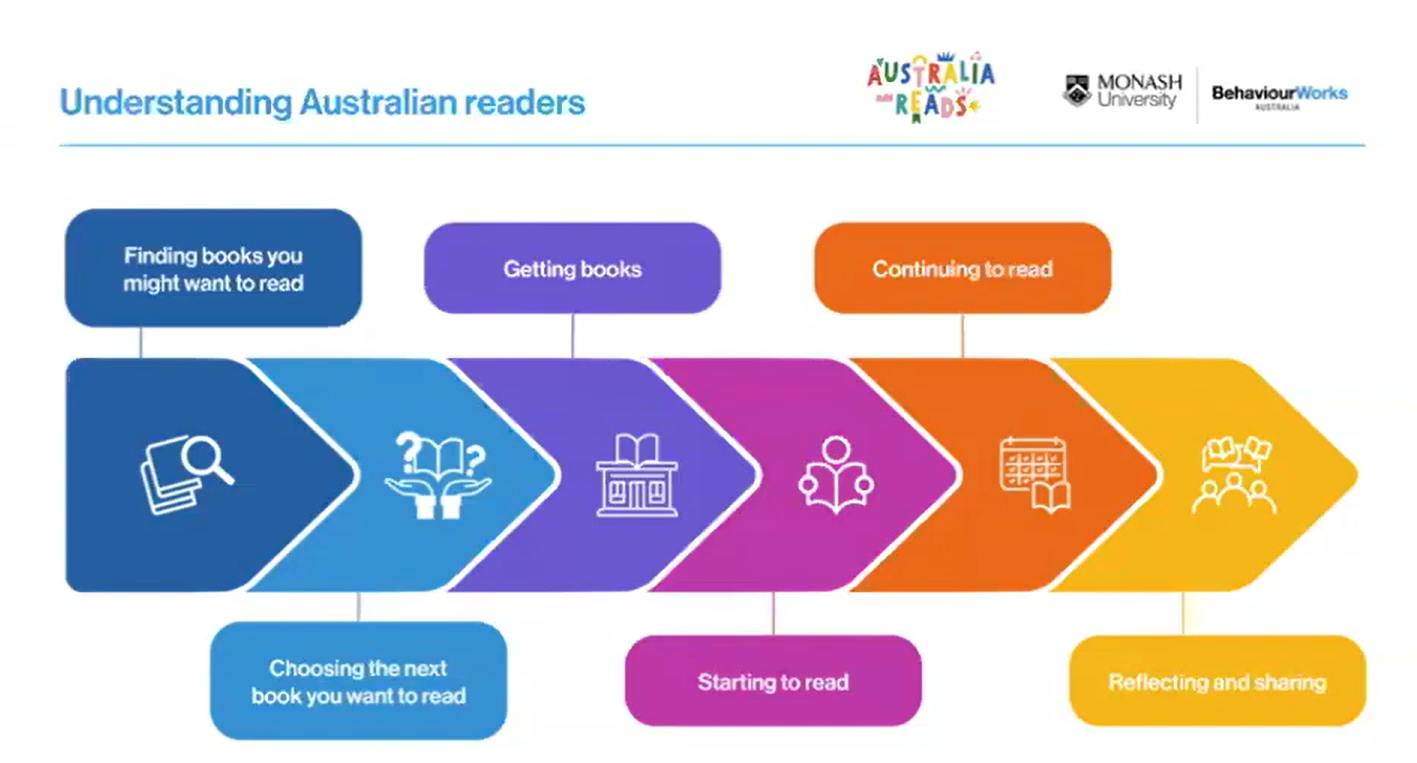
I really liked how the report broke down the different behaviours that make up a reading journey, and how these behaviours aren’t necessarily linear. The report also notes that different groups will exhibit different behaviours in each of these steps of the reading journey and face different barriers; therefore, there’s no one size fits all approach to increasingly Australia’s lagging recreational reading rates.

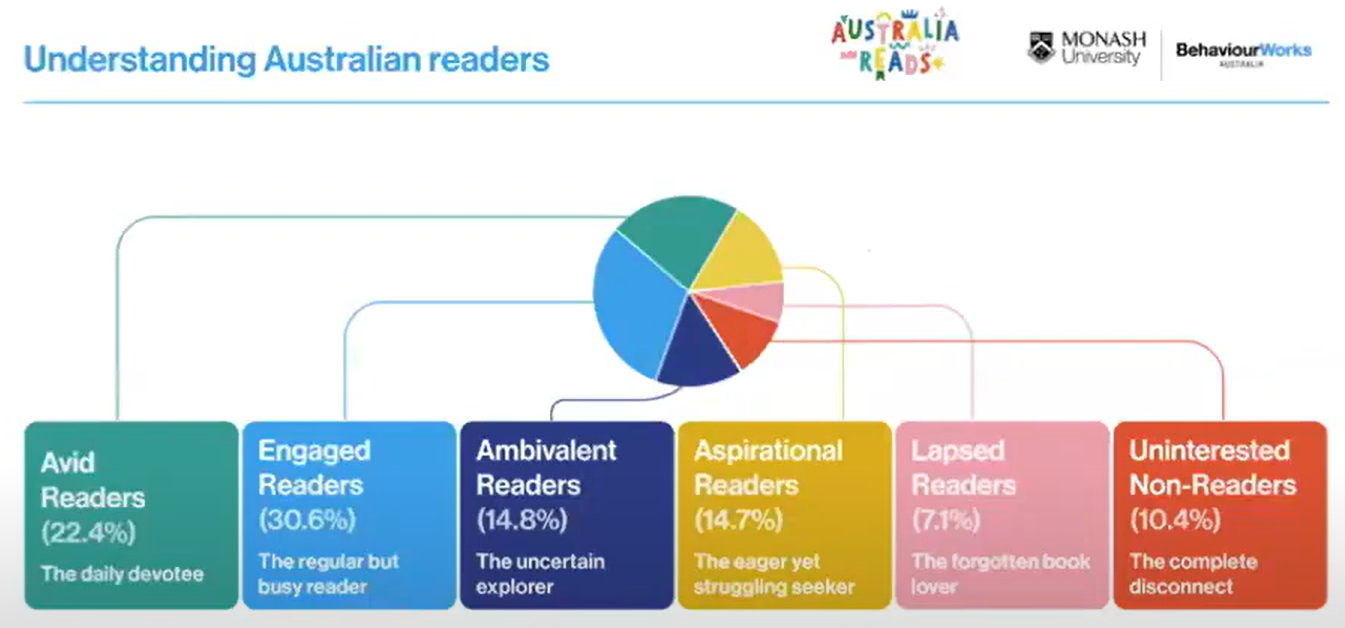
The report also explores the different types of readers, presenting these identities on a spectrum that includes both readers and non-readers. It was interesting to see that reader identity isn’t fixed and that people move between these different stages at different points in their lives. For instance, I would have once identified as an Avid Reader (I was the kind of kid who used to take books with me everywhere!) but now, due to time constraints and work overload, I’d probably fit the Lapsed or Aspirational Reader categories.

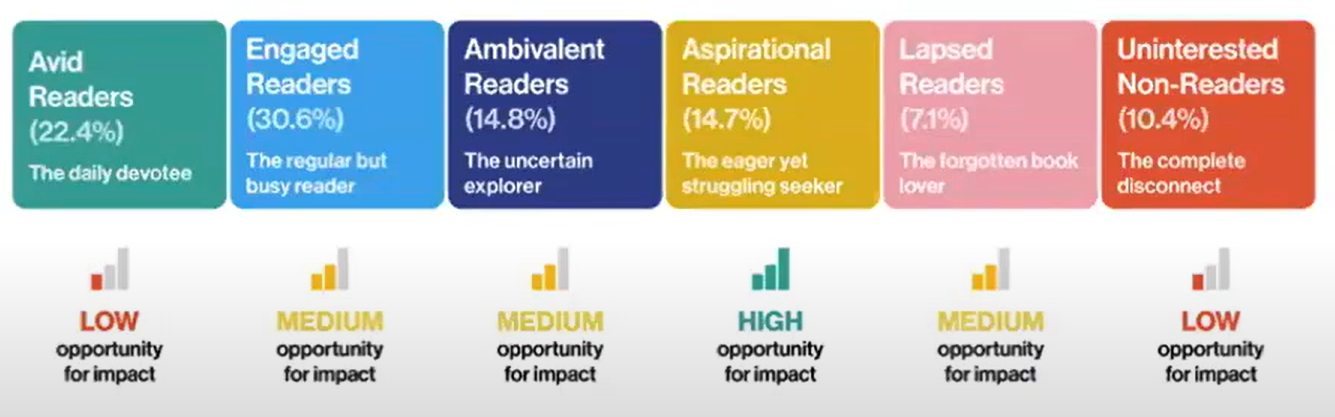
Interestingly, the report also notes that readers on each extreme of this spectrum are less likely to change their reading behaviours and are therefore less effective targets for behavioural interventions. This is a key insight for me as a teacher-librarian, as it helps me understand where my energy is best directed in my lessons. The report concludes that Aspirational Readers are the most impactful group to target, followed by Engaged, Ambivalent, and Lapsed readers.

The report has a number of other crucial implications for my work as a teacher-librarian. Firstly, the fact that Uninterested Non-Readers don’t remember a single positive reading experience emphasises the importance of having qualified, well-supported teacher-librarians in schools who can support these formative reading identities in a positive way. Secondly, the report highlights the need to validate everyone’s reading experiences and identities, and the need to avoid judgements around different reading behaviours.

The webinar also gave three quick takeaways to help us moving forward:

  • Focus on the behaviour we want to see, not the behaviour we don’t want – sell the benefits of the product rather than the product itself.
  • Social norms are powerful but we need to make sure that our messages are coming from sources of authority that our audience finds relevent, valuable, and trustworthy.
  • Reduce choice overload to make it easier to connect people with relevent reading materials.

Based on the interventions recommended in the report, I’ve created a table of possible strategies to incorporate into my Wide Reading Program linked to the various stages of the reading journey. This year I’ve chosen 3-4 students from each class to focus on helping them achieve their self-nominated reading goal. These interventions will hopefully provide me something tangible to action in our lessons, and will help me shape my ongoing reworking on my Wide Reading Program scope and sequence.

Intervention TypeFinding BooksChoosing BooksStarting to ReadContinuing to Read
Education: Provide information to increase knowledge of understanding about a behaviour or issueEncourage engagement with social media or other book related content
Target browsing shelves as a worthwhile activity
Highlight value of graphic novels, short stories, novellas, middle grade and picture booksHave influencers or relatable individuals promote the benefits of reading in short, engaging video clips or interviews
Emphasise that reading can be a social activity, not just isolating
Emphasise reading is a restorative activity, not another chore
Highlight that reading habits evolve over time
Model reading habits
Reframe what it means to be a ‘good’ reader
Emphasise that reading confidence emerges from personal engagement and enjoyment, not proficiency
Training: Develop skills required for people to perform a behaviour effectively Provide training on how to find booksCreate tutorial videos or provide live demonstrations showing how to select books
Provide explicit training on how to select books
Use apps to block device notificationsCreate tutorial videos or provide live demonstrations showing how to incorporate reading into your daily routine
Persuasion: Use communication to induce positive feelings and change peoples’ attitudes or beliefsConnect reading to other activities and content they enjoy
Reframe away from the act of reading to engagement with other enjoyable content e.g. becoming a better footy player
Remind students about the enjoyment and benefits of reading
Reinforce message that there’s a book for every mood, and that any mood is a reading mood
Reinforce it’s ok to put down a book that isn’t meeting expectations
Reframe that it’s ok to skip parts or not finish books
Incentivisation: Offer rewards or benefits to motivate people to engage in a desired behaviourEncourage people to log and track their reading habits via apps, providing occasional rewards for continued progress
Modelling: Demonstrate or provide examples of desired behaviours for others to observe and imitateShow role models or peers who can demonstrate that spending a little time finding books can lead to greater reading enjoymentConnect readers with trusted reviews
Use peer-driven content and reviews
Share stories of relatable readers who have made time for reading
Show people they admire who enjoy reading
Enablement: Remove barriers and provide support to help people adopt new behavioursPromote audiobooks, quick reads, visual texts
Encourage people to use platforms like Goodreads to see what’s popular, get personalised recommendations
Encourage expansion of preferences to include digital and audio to increase accessibility
Use curated book lists to reduce effort in choosing books
Provide personalised recommendations 
Encourage use of platforms that give one-click recommendations based on past reading preferences
Encourage placing phones on silent, in other rooms
Pair individuals with reading buddies
Set reading goals
If-then implementation intentions
Create personalised reading schedules
Environmental restructuring: Change the physical or social environment to make desired behaviours more likelyKeeping books in visible spots
Connect readers with relevant books
Use AI reader advisory
Genrefy the collection
Read sample chapters or summariesSetting phone reminders to and timers to read
Encourage readers to keep a book in their bag to read on public transport, in doctor’s surgeries etc.
Encourage book clubs and reading groups to enhance social accountability

Wide Reading Program: Using AI to Help with Data Analysis

This fortnight I’ve been focusing on introducing the Wide Reading Program in more detail to my classes. This lesson starts with a discussion about what the research says about the benefits of reading for pleasure to emphasise to my students why we have these lessons.

I then follow up with a quick survey to help ascertain my students’ reading identities and experiences. This year I adjusted my previous survey based on some PL I’d undertaken in 2024 and asked only 6 questions:

  1. I think I am: a) a confident reader; b) an OK reader; c) not a very confident reader
  2. I am: a) someone who loves reading; b) someone who will read if there’s nothing else to do; c) someone who doesn’t like reading but wishes I was better at it
  3. What was the last book you remember reading? What did you think of it?
  4. What was the best book you have ever read? Why did you enjoy it?
  5. My favourite genre or type of book to read is …
  6. What is your reading goal for 2025?

I’ve had three classes so far do the survey. I love going through their responses but it can be time-consuming, so this year I thought I’d see if ChatGPT can help analyse the survey data. I opened their responses on a Google Forms sheet, copied into ChatGPT and sat back while it spat out its summary.

Year 9

Here’s an analysis of the data, breaking it down into key trends:

1. Reading Confidence & Attitudes

  • Confident Readers: 14 students (56%) identified as confident readers. However, 8 of them (57%) admitted they only read if there was nothing else to do.
  • OK Readers: 7 students (28%) considered themselves OK readers.
  • Struggling Readers: 2 students (8%) said they don’t like reading but wish they were better at it.
  • Non-Readers: 2 students (8%) explicitly stated they do not want to read.

2. Book Preferences

  • Most Popular Genres:
    • Romance (6 students)
    • Fantasy (4 students)
    • Dystopian (3 students)
    • Mystery/Thriller (3 students)
    • Historical Fiction (3 students)
    • Horror, Comedy, True Crime, and Action/Adventure were each mentioned by 2 students.
  • Popular Authors & Books:
    • The Hunger Games (3 mentions)
    • Pig the Pug (2 mentions)
    • If He Had Been with Me (2 mentions)
    • Lessons in Chemistry (2 mentions)

3. Reading Goals for 2025

  • Finding Enjoyment in Reading: 6 students want to find a book they enjoy.
  • Reading a Whole Series: 3 students want to complete a series.
  • Reading with Others: 3 students want to read the same book as a friend.
  • Setting Number Goals:
    • 1 student wants to read 100 books.
    • 1 student has a Goodreads goal of 15 books.
    • 1 student wants to read 20 books in a year.
    • 1 student wants to read one book per month.
    • 1 student wants to read 2 books for fun.
  • Exploring Different Genres: 3 students want to try new types of books.
  • Reading Biographies: 2 students want to read more biographies.
  • Avoiding Reading: 2 students said they don’t want to read any books.

4. Engagement with Books

  • Some students (especially confident readers) are enthusiastic about reading, mentioning books in detail.
  • Others struggle with engagement—one student only remembers reading Pig the Pug, and two openly stated they have no interest in reading.

Suggestions for Teaching & Support

  • For Reluctant Readers: Offer high-interest, low-difficulty books like graphic novels, short stories, and engaging non-fiction (e.g., sports, biographies).
  • For Goal-Oriented Students: Provide challenges (e.g., Premier’s Reading Challenge, book clubs, reading trackers).
  • For Genre Explorers: Recommend books based on their favorite themes but in new genres.
  • For Social Readers: Create buddy reading programs or class book clubs.

Year 7, top class

Here’s an analysis of the data you provided:

1. Reading Confidence Levels

  • Confident Readers: 7 students
  • OK Readers: 11 students
  • Not Very Confident Readers: 1 student

2. Attitudes Toward Reading

  • Love Reading: 6 students
  • Wish They Were Better at Reading: 5 students
  • Read Only If There’s Nothing Else to Do: 9 students

3. Most Recently Read Books

  • Blueback (3 students)
  • Diary of a Wimpy Kid (2 students)
  • Dog Man (2 students)
  • Other books varied, including manga, fantasy, sports books, and classic literature.

4. Favorite Books

  • Blueback (2 students)
  • Diary of a Wimpy Kid (2 students)
  • Dog Man (2 students)
  • Other favorites ranged from The Little Prince to Percy Jackson and Fight Club.

5. Favorite Genres

  • Action, Adventure, and Fantasy: 6 students
  • Horror: 4 students
  • Romance: 4 students
  • Sports: 2 students
  • Manga/Graphic Novels: 2 students
  • Mystery, Crime, and Thrillers: 3 students

6. 2025 Reading Goals

  • Read a Specific Number of Books: 7 students (e.g., “read 10 books this year,” “read 30 books this year”)
  • Find a Book They Enjoy: 5 students
  • Finish a Series: 2 students
  • Read More Frequently: 5 students
  • Read a Specific Genre or Author: 3 students
  • Complete a Reading Challenge: 1 student

Key Takeaways

  1. Many students want to improve their reading habits – Several students wish they liked reading more or want to develop their reading skills.
  2. Popular books among students are graphic novels, fantasy, and sports books.
  3. Goals are mostly about reading more books and finding books they enjoy.
  4. Manga, romance, and horror are increasing in popularity.

Year 7, mixed ability class

1. Confidence in Reading

  • Confident Readers (6 students)
    • 2 enjoy reading
    • 4 will read if there’s nothing else to do
  • OK Readers (12 students)
    • 7 don’t like reading but wish they were better
    • 5 will read if there’s nothing else to do
  • Not Very Confident Readers (1 student)

2. Attitudes Towards Reading

  • Many students who don’t like reading still want to improve.
  • A few confident readers read for pleasure and set ambitious goals.
  • Some OK readers struggle with finding books they like.

3. Popular Books & Genres

  • Most Commonly Mentioned Books:
    • Diary of a Wimpy Kid (Multiple students)
    • Blueback (From other dataset, but still a trend)
    • Dog Man (Younger, reluctant readers)
    • Hunger Games (Engaging for those who like action)
    • Ronaldo Rules and Usain Bolt Biography (Popular with sports fans)
    • Twilight Saga (Appeals to fantasy/romance fans)
  • Most Popular Genres:
    • Action/Mystery/Crime (3 students)
    • Fantasy (3 students)
    • Manga (3 students)
    • Romance (2 students)
    • Horror (2 students)
    • Biography (2 students)
    • Sports books (2 students)
    • Diary-style books (1 student)

4. Reading Goals for 2025

  • Most Common Goals:
    • “Find a book I enjoy” (3 students)
    • “Read more books” (3 students)
    • “Finish the Premier’s Reading Challenge” (2 students)
    • “Read at least 10 books” (2 students)
    • “Read more diary books” (1 student)
    • “Read for fun” (1 student)
    • “Improve academic skills through reading” (1 student)
    • “Read without jumbling words” (1 student)

5. Insights & Recommendations

  • For Reluctant Readers: Focus on engaging, fast-paced books with humor, sports, or graphic elements (e.g., Dog Man, Diary of a Wimpy Kid).
  • For Confident Readers: Encourage book challenges, peer recommendations, and series completion.
  • For OK Readers: Introduce high-interest books like sports biographies, action-packed fiction, and manga.
  • For Goal Setting: Some students need structured challenges (e.g., Premier’s Reading Challenge), while others just need help finding books they love.

Combined analysis

Wide Reading Program Analysis & Recommendations

1. Student Reading Confidence & Attitudes

  • Confident Readers: ~27 students (~46%)
    • Many only read if there’s nothing else to do.
    • A few are passionate readers with ambitious goals.
  • OK Readers: ~30 students (~51%)
    • Some struggle to find books they enjoy.
    • Several wish they were better at reading.
  • Reluctant/Struggling Readers: ~4 students (~7%)
    • Some explicitly stated they don’t want to read.

Key Insight: While many students can read, motivation and engagement vary widely. Some need support to find enjoyable books, while others need structured challenges.


2. Book Preferences & Popular Genres

Most Mentioned Books:

  • Diary of a Wimpy Kid, Dog Man (reluctant readers)
  • Hunger Games, Twilight Saga (action, romance fans)
  • Blueback, Pig the Pug (younger or middle-grade readers)
  • Ronaldo Rules, Usain Bolt Biography (sports fans)

Most Popular Genres:

  • Fantasy, Romance, Action/Adventure (Most common across all classes)
  • Manga/Graphic Novels (Growing popularity)
  • Mystery/Thriller, Horror, Historical Fiction (Moderate interest)
  • Biographies/Sports Books (Popular among sports enthusiasts)

Key Insight: Fantasy and action-based books dominate, while romance and manga are increasing in popularity. Reluctant readers favor graphic novels, humor, or sports-themed books.


3. Reading Goals for 2025

Most Common Goals:

  • Finding a book they enjoy (12+ students)
  • Reading more books overall (10+ students)
  • Setting a specific number goal (e.g., 10-100 books)
  • Completing a series (5+ students)
  • Trying new genres or authors (5+ students)
  • Reading with friends (3+ students)
  • Finishing the Premier’s Reading Challenge (4+ students)

Key Insight: Students are motivated by personal discovery, social reading, and structured challenges. Some aim for ambitious reading goals, while others need guidance in finding books they like.


4. Engagement & Challenges

  • Engaged Readers: Confident readers show excitement, often recalling books in detail.
  • Struggling Readers: Some cannot name books they’ve read or express disinterest.
  • Social & Goal-Oriented Readers: A portion of students are motivated by group reading, challenges, or tracking progress.

Key Insight: Encouraging peer discussions and reading challenges could help boost engagement among hesitant readers.


Recommendations for the Wide Reading Program

1. Support Reluctant Readers

  • Offer high-interest, low-difficulty books (graphic novels, short stories, sports biographies).
  • Implement structured incentives (e.g., “Read 3 books and get a reward”).

2. Challenge Confident Readers

  • Provide goal-setting tools (Goodreads, reading logs, book challenges).
  • Encourage peer recommendations & book clubs to deepen engagement.

3. Encourage Social & Goal-Oriented Reading

  • Organize buddy reading or class book clubs.
  • Support the Premier’s Reading Challenge for structure and motivation.

4. Expand Genre Exploration

  • Offer cross-genre book pairings (e.g., “If you like fantasy, try historical fantasy”).
  • Create displays & book talks around popular themes (manga, horror, sports).

5. Track & Support Reading Progress

  • Use reading logs or classroom trackers to encourage small, consistent reading habits.
  • Celebrate reading milestones with small recognitions or events.

Thoughts

I really liked how the AI tool was able to quickly identify patterns and trends amongst the responses, such as how many students liked the same book, or how many students had set the same goal. This makes it easier to group students according to interests and abilities in my activities, and showcased which genres I can be purchasing more of to spark their interest. Even if this latter point was something that I’d realised through observation, it’s nice to have it confirmed through their survey responses. It was also interesting that a lot of the key insights support what the research says about engaging teens with reading for pleasure. While AI has a lot of work to do before it replaces the manual work I do as an educator, in this instance it was a useful tool that saved me a bit of time and gave me some good suggestions for how I can move forward with future lessons.

Wide Reading Program: Buddy Reads Activity

As any teacher can tell you, teenagers are inherently social beings. They’ll also tell you that, for so many reasons, for the most part teens also don’t want to read for pleasure.

Last year I attended ALIA’s online webinar Fostering A Passion For Reading, and Karen Eyre’s brilliant session focused on how reading needs to be more social to overcome the reasons behind adolescent aliteracy. She discussed her ‘read with a mate’ program, where she often pairs students with their friends so they can take turns reading to one another.

This week I decided to adapt her activity and tested out my newly formed ‘buddy reads’ activity. I changed the activity slightly, so that instead of working in pairs students on novels could work in larger groups with picture books. They could either take it in turns to read to one another or designate one ‘teacher’ who would read to the rest. By doing this I was hoping to hook some of our more social and performative students while tapping into their nostalgia for being read to as children in their primary classes.

I had some doubts about how focused the groups would be, but to my surprise and delight they did a fantastic job of staying on task and really engaged with their reading! Many of the usually disengaged boys combined into one big group, which initially drew my attention and concern, but I needn’t have worried. Two boys took it in turns to read to the others and did wonderful work displaying prosody and discussing the visual elements of the books. Their listeners were rapt, and another less condfident boy even picked up a book and wanted to have a go reading to the others because he saw it modeled by his mates!

Some of our more shy students elected to read independently, but for the students who chose to engage with the buddy reads activity I found it a remarkable testament to the power of social reading. The feedback from the class was positive, with an overwhelming majority wanting to do something similar again in future. I think in future lessons I’ll gradually increase the length and complexity of the text types, and gradually reduce the number of people in the groups to allow for deeper examination of their reading materials.

Added bonus: it gives me a chance to advocate for our library on social media!

https://www.instagram.com/p/DHCzCz5M385

Welcome Back for 2025!

The start of the school year is always hectic, and 2025 has been no different!

This year I’ve got 11 classes from year 7, 8, 9 and our Support Unit participating in the Wide Reading Program, which is super exciting. The first lesson of the year is always an orientation to introduce our resources and services.

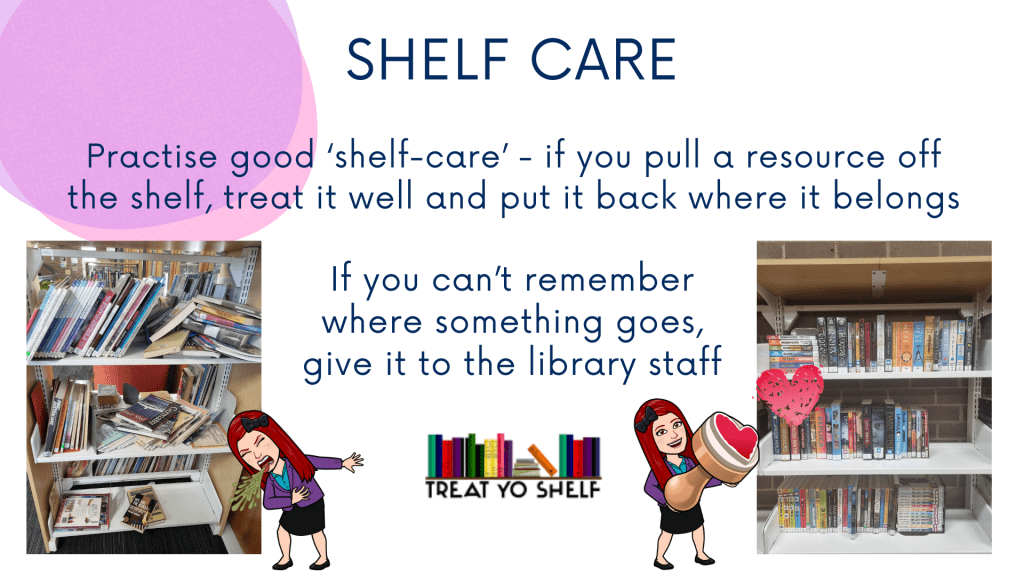
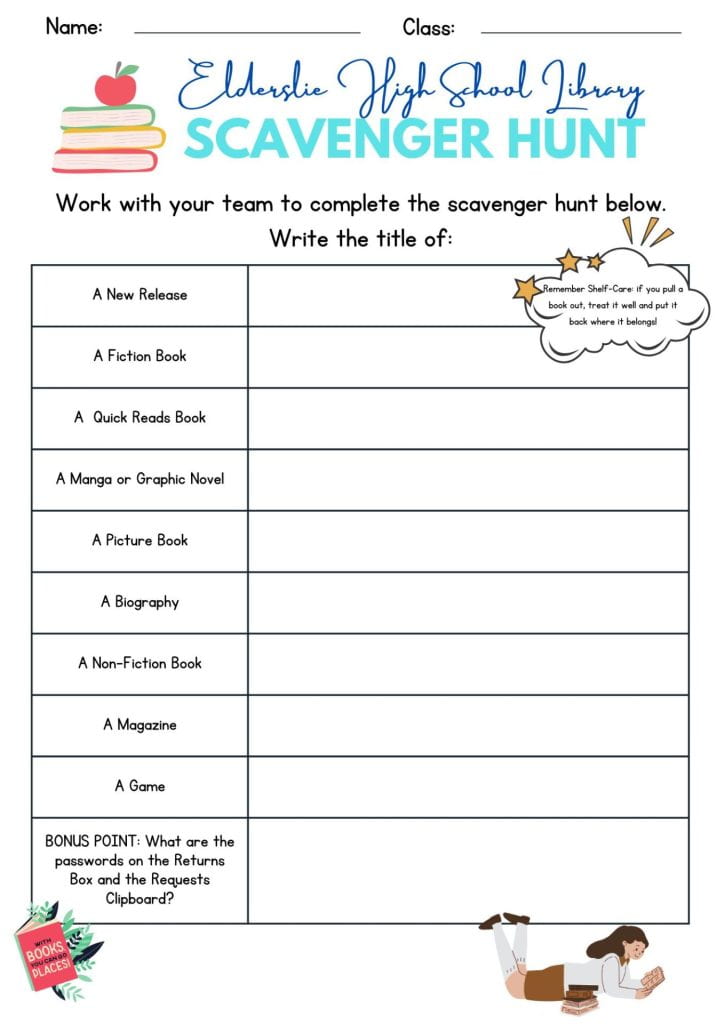
For our new year 7 classes I go through a Canva presentation with them, followed by a Scavenger Hunt activity designed to familiarise them with our different collections. This year I’m also using these activities to emphasise “shelf-care”, or proper treatment of the resources on the shelves. So far the feedback from students has been positive, with some students choosing to borrow books from the collections that they’ve been exploring. This orientation is split across two lessons, with the first introducing the library’s physical resources and the second introducing the library’s digital resources.

For the year 8 classes, most students have participated in the program last year so already have an idea about the resources and services we provide. I therefore run a revision Kahoot, which the kids always love!

Having the students participate in these lessons has proved to be such a great way to familiarise them with our library, which has in turn translated to increased patronage and loans. Over the last two weeks we’ve loaned 220 books to students and each book in the hands of a student represents an opportunity to improve their literacy and wellbeing!

Book Week 2024 Activity: Word Cloud Metaphor Race

I’ve returned to work on site part time this term while I continue to recover from my knee injury, which means that I’m not seeing as many of my Wide Reading classes as I’d like. I’m also not able to plan properly for Book Week, coming up very soon in Week 5. Nonetheless, I do what I can when I can, and here’s a little activity I’ve put together to get kids excited for this years theme: Reading is Magic!

Today I had our Tech Elect class which utilises iPads and other innovative technology tools in their lessons. We’ve previously done a bit of work on reader identity and today I presented them with the prompt “If reading is magic, then readers are …”. They then had to come up with as many metaphors to finish the sentence in 2 minutes as they could. To add an element of collaborative competition, I gave them a QR code to a Google Doc they could edit and assigned each student a team; the team with the most unique metaphors at the end of the game won. I’ve previously run similar games in my classroom by having students line up in two teams and write their answers one by one on a whiteboard, but I thought that would be a bit too much chaos in my already chaotic open-plan library space. After reminding the class about the definition of a metaphor, they were off!

I’ve taken their words and placed them into a word cloud; if you couldn’t guess from the words they’ve chosen, this particular class is completing a novel study based around Harry Potter and the Philosopher’s Stone. While some words were disqualified because they were not metaphors (leading to another teachable moment on the difference between a description and a metaphor), there were some interesting discussions about what readers are that emerged from this activity. Plus, I’ve now got their word cloud to promote the program on social media and in my annual report. It took a bit longer than I anticipated (largely due to tech issues around scanning the QR code) but is definitely something I’d run again with another class – maybe by removing the competitive element and using a single word cloud generated by a platform like Mentimeter.

If anyone has a fun activity they’re running to build excitement for Book Week 2024, leave a comment below!

Engaging Reluctant Readers Through Magazines

As part of my Wide Reading Program, I give students in years 7 and 8 the time to read whatever they want in the library space, free from judgement. As many high school teachers and academic researchers can attest, reading for pleasure falls away in adolescence and by this point teens either see themselves as readers or (increasingly it feels) as non-readers.

Research from Open University’s Reading for Pleasure program shows that a significant barrier to teens forming a positive reading identity is a lack of positive reading experience, whether due to lack of skill, confidence, or enjoyment. So many of my students (particularly the boys) complain that they hate reading, and their experiences up to this point have reinforced that reading isn’t for them because the texts they’ve been given have been boring, too difficult, or they find no reason to focus for long enough to get into it.

This is where I’ve found magazines to be a game changer. The content is usually short, includes visuals to support the written text, caters to a variety of literacy levels, and can be found on a variety of engaging topics that are of genuine interest to my students. Each year I ask students for recommendations on what titles they’d like me to purchase for them, which I’ve found is a powerful way to get students to feel connected to the library and to take ownership of the resources. The most frequent requests are always for car and sports magazines, and loans data from the past 12 months supports my observations about their popularity. As you can see from the chart below, a whopping 68.4% of all magazine borrowed in the past year catered to this interest:

During my Wide Reading lessons so far this year I’ve witnessed whole groups of boys sitting together, reading the articles and discussing what they’re reading. During our Book Talks at the end of these reading sessions, most of the boys will also willingly share information about the articles they’ve read with the whole class, supporting the academic researchers’ claims that social reading can be a powerful motivator in getting reluctant readers on board. My students love it when a new magazine comes in since they often contain new posters, and they race to ask me if they can be the one to take the poster home. Even better, sometimes these reluctant readers even turn into borrowers!

The magazines they read during our lessons might not be counted in my quantifiable loans data which I present to my senior executive staff in my Annual Reports, but they represent something far more valuable – an opportunity for every child to find the joy in reading and to see themselves as a reader.

Reference List:

Open University Reading for Pleasure & World Book Day. Overcoming barriers to RfP – Ep 4: ‘Readers don’t always find it easy to concentrate …’. OURfP &WBD [YouTube]. https://www.youtube.com/watch?v=3kquvtflx4U

Introducing the Wide Reading Program to Students

Last week I posted about the structure of the Wide Reading Program I’ve been trialling for the past few years. This week I thought might be useful to give a bit more detail about how I introduce the program to students.

Activity 1: Brainstorm and Discuss the Benefits of Reading

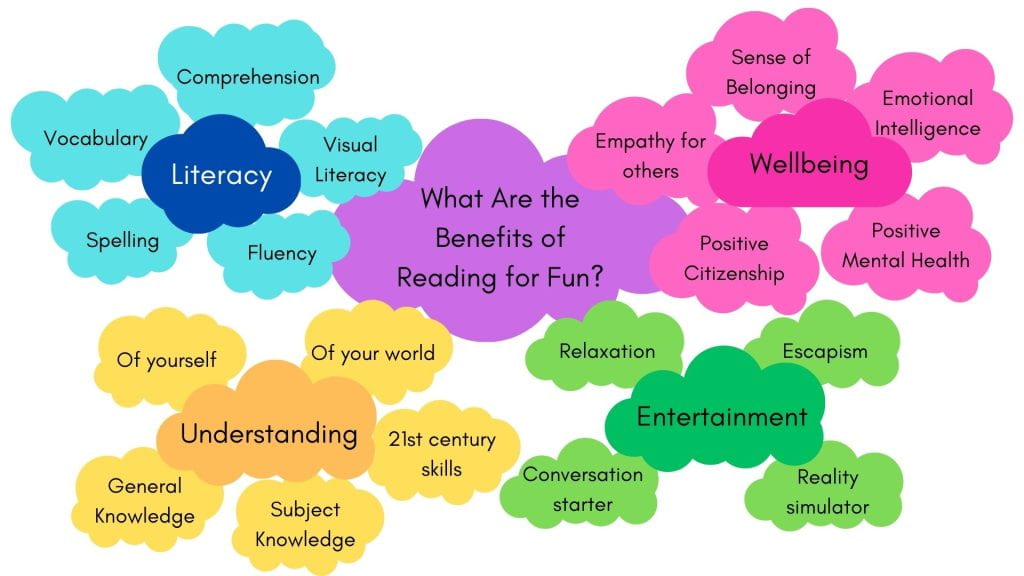
As we all know, if we simply tell a teenager to do something they’re probably not going to follow our instructions. I’m therefore a big believer in trying to get our students to understand the reasons why we learn certain things, and this is where I start with the Wide Reading Program. In previous years I’ve relied on a class brainstorm and discussion of the benefits of reading for pleasure, but this year I rejigged things to include a Canva presentation which sets things out for my students more explicitly.

This year I found that during the brainstorm and discussion most students were able to easily identify the literacy benefits to reading for pleasure while some said it helped them to learn about things or to relax or escape from their problems. However, I found that very few students recognised the wellbeing benefits. In particular I focus on the idea of reading as developing our ability to empathise with others, since this is inherently relevant to the teen experience. Hopefully seeing the visual in the presentation helped them to recognise the multitude of ways reading can help them in their everyday lives.

My reading lessons are only an hour long, and this year due to the excellent discussion sparked by the Canva visual I found that I didn’t really get to the second and third discussion points regarding why they read or don’t read and what behaviours they count as reading – these ended up being incorporated into subsequent lessons. Next year I’ll likely remove them completely from the lesson to streamline my teaching activities.

Activity 2: Reader Identity Survey

Instead, my priority was to get students to complete the reading habits survey so I could get a better understanding of who they are as readers and how I can best support their reading journey. The first two questions in this survey are based around their reader identity and confidence:

  1. I think I am:
    • A confident reader
    • An OK reader
    • Not a very confident reader
  2. I am:
    • Someone who loves reading
    • Someone who will read if there’s nothing else to do
    • Someone who doesn’t like reading

I’ve previously examined their this year’s results, with most students identifying themselves as OK readers who aren’t that enthusiastic about doing it for fun which is consistent with the research in this area. However, after attending a recent webinar by ALIA on Fostering a Passion for Reading, next year I’ll reword the second question to something like “I really don’t like reading but wish I was better at it” to promote a growth rather than fixed mindset.

The second part of the survey asks students about their reading preferences:

However, this is an indecipherable wall of text for struggling readers and rather difficult to navigate on the devices we used. This screenshot is only capturing half of the options I’ve given them! Next year I’ll therefore either simplify this or remove it; I did actually remove it for our streamed Literacy class and found it worked much better. I originally included it with the intention of using it to find specific books for each student but due to time restraints I haven’t had the opportunity to do this yet and doubt I will find the time in future years.

The third section of the survey is a bit more open-ended and could easily replace this second section to help me get a better idea of who my readers are. It features 3 questions:

  1. What was the last book you remember reading? What did you think of it?
  2. What was the best book you have ever read? Why?
  3. What is your reading goal for 2024? e.g. would you like to read a certain number of books, a certain style of books, books from a specific author or culture etc.?

In future I’d love to work with the classroom teacher to nominate three students each per term to target based on these goals. While this won’t allow us to reach everyone in the class, it will allow us to focus on the kids who might otherwise slip through the cracks.

So there you have it – my first lesson in the Wide Reading Program. If anyone has suggestions on how else I can improve or activities that have worked for you, please leave a comment below! If you’re enjoying these activities, stay tuned for more in coming weeks.

Wide Reading Program: Mission Statement and Guiding Questions

One of the difficulties I’ve found in transitioning from a classroom teacher to the teacher-librarian role is the lack of clarity around our role and what we actually teach. As an English and History teacher I always had a syllabus with specific outcomes to guide my teaching programs, and moving into the TL role felt a little bit like I was lost at sea without a map. While the Information Fluency Framework released recently by the NSW Department of Education provides some structure to our role as information specialists, there isn’t a similar local guideline for our roles promoting reading for pleasure.

To help guide my programming for the Wide Reading Program I’ve been trialling over the past few years, I created a mission statement and a series of inquiry questions. These are still very much in the draft stage but have been useful in directing my teaching and learning activities and helping me focus on specific aspects of developing a positive pleasure reading experience for my students. Ideally each term would focus on a separate concept with a different guiding question each fortnight but, due to the number of interruptions we experience each year, this has yet to be the case.

Mission Statement

This program aims to create a school-wide culture of pleasure reading. Reading for pleasure has repeatedly been shown to improve student literacies and socio-emotional development. Student reading drops off during adolescence for a number of reasons, including lack of access to quality texts, lack of positive reading role-models, lack of time, and lack of confidence in their reading ability. This program aims to address these issues by providing students access to appropriate, self-selected texts and by setting aside a 60 minute period each fortnight to allow students time to explore, share, and value their reading in a socially supported positive learning environment. Through this program we aim to create independent, lifelong readers who are set up for personal and academic success.

Guiding Concepts and Questions

Term 1 Focus Concept: Introduction to the Library and Reading Behaviours

  • How can the library help you achieve your personal best?
  • Why do we read? What are the benefits?
  • Who counts as a reader?
  • What behaviours count as reading?
  • What positive and negative experiences have we had as readers?

Term 2 Focus Concept: Reader Identity

  • What sort of reader am I?
  • What rights do I have as a reader?
  • What barriers prevent us from reading for pleasure?
  • How can we overcome these barriers?
  • How can reading shape our sense of self?

Term 3 Focus Concept: Social Reading and Building a Reading Community

  • How do we find the right book?
  • How does social media influence what we read?
  • How can reading be a social activity?
  • What benefits can reading have on our sense of connection with others?
  • How can we share our reading experiences with others?

Term 4 Focus Concept: Building Reading Stamina and Motivation

  • How can we get the most out of our reading experiences?
  • How can we build our stamina as readers?
  • What motivates us to read and keep reading?
  • How we achieve our personal best through reading?

Over the coming weeks I’ll try to post some activities that have worked for my classes, so stay tuned for more detail about how these guiding questions translate to actual teaching and learning activities!

Professional Development: Overcoming Barriers to Reading for Pleasure

While I’m on school holidays and have a little more time, I thought it would be a good opportunity to watch the videos currently available in the Open University Reading for Pleasure and World Book Day webinar series, Overcoming Barriers to Reading for Pleasure.

The first video, ‘Readers Don’t Always See Genuine Role Models‘, featured some interesting discussion about the importance of being positive reading role models for our students, especially if they’re not seeing these role models elsewhere in their lives. One excellent point they raised was that there’s a difference between encouraging students to read and modelling reading. I think most teachers would do the former quite well, but due to time constraints and high workloads the second probably isn’t as common as it should be. They also referenced research from 2009 which suggests that for most younger children, their reading role models are their parents, but after year 6 this changes to peers and teachers holding this key place for our students. Its therefore vitally important that we offer ourselves as potential reading role models for our high school students, to show that that all reading behaviours count and to help them understand that reading is everywhere and they, too, can count as members of the diverse reading community.

The second video, ‘Overcoming Barriers to RfP’, drew more heavily on current research and professional practice in its lengthier discussion. They explored the 6 key aspects of reading for pleasure, as supported by the evidence provided on the World Book Day website:

  1. Being read to regularly
  2. Having books at home and school
  3. Finding time to read
  4. Having trusted help to find a book
  5. Giving children a choice in what to read
  6. Making reading fun

One key element they discussed as having an important role in overcoming barriers to our students’ reading for pleasure was to identify and discuss the barriers to our own pleasure reading. Discussing these barriers as well as the physical and mental spaces that help or hinder our reading can help normalise and destigmatise some of the feelings and behaviours our students experience, such as feeling they don’t have the time to read, like they’re too distracted to get into a book, or that they simply aren’t enjoying a book and want to put it aside.

Some of the specific barriers to reading explored in this webinar include:

  • lack of access to appropriate, interesting books
  • lack of time to read
  • lack of will (especially due to competing interests and activities)
  • lack of skill
  • peer pressure around what does and doesn’t count as reading
  • distraction
  • tiredness

Teresa Cremin provided a summary of her research, arguing that there are four main factors affecting reading for pleasure:

  1. Intrinsic motivation

Cremin revealed that the research repeatedly shows that intrinsic motivation is far more important than extrinsic (external, reward based) or social motivations when it comes to getting students reading. She said that students with intrinsic motivation read because they care about the subject, relate to the characters, and want to know what happens next. She notes that extrinsic motivation, however, dominates in professional practice where we see reading challenges and certificates promoting reading for others, rather than reading for ourselves.

  1. Choice and agency

Cremin referenced data which suggests that only 14% of students chose a text based on a teacher’s recommendations. This highlights the importance of student choice in their reading material, and we therefore need to deveop their ability to browse and select appropriate, interesting texts and to support their choices without judgement.

  1. Informal book talks

This socially motivates readers, which in turn can develop intrinsic motivation to read and allows students to see themselves as part of a wider community of readers. Cremin noted that talking about fiction is almost as important as reading it in the first place, and that “low key, relaxed blether” about books can allow us to reframe reading as a fun social endeavour which links students to the collective, communal reading journey.

  1. Role models

Cremin and the other presenters all emphasised that building relationships with our students is crucial to developing reading for pleasure as a habit amongst our students, and that we need to know our students and their interests in order to champion their emerging reader identities.

Overall, there was a lot of useful information in these two videos, and a number of suggestions to help us incorporate evidence-based strategies into our practice. The good news is that a lot of what I’m doing with the Wide Reading Program lessons is on the right track. Some of the new strategies I noted as possibly being suitable for my context include:

  • Modelling reading and giving students a break while they develop their stamina by having the teacher read aloud from a novel’s right hand page (usually the first page of a chapter) with students reading from the left hand page. I thought that I could also incorporate ICT with this strategy by using the library’s document camera to project the pages to the class.
  • Having a discussion around the types of barriers both students and staff experience with their own reading.
  • Reading blanket: lay out a selection of books on a blanket and use them as a prompt for an informal book talk and student selection of materials. Another activity that could emerge from this is that students could vote on which books they’d prefer to read, followed by a discussion about why.
  • Students could select a number of books they feel should be highlighted through our library’s dynamic shelving. This could help them to feel a sense of ownership within the space while showing them that staff honour and support their reading choices.
  • Students choose a book for staff to read aloud to the class. Due to the fact that classroom teachers support me in these lessons, we could even split the class to ensure more students are satisfied with their grouping’s choice.
  • Engage parents in pleasure reading and as reading role models through a parents book club, breakfasts, parent teacher night discussions, by giving recommendations and allowing parents to borrow books (one presenter said that The Midnight Library never fails her in this regard!)

This is just the tip of the iceberg regarding the research and strategies offered by the Open University’s Reading for Pleasure program. Their website features a plethora of different resources to help educators like myself develop strong pleasure reading programs in our own schools, and as I move forward with my colleagues to create a school-wide culture of reading for pleasure in our own context I have no doubt I’ll be referring to their work quite frequently!

Term 1 2024 Reflections

Term 1 for 2024 has wrapped up, so it’s a good time to pause and reflect on my practice so far this year.

Supporting Teaching and Learning

Supporting teaching and learning across the school is a vital aspect of the teacher-librarian’s role and helps us showcase our value to our colleagues. During Term 1 I was able to display this in four key ways: first, through supporting the NAPLAN testing running in the library; second, through supporting the ongoing programming, implementation, and resourcing of the new 7-10 English syllabus; third, through the provision of one-on-one senior mentoring and assessment assistance; and fourth, through the expansion of the Teacher Reference collection.

However, reflecting on my practice in this area reveals that there’s more I could be doing to support teaching and learning across other curriculum areas, especially if I wish to raise the library’s profile amongst the teaching staff. I have recently conducted a significant weeding of our non-fiction resources, so could restock this collection with more relevant, updated texts to support current teaching units across the school. At the moment my information literacy and research skill lessons are one-off bookings, so I could also approach different faculties to embed these skills into their assessment tasks, or create pathfinders to support staff as they guide students through the research process.

I’ve previously put out surveys to my colleagues asking for feedback on what they teach and what resources they’d like to see from me, as well as asked staff to send me their assessment notifications so I can support their faculties with informative displays and assessment help. However, staff responses are always limited, revealing that when teachers are under the pump and feeling the pressure of heavy workloads they’re unlikely to prioritise such surveys even if they see their value. It therefore might be more effective to visit different staffrooms in person, either by attending different faculty meetings or by booking in time with each Head Teacher to see how best I can support the teaching and learning in their specific curriculum areas. I could also use this time to promote our Teacher Reference section, which isn’t getting much love from our time-poor staff.

Action moving forward: Speak with Head Teachers in person to determine how I can support teaching and learning in their faculties.

Developing a Whole-School Reading Culture

As I’ve discussed previously, some of my colleagues and I are in the early stages of planning a new whole-school reading culture initiative. We’ve made some small progress in this space over the last term and have begun putting together a strategic proposal (inspired by the work I completed during my degree) which we plan to eventually present to the Senior Executives at our school. One of the teachers has also taken the initiative to create a ‘Current Reads’ poster for the English staffroom windows which has already launched several conversations with students about reading for pleasure.

Action moving forward: Collaboratively develop the reading culture initiative proposal.

On my end, I’ve been working on developing a culture of pleasure reading in a number of different ways. This term I’ve been working on developing the Wide Reading Program for years 7 and 8, with all classes bar one participating. As always seems to be the case, these lessons experienced significant interruptions in Term 1, with 51% of lessons needing to be cancelled because of other programs using the library space, staff illness, public holidays, and other whole-school events. As a result, four of the ten participating classes have less than 50% program attendance, with two of those classes having had only one lesson to access the library and its resources.

To ameliorate the impacts of my absences when I was sick, I supported the classroom teachers in running the program themselves by providing the lesson materials. However, staff feedback suggests that the program runs best when I’m at the helm, reinforcing the value of a trained teacher-librarian’s expertise and skill in spreading a passion for reading!

Student feedback so far this term has also been positive. I’ve placed a significant emphasis on trying to build excitement around reading and on highlighting different reading behaviours in an attempt to get students to self-identify as readers. As such, we’ve played a variety of games such as Never Have I Ever and an adapted mad-libs game inspired by Cards Against Humanity which I’m calling Books Against Humanity. In this game students must obtain a variety of quotes from the book they’re reading and in small teams choose the best quote to complete the prompt I give them. There were a lot of laughs at this one, and it was great to see even reluctant readers engage with the task!

In large part due to the Wide Reading Program, our loans stats are strong so far this term. While this is not a hard and fast indication of reading culture, it does give some indication regarding the number of books ending up in student (and staff) hands. During Term 1 we loaned out 1140 resources from our physical and digital collections, surpassing the total loans for some previous years in their entirety. However, this is compared to the 1250 resources we loaned during the same time last year; the down-turn is due in part to falling student enrolments, the number of interruptions leading to the library’s closure, as well as a decrease in digital loans from our virtual library. Another pertinent fact emerging from this data is the increasing popularity of our magazines, with 31 loaned this term compared to only 2 in the same time last year.

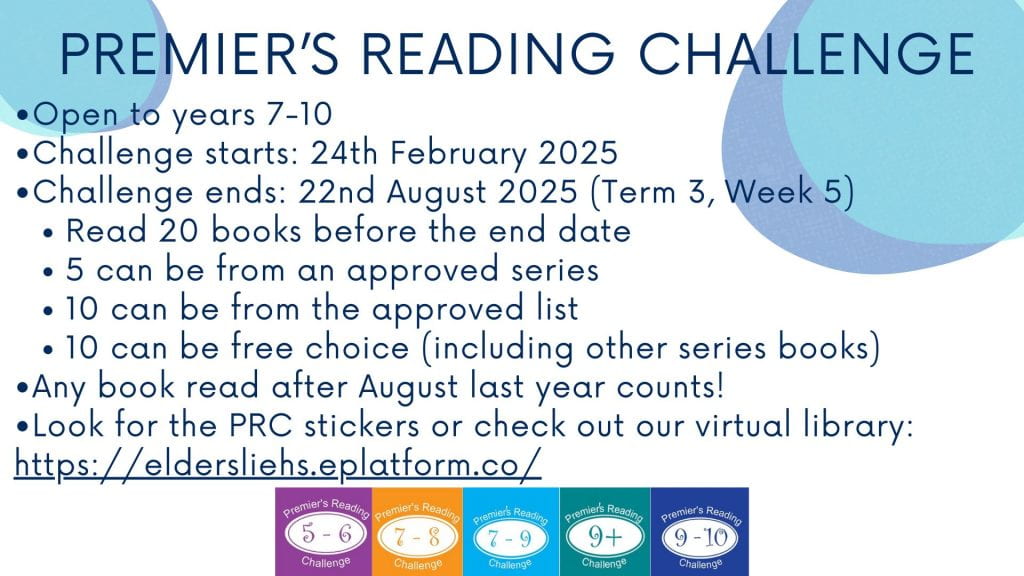
Another way I’m trying to build a reading culture is by celebrating reading achievements in our school. I’m updating our Readerboard every month to show the students with the highest number of loans, and giving these students both merit certificates and house points in their roll calls to visibly highlight their achievement and show that we value reading. I’m also in the early stages of planning a celebratory afternoon for the students who finished the Premier’s Reading Challenge last year – they’ve chosen a movie afternoon as their reward, so hopefully other students will see their reward and want to get in on the action too! Another way I can increase participation is by embedding the challenge into the Wide Reading Program through read-alouds, book talks and activities such as the CBCA Shadow Judging.

Action moving forward: Embed PRC resources into the Wide Reading Program and continue developing activities to develop enthusiasm around reading.

Fostering Positive Wellbeing

Our school’s strategic plan has a strong focus on wellbeing; this is therefore an area where I can support the school community while advocating for the value of the library. I recently bought some of Margaret Merga’s books on this topic and intend to add them to our Teacher Reference collection, and can’t wait to read them to gain some more ideas on how to be active in this space.

So far this year, I’ve continued to support social-emotional learning through the provision of social clubs during the breaks. I’ve encouraged students to form their own clubs with my support, and as a result we’ve now added a Trading Card Game Day and Origami Club into our schedule, alongside our regular offerings of the Nintendo Switch Club and Dungeons and Dragons. While the Nerdvana Day didn’t get off the ground this term due to time constraints, this has previously been a great success with students and I will endeavour to make it a priority in Term 2. I have also discussed the possibility of a Year 12 Reading Retreat during their Trial exams to help them relax during this otherwise stressful period.

Action moving forward: Organise the Nerdvana Day and Year 12 Reading Retreat in Term 2.

These clubs and activities have had a significant impact on our daily visitor numbers, with an average 138 students visiting each break. Our biggest day was a whopping 334 students! While these increased visitor numbers contribute to a lot of noise and chaos in the library, they also represent an opportunity for students to be exposed to the reading culture I’m attempting to build, with several students who wouldn’t normally identify as readers borrowing books that they wouldn’t have come into contact with had they not been in the library space. However, the data suggests that our daily visitors and loans were trending down towards the end of term; this is no doubt due to the number of interruptions affecting the library’s ability to open in those later weeks, such as the fact that I’m not replaced when I’m absent. Ensuring continued access to the space is therefore an area for improvement in future.

Action moving forward: Advocate for the library space to be covered like any other playground duty in my absence.

Our Library Monitor program is also expanding, with several students approaching me throughout the term asking if they can join the program. Early in Term 2 I will incorporate these new students into the program and develop their skills as junior librarians in training. Their assistance is vital in helping maintain the library collections, especially as our loans increase.

Action moving forward: Train the incoming library monitors.

Maintaining Effective, Relevant Collections

Collection management is one of the biggest, most underappreciated aspects of our role as teacher-librarians, largely because so much of it is done behind the scenes and is therefore invisible to the majority of our school community. We’ve had an influx of student requests, so in addition to my plans to replace many of the outdated resources weeded over the last few years I’ve had to dedicate a significant portion of my budget to fulfilling these requests. As a result, there’s not a huge amount of money left for future purchases! A more balanced allocation of funds might be prudent in future years. However, one benefit of ordering so much so early in the year has been that we are getting a steady arrival of new resources to process in our systems as stock becomes available. This will hopefully allow us to spread out the accessioning process and reduce the number of orders we need to chase up at the end of the year.

Over the past few years I’ve invested a significant amount of time in updating our collection to ensure it’s relevant to the learning and recreational needs of our school community. When I first started, the fiction and non-fiction collections hadn’t been weeded for several years and the median date of publication was 1981. Last year our average date of publication was 2006, and I’m happy to report that due to my efforts last term this date is now 2010, while our median date is now 1995. While this is still not as up-to-date as I’d like, it’s a significant improvement.

I’m also in the process of cleaning up our catalogue and moving some items to locations where our students and staff are more likely to find them. I’ve set myself the goal of cleaning up 10 catalogue records a day, and while this isn’t always achievable it has made a significant impact on the number of resources with outdated or incorrect catalogue metadata.

Action moving forward: Complete catalogue clean-up.

Progressing with my Professional Development Plan

In NSW Department of Education schools, we are required to have a Professional Development Plan (PDP). This year I’ve set myself three somewhat ambitious goals.

Goal 1: To raise the perceived status, professionalism and value of the school library by ensuring its effective management. This will be achieved by conducting a needs assessment and creating a strategic plan aligned to the school’s Strategic Improvment Plan by the end of Term 3.

This is a huge goal with multiple steps, which is why I’ve set its completion at the end of Term 3. This term I asked for planning time and was knocked back, so have asked for time again in Term 2. I’ve submitted a proposal through my Head Teacher for this planning time to be during the HSC Trial exam period when the library would normally be closed; hopefully my line managers will see the value of this goal and understand my attempts to support the school while minimising disruption.

Action moving forward: Gain approval for planning time in week 9.

Goal 2: To support the diverse needs of our students by working with the Engaged Students for Learning committee to reintroduce a school-wide High Potential and Gifted (HPGE) education initiative.

This is another area where I’ve sadly made limited progress, largely due to the restrictive nature of our committee meeting schedule which has meant we’ve only had one official meeting last term. We were supposed to deliver a presentation during a staff meeting on how to identify and support HPG students, but beyond informal conversations with staff there’s been no movement in this space for me yet.

Action moving forward: Conduct an evaluation of existing HPGE activities with the committee.

Goal 3: To forge strong connections between the library, teaching staff and students by supporting the implementation of the new English syllabus through the expansion of the Wide Reading Program and engagement with research into reading for pleasure and for information.

I feel that this is one area where I have successfully achieved my professional goal. The new English syllabus explicitly references reading for pleasure and our English faculty has embedded the Wide Reading Program into their units as a result of my continued advocacy over the past two years. I’ve also posted previously about my research into reading for pleasure, though more could be done in the information literacy space.

Action moving forward: Continue research into reading for pleasure and information; continue using data and feedback from students and staff to plan engaging activities which provide access and time for self-selected, socially supported reading with the Wide Reading Program.

New Tool: Playing with CapCut

I’ve been off work sick the last week, and now that I’m finally starting to feel a bit better and have a bit of energy I thought I’d investigate a tool discussed in the social media webinar I did a few weeks ago. CapCut is free to use and so far seems fairly easy as a content creation tool. I have always wondered how all those fun reels on Instagram use existing clips and superimpose them over their own content but it is a mystery no more! CapCut has a fantastic series of templates that made it super easy to create my own fun video in less than 5 minutes.

My Instagram may never be the same! I can’t wait to work with the Student Media Team to create new content promoting the library, or to integrate this tool into my Wide Reading Program to build a culture of reading for pleasure!

Adjusting the Wide Reading Program for the Tech Elect Class

While I was completing my Master of Education degree at CSU, I came across some fascinating research about the social elements of reading. This is often seen as a solitary past-time and therefore might be a turn-off for some teenagers, who are going through a development phase of seeking social interactions and determining their identities in these social settings. At the time I started to muse about incorporating more social reading activities it into my Wide Reading Program, but alas! Time was my enemy. While we’re still not exactly on the best terms, I do have a little more of it up my sleeve at the moment and therefore I’m revisiting the idea of leveraging research into social behaviours in this year’s program.

I’m lucky to have the Tech Elect class joining us again. I had them last year when they were in Year 7, and while many students enjoyed the program and found it beneficial, I’m still concerned by the number who did not enjoy the program or who reported a decline in their enjoyment of reading.

This class is a BYOD iPad class and therefore the perfect guinea pigs to trial using technology to boost the social aspect of reading for pleasure. I’ve found that my own reading habits have been positively influenced by social media such as Bookstagram, while Booktok has had an undeniable effect on the reading landscape in the past few years.

This year, I’m hoping to start incorporating these elements by getting students to create a Goodreads account and to use the Goodreads app on their devices. One of my uni lecturers, Krystal Gagen-Spriggs, has worked in this space and written a fascinating article on how she used Goodreads in her own Teacher-Librarian programs.

This will by no means be an easy feat but it is one that I definitely feel has the potential to transform my students’ perceptions of reading behaviours and hopefully will increase their enjoyment of reading for fun.

The Wide Reading Program Returns

Last week the Wide Reading Program started back up for 2024. I had three classes (two year 8, one year 7) come into the library for their first lesson, where we explored the reasons why we are running the program and what the research says about the benefits of reading for pleasure:

During this lesson I ask students to fill out a survey to give me information about their perceived reading ability, their identity as readers, and their reading preferences. Here’s the results from the three classes I’ve seen so far.

There’s no real surprises here; short books, books with images, and books with connections to other media such as movies or TV shows are usually the top picks for my students. Series books are also identified as a popular choice, supporting the academic research in this space. While manga is generally the most popular genre in my library each year, many students aren’t actually aware of what it is, suggesting that dedicated lessons on manga and how to read it would be beneficial.

Their responses for the reader identity question also supports the research I’ve mentioned previously around teen reading habits, which suggests that by the time they reach high school they are increasingly ambivalent to the idea of reading as a leisure activity.

In this survey I ask students to tell me about the last book they’ve read as well as their favourite book. I also ask them to set themselves a reading goal for the year, and plan in a future lesson to get them to reflect on these goals while designing personalised bookmarks to help keep them on track.

This is only my third year running this program (and my first since graduating from the teacher-librarianship Master degree). There’s no formal curriculum to work with and the high staff turnover alongside constant interruptions in the library space have previously made it difficult to assess the program’s efficacy. Fingers crossed that this year I’ll be able to run it more consistently and I’ll be able to gather useful data to inform the program’s future activities.

Reflections on Week 1 Advocacy and Successes

School returns in NSW this week! So far I’ve had a few opportunities to advocate for my role and the value of the school library, which I’ve tried to grab with both hands.

This year I’ve been placed under the Head Teacher of Teaching and Learning, and had the fantastic opportunity to sit with her to discuss my vision for the role and a strategic path moving forward.

I also sent out a welcome email to all teaching staff, outlining the various ways I can save them time and support them in their teaching:

  • One-off or ongoing research lessons 
  • Collaborative planning, teaching, and/or assessing of an inquiry or PBL unit (Maria and I had great fun with this last year!)
  • Gamification of units to support engagement
  • Support integrating literacy strategies (e.g. Super Six, literary learning) into your units
  • Support integrating information literacy strategies and research skills into your units
  • Support integrating digital literacy, media literacy, or ICT strategies into your units
  • Curated book boxes to support classroom learning
  • Curated digital resource lists or pathfinders to support classroom learning and assessments
  • Targeted library displays which support your subject units or assessments
  • Accessioning of senior faculty textbooks to keep track of which student has been issued which resource (we currently do this for English and Science)
  • Summaries of current research in an area of your choosing
  • A guided tour of the library, its resources and how it can support you (useful for new staff especially!)
  • Training in how to use our subscriptions such as Clickview or our digital library via Wheelers ePlatform
  • Training in how to use our library catalogue to search our collection or the local library collections for relevant resources
  • Personal delivery of requested magazines or books
  • Collaborative creation and ongoing support of social clubs developing wellbeing and student voice (I’ve previously worked with staff on the Anime Club, Warhammer Days with great success)
  • Targeted one on one support for students who might need assistance developing their study skills

Finally, my hard work over the last two years with the Wide Reading Program has paid off. I currently have 10 year 7 and 8 classes booked in for a fortnightly Wide Reading lesson. This is a significant increase from the 1 class in 2022 and 3 in 2023 who consistently attended. Last year we also had positive feedback from the majority of the students who participated, with positive changes to many students’ reader identity and confidence.

Last year was a outstanding year for borrowing, and we broke our previous best record by 455 books largely due to the engagement created by the Wide Reading Program. I’m excited to see what 2024 holds!

ETL512 Assessment 6: Professional Reflective Portfolio

Part A: Statement of Personal Philosophy

Effective 21st century teacher-librarians require strong interpersonal skills alongside the pedagogical knowledge to teach a multitude of competencies and literacies across different curriculum areas. Through proficient leadership, strategic planning, resource management, and innovative program design, modern teacher-librarians inspire passion for reading for pleasure and information while supporting learning and wellbeing in our communities.

Modern libraries are about people, not just resources. Our ability to form effective relationships with students, staff, parents, and professional networks allows teacher-librarians to meet the diverse educational, wellbeing, and recreational needs of our learning communities and to advocate for our value in an ever-changing information landscape.

Part B: Critical Evaluation

My very first assessment for this degree required me to reflect on my understanding of the role of teacher-librarians in schools (Lysaught, 2021a). For this task, I discussed the roles I focused on as part of my then-recent job application:

Little did I know, but this visual would serve as a prescient highlight to many of the issues explored throughout this course.

The early work completed in ETL401 introduced me to several roles expected of modern teacher-librarians, and as a result of my continued learnings in this degree I have consolidated these varied elements into three key themes.

Theme 1: Resourcing and Inspiring Reading for Pleasure

The first theme, resourcing and inspiring reading for pleasure, in many ways reinforces pre-existing stereotypes about the work of teacher-librarians as predominantly dealing with books. I discussed this misconception in my early blog posts, noting that these perceptions were largely based on community experiences (Lysaught, 2021a; Lysaught, 2021b). As a result of the readings and learning tasks in this degree, I have concluded that teacher-librarians must therefore ensure that we provide a multitude of different experiences to our communities to shape their perceptions of our roles as varied and valuable in an ever-changing modern information landscape.

However, Herring (2007, p.31) noted that fulfilling all the possible roles expected of teacher-librarians at one time is impossible. Anecdotal evidence suggests many teachers still don’t know what information literacy is, let alone a teacher-librarian’s role in developing student proficiency; those few who do often lack the time for collaborative planning and teaching. Rather than stress myself out by fighting an uphill battle and overhauling community perceptions completely, at the start of my teacher-librarian journey I’ve chosen to draw on my strengths as an English teacher and my pre-existing relationships with this faculty to lean into community expectations and show my value to our school by establishing a culture of pleasure reading. Once trust in my abilities as a teacher-librarian and strong relationships are formed through this Trojan horse, the plan is to leverage my success and branch out into other facets of my role, such as information specialist, to further entrench my value to our school community.

Step one in my plan to channel then subvert community expectations was to create a Wide Reading Program for the Stage 4 English classes. To show the value of this program to our school leaders, I aligned it with our Strategic Improvement Plan, foreshadowing the learnings of ETL504 Teacher Librarian as Leader. This program, inspired by the ETL402 Literature Across the Curriculum readings, aims to create a school-wide culture of pleasure reading. Reading for pleasure has repeatedly been shown to improve student literacies and socio-emotional development (Combes & Valli, 2007; Howard, 2011; Allington & Gabriel, 2012; Kid & Castano, 2013; Gaiman, 2013; Wu et al., 2013; Whitten et al., 2016; Ipri & Newman, 2017; Stower & Waring, 2018; Smith, 2019; Merga, 2021; Merga, 2022). Student reading drops off during adolescence for several reasons, including lack of access to quality texts, lack of positive reading role-models, lack of time, and lack of confidence in their reading ability:
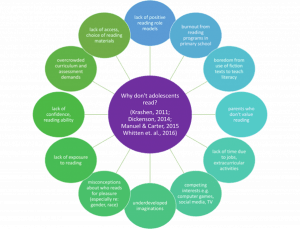
This program aims to address these issues by providing students access to appropriate, self-selected texts and by setting aside a 60-minute period each fortnight to allow students time to explore, share, and value their reading in a socially supported positive learning environment (Gibson-Langford & Laycock, 2008; Krashen, 2011; Fisher & Frey, 2018; Merga & Mason, 2019; Allington & McGill-Franzen, 2021). Through this program I aim to create independent, lifelong readers who are set up for personal and academic success.

This initiative was first trialed in 2022, our first year without a school-wide DEAR program. It initially ran with 4 Year 7 classes which dropped back to 2 due to staffing issues and frequent interruptions. Data revealed that overall, the students who participated enjoyed the experience and found it beneficial, and I reported these findings to our Senior Executive via my Annual Library Report (Lysaught, 2023a):

In 2023 the Wide Reading Program was expanded from one teacher to six and now includes our Support Unit and two Year 8 classes, largely due to word of mouth and positive feedback from participating teachers – proving Bonanno’s (2011) argument that we should build relationships with the staff willing to work with us, since others will choose to follow once trust is developed (Crippen & Willows, 2019, p.173).

A crucial element of successfully inspiring reading for pleasure, especially amongst teens asserting their independence and exploring their identity, is the provision of relevant resources which support self-selection of reading materials (Beach et al., 2011; Allington & Gabriel, 2012; Fisher & Frey, 2018). To ensure a robust collection which meets the needs and interests of my patrons, I drew heavily upon the learnings gained in ETL503 Resourcing the Curriculum. Library hygiene is an important element of ensuring an enticing, relevant collection (Fieldhouse & Marshall, 2011), and thus at the end of 2022 I completed a stocktake and significant weed of our Fiction and Quick Reads collections (Lysaught, 2023a). This was the first stocktake since 2018 and the median age of deselected resources was 1999, necessitating a serious update of our collection to ensure continued relevance. This was followed by subsequent stocktakes of our Picture Book and Graphic Novel collections at the start of 2023. Once these stocktakes were completed I introduced dynamic shelving to make the shelves more enticing and facilitate browsing (Bogan, 2022).
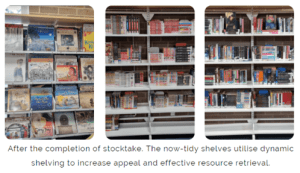
 

I also implemented patron-led acquisitions to increase circulation and user connection to the library’s resources (Hughes-Hassell & Mancall, 2005, p.9; Kimmel, 2014; Johnson, 2018; Aaron Cohen Associates, 2020, para.6; Crawford et. al, 2020, p.2), with 49% of newly acquired fiction resources specifically requested by staff and students in 2022 (Lysaught, 2023a). Drawing upon my experiences during my practicum, this year I bought 131 Hi-Lo books for our Quick Reads collection, and plan to use them for future Book Club activities during the Wide Reading lessons (Lysaught, 2023b). I am also in the process of genrefying our Quick Reads collection for easier browsing and selection, trialing the learnings gained in ETL505 Describing and Analysing Educational Resources (Lysaught, 2022a) in one of our popular, manageable collections.

Fisher & Frey (2018) argued that interventions designed to increase reading volume should rely on four factors: access, choice, classroom discussion of texts and book talks. The initiatives described above aimed to incorporate these four factors alongside efficient collection development and management. Loans statistics indicate that circulation has increased on the days when the Wide Reading lessons run, and as a result Oliver data shows we are on track to meet or beat our previous loans records since I became the teacher-librarian in 2020, despite our removal of a whole-school DEAR program in 2022.

Theme 2: Resourcing and Developing Reading for Information

As mentioned above, despite the importance of reading for pleasure in developing literacy, the role of a modern teacher-librarian should expand beyond the realm of books and into the crucial realm of information literacy to avoid the misunderstanding that our roles are limited and unnecessary in modern schools. I personally was guilty of this misconception prior to starting this degree, so I can hardly blame time-poor classroom teachers and senior leaders for not understanding our role, especially if they’ve never seen it in action! It is therefore necessary that we provide a variety of different experiences to our communities to shape their perceptions of our roles and ensure they understand our vital importance in developing our students as ethical, efficient users and creators of information. We cannot risk becoming an “invisible profession” (Valenza, 2010; Bonanno, 2011) and resourcing our libraries to develop information literacy is a path forward for teacher-librarians to show our value in a shifting infosphere increasingly filled with mis- and disinformation (Floridi, 2007, p.59; Lysaught, 2021c).

ASLA 2011. Karen Bonanno, Keynote speaker: A profession at the tipping point: Time to change the game plan from CSU-SIS Learning Centre on Vimeo.

The learnings gained in ETL401 Introduction to Teacher Librarianship were crucial in forcing me to revise my misunderstandings regarding the role of the modern teacher-librarian. For the second assessment I focused on how social media platforms affect our relationship with information, and discovered that improved internet access has changed information-seeking behaviours to favour passive information acquisition which uses the path of least resistance (often relying on social interactions), significantly impacting users’ ability to determine fact from fiction (Bates, 2010; Herbst, 2020; Liu, 2020; Kuhlthau et al., 2021). Teenagers are particularly likely to gain information from online, social sources and, far from being ‘digital natives’ equipped to navigate online information, are uniquely vulnerable to misinformation (Combes, 2009; Jacobson, 2010; O’Connell, 2012; Common Sense Media, 2019; Australian eSafety Commissioner, 2021). As a high-school teacher-librarian, I therefore have an ethical responsibility to ensure that my collections and programs equip my students with the skills and competencies they’ll need to be information literate in an increasingly digital world. Anecdotal evidence suggests that for many secondary classroom teachers, the fact that teacher-librarians don’t teach to a specific curriculum demeans our value. The recently released Information Fluency Framework (NSW Department of Education, 2023) offers an exciting way to legitimise our work moving forward, showcasing that we can be the glue which brings learning areas together, and will form the focus of my professional learning after finishing this degree. In the meantime I will continue to run one-off research skill lessons for my colleagues as requested.

Inquiry learning was another key aspect of our role explored in ETL401. While I had been familiar with concepts such as Project Based Learning from my time as a classroom teacher (Lysaught, 2021d), other methods such as Guided Inquiry Design were eye-opening and revealed a new pedagogy full of potential for my students (Lysaught, 2021e), since information literacy is foundational to inquiry learning (Fitzgerald, 2015). I greatly enjoyed reworking our existing Year 7 Shakespeare unit into a Guided Inquiry Design unit and look forward to the opportunity to co-teach it in future (Lysaught, via Guided Inquiry in Australia, 2020), alongside the digital narrative I created for ETL533.


ETL533 Assessment 4 – Digital Storytelling: A Day in Elizabethan England by Danielle Lysaught (Danielle Lysaught)

However, implementing inquiry learning and developing information literacy programs has not been without significant challenges in reality. Early on I identified that high staff workloads and minimal free time would likely hamper potential attempts to implement collaborative inquiry learning (Lysaught, 2021f). As such, there has been limited staff uptake. However, largely due to the relationships and trust developed through the Wide Reading Program, I have finally been asked to work with one of the English teachers and her Year 8 class in Term 4 on a unit exploring suspenseful narratives. The ETL512 Study Visits emphasised the importance of emotional intelligence and persistence as key traits for teacher-librarians, and my personal experience shows that we must be resilient in the face of setbacks and persist in the hope that we can eventually have the opportunity to showcase our value to our colleagues.

Effective collection management is another crucial aspect to developing information literacy in our community. ETL503 Resourcing the Curriculum and ETL505 Describing and Analysing Educational Resources reinforced the importance of efficient resource management for supporting curriculum learning. In 2021 I completed a stocktake of our non-fiction collections – the first since 2018. The shelves were overflowing, messy, and not conducive to easy selection of relevant material:

Prior to this stocktake, the median date of publication was 1981. I weeded 2468 outdated or damaged resources, almost halving the collection and bringing the median date of publication to 2000 – an improvement, but indicating that there is still significant work to be completed to ensure a current, relevant collection which meets the needs of my staff and students. Foreshadowing the learnings of ETL504, I published the findings from this stocktake in my 2021 Annual Report and shared it with the Senior Executive to highlight the complexities of my role to our school leaders (Lysaught, 2022b).

In 2022 we started accessioning English novels to support their resource management, leading to it becoming our third largest collection:

This year, due to the success of this initiative, we have also had requests from the Science Faculty to assist with the management of their Stage 6 resources. While not without challenges, this provides a way for me to showcase my value to my colleagues, support curriculum learning through effective resource management, and interact with students who would otherwise possibly not utilise the library.

Theme 3: Promotion and Advocacy through Leadership

Two of the most used tags on my blog are ‘promotion’ and ‘advocacy’, so it’s only appropriate that the final theme discussed focuses on these issues.
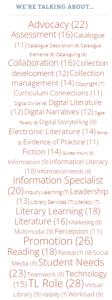
Early in this degree the readings revealed the importance of advocating for our positions (Lysaught, 2021g), meaning that right from the start I’ve developed an awareness of the importance of perception and relationships in our role. This was consolidated throughout this degree in every unit.

In an early blog post for ETL503 Resourcing the Curriculum I noted that, due to the teacher-librarian’s often poorly defined role and lack of clear curriculum direction, we are often utilised in different ways to support whatever the school requires (Lysaught, 2021h). It is therefore crucial for us to collaborate with our colleagues so that they understand our varied roles, ensuring our continued visibility and effectiveness to our school community. As seen through the frequent ‘promotion’ and ‘advocacy’ tags in my blog, so much of our work gives us the chance to increase our visibility; while it can be tempting to give up in the face of colleagues who view us as having the “cushy job”, we need to change our mindset and instead reframe challenges as “chopportunities” (Weisburg, 2020) and look for ways to make our work seen, valued, and understood (Valenza, 2010; Bonanno, 2011).

My final unit, ETL504 Teacher Librarian as Leader, emphasised the different leadership styles that we can leverage to maximise our effectiveness to our colleagues. Effective leadership, regardless of the approach or title, should focus on building strong relationships with others through mutual trust, respect, and effective communication (Holmes et al., 2012, p.271, 276; Moir et al., 2014, p.37; Ezard, 2015; Gleeson, 2016). My very first blog post had outlined my intent to support both staff and students (Lysaught, 2021i), and thus Servant Leadership appealed to me from the start (Lysaught, 2023c). In particular I was drawn to Servant Leadership due to its focus on empowering and developing others, humility, commitment to growth and community building, highly developed interpersonal skills, stewardship, healing, conceptualisation, and foresight  (Arar & Oplatka, 2022, p.83-87; Crippen & Willows, 2019; p.171-172), and found that its guiding questions – ‘do you want to serve or be served?’ and ‘do those served grow as persons?’ (Blanchard & Broadwell, 2018; Greenleaf, 2008, p.36) – aligned well with my personal traits and values, and could help me support and heal cynical, time-poor staff and to act as mentors for both staff and students (Branch-Mueller & Rodger, 2022, p.46-47; Reinsel Soulen, 2020, p.39-40; Uther & Pickworth, 2014, p.21-23).

As a result of the learnings in this degree, I’ve experimented with a variety of different promotions and advocacy methods. I began this degree in mid-2021 when NSW started online learning followed by cohorting, which made collaboration and promotion particularly challenging early on; this has been further compounded by the current teacher shortage and high staff turnover at our school. Some of the early initiatives I implemented to raise the library’s profile include the Student Media Team, a Babble, Books and Breakfast club working alongside the Wellbeing faculty, and a Staff and Student Book Club (Lysaught, 2021j). While the book club fell apart due to lack of interest and time after online learning finished, the other two initiatives are still going strong. My early attempts at strategic planning appear quite amateurish in hindsight, though the alignment of my initiatives to our Strategic Improvement Plan and promotion of my work through Annual Reports foreshadowed the strategies suggested in ETL504 (Lysaught, 2023d). Our school recently experimented with the idea of holding all Stage 6 exams in the library, which if enacted would necessitate its closure for over 2 months of the school year. I was able to successfully leverage leadership strategies and use visitor and loans data collected each day to show the impact library closures would have on our school community, convincing the decision makers to choose another option:

Looking to the future, I will continue to experiment and expand on the learnings gained from this degree. First I will create a library operations folio to ensure effective management and strategic planning moving forward (Braxton, n.d.; National Library of New Zealand, n.d.; Oberg & Schultz-Jones, 2015). I was particularly inspired by the idea of hooking in new and current staff via mentoring (Cox & Korodaj, 2019; Reinsel Soulen, 2020), and building community ownership through a library committee has been a long-time goal of mine (Lysaught, 2021h). Inspired by ETL505 and the ETL512 study visits, I’d also love to create a library website to increase visibility and support teaching and learning by providing easily accessible pathfinders and research lessons. This journey is a marathon, not a sprint, and this degree has shown countless potential pathways to follow in future.


Part C Reflection

At the beginning of this course, we were asked to consider what makes a teacher-librarian (Lysaught, 2021a). My understanding of the role has expanded significantly since those early days:
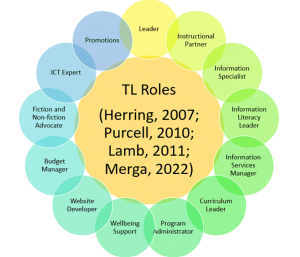
However, despite the complexity of our role, our work is still widely misunderstood. This degree has shown me that to be seen as professionals, we must act as professionals and take every opportunity to advocate for our role through the work we do in our school communities. The professional standards developed by the Australian Library and Information Association (ALIA) and the Australian School Library Association (ASLA) provide a useful framework for evaluating our professional practice and ensuring that we remain relevant and visible to our peers.
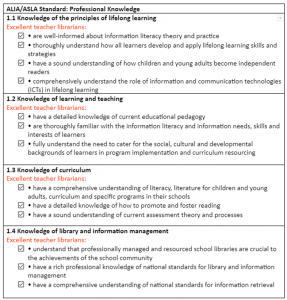
As a classroom teacher with experience teaching both the English and History syllabi from Year 7 through to Year 12, including the Extension courses for both subjects, I feel quite confident in my abilities as a teacher with strong professional and pedagogical knowledge who meets the Australian Professional Standards for Teachers, many of which align with the ALIA/ASLA Standards through their similar professional domains (Australian Institute for Teaching and School Leadership [AITSL], 2022). While I already had a strong understanding of reading practices, assessment, and ICT, this degree introduced me to the wonders of information literacy and collection management which have allowed me to be even more effective in my classroom practice and developed my understanding of how to support my colleagues more efficiently in my library role.

As a relatively new teacher-librarian, I feel that I still have a fair way to go regarding my professional practice, particularly regarding our role as information specialists. While I believe that I have created an environment where learners are encouraged to engage with our resources for understanding and enjoyment, I need to do more to ensure an information-rich learning environment which meets the needs of my community. I’ve worked hard over the last 2 years to build an environment which fosters positive wellbeing and strong reading culture, and due to these relationships and the trust I’ve developed with our teaching staff I’ve finally got the opportunity in Term 4 to collaboratively develop and teach a Guided Inquiry unit. Likewise, while I’ve previously done some strategic planning and budgeting (Lysaught, 2023d), the skills gained in this course will leave me much better equipped to plan for the future and ensure the library’s continued relevance and value to my school. In Term 4 I therefore intend to create a Library Operations Folio, including strategic and operations plans alongside policies for collection development, ICT use, and potential challenges.

I am already a member of several professional organisations, and fully intend to take advantage of their professional development. This will focus on the development and delivery of information literacy programs and wellbeing programs, broadening my understandings further and allowing me to showcase the potential in our practice to our wider school community.

Advocacy through action and alliances is my path forward in what could otherwise be an isolated, misunderstood role. While building my Wide Reading Program I have relied heavily on the action research process to ensure that my practice is evidence-based, innovative, and meets the needs of my staff and students. I have used this research to showcase my professionalism and the potential of my role to my colleagues, particularly to my school leaders. However, evaluating my work against the ALIA/ASLA standards shows that more could be done to develop my leadership capabilities. ETL504 emphasised the importance of leading from the middle by working with staff as well as students, such as through collaboratively teaching, leading professional development, or running key committees (Green, 2011; Wong; 2012; Wolf et al., 2014; Baker, 2016; Crippen & Willows, 2019; Reinsel Soulen, 2020). High staff turnover makes developing relationships with my colleagues a challenge, but also presents a ‘chopportunity’ (Weisburg, 2020) to exhibit both transformational and servant leadership, hook in new staff, and build a culture of library collaboration and appreciation from the ground up.

References:

Aaron Cohen Associates, ltd. (2020, October 23). Libraries provide ‘just in time’ expertise / ‘just in case’ resources. The Library Incubator: Library Consultant Web Site. https://www.acohen.com/blog/libraries-provide-just-in-case-experiences-just-in-time-access/

Allington, R. L., & Gabriel, R. E. (2012). Every child every day. Educational Leadership, 69(6), 10-15.

Allington, R. L., & McGill-Franzen, A. M. (2021). Reading Volume and Reading Achievement: A Review of Recent Research. Reading Research Quarterly, 56(1), S231–S238. https://doi.org/10.1002/rrq.404

Arar, K., & Oplatka, I. (2022). Advanced theories of educational leadership. Springer.

Australian eSafety Commissioner (2021). eSafety research: the digital lives of Aussie teens. https://www.esafety.gov.au/sites/default/files/2021-02/The%20digital%20lives%20of%20Aussie%20teens.pdf

Australian Institute for Teaching and School Leadership [AITSL] (2022). Australian Professional Standards for Teachers. https://www.aitsl.edu.au/docs/default-source/national-policy-framework/australian-professional-standards-for-teachers.pdf

Baker, S. (2016).  From teacher to school librarian leader and instructional partner: A proposed transformation framework for educators of preservice school librarians. School Libraries Worldwide, 22(1), 143-159. https://iasl-online.org/resources/Documents/PD%20Library/11bakerformattedfinalformatted143-158.pdf

Bates, M. J. (2010). Information Behavior. Encyclopedia of Library and Information Sciences, 3rd Ed. 2381-2391.

Beach, R., Appleman, D., Hynds, S., & Wilhelm, J. (2011). Teaching literature to adolescents. Taylor and Francis.

Blanchard, K., & Broadwell, R. (2018). Servant leadership in action.

Bogan, K. (2022, February 28). Dynamic shelving pt. 1: Introducing dynamic shelving. Don’t Shush Me! https://dontyoushushme.com/2022/02/28/embracing-dynamic-shelving/

Bonanno, K. (2011). A profession at the tipping point: Time to change the game plan. Vimeohttps://vimeo.com/31003940

Branch-Mueller, J., & Rodger, J. (2022). Single Threads Woven Together in a Tapestry: Dispositions of Teacher-Librarian Leaders. School Libraries Worldwide, 39–49. https://doi.org/10.29173/slw8454

Braxton, B. (n.d.). Policies and procedures. 500 Hats: The Teacher Librarian in the 21st Century. https://500hats.edublogs.org/policies/

Combes, B., & Valli, R. (2007). Fiction and the twenty-first century: A new paradigm? Paper submitted to Cyberspace, D-world, e-learning. Giving schools and libraries the cutting edge, 2007 IASL Conference, Taipei, Taiwan.

Combes, B. (2009). Generation Y: are they really digital natives or more like digital refugees? Synergy 7(1), 31-40.

Common Sense Media (2019). The Common Sense census: media use by tweens and teens. https://www.commonsensemedia.org/sites/default/files/uploads/research/2019-census-8-to-18-key-findings-updated.pdf

Cox, E. & Korodaj, L. (2019). Leading from the sweet spot: Embedding the library and the teacher librarian in your school community. Access, 33(4), 14-25.

Crawford, L. S., Condrey, C., Avery, E. F., & Enoch, T. (2020). Implementing a just-in-time collection development model in an academic library. The Journal of Academic Librarianship 46(2), p.102101.

Crippen, C. & Willows, J. (2019). Connecting teacher leadership and servant leadership: A synergistic partnership. Journal of Leadership Education, 18(2), pp. 171-180.

Ezard, T. [BastowInstitute]. (2015, July 27). Building trust and collaboration – Tracey Ezard [Video]. Youtube. https://youtu.be/kUkseAdKyek

Fieldhouse, M., & Marshall, A. (2011). Collection development in the digital age. Facet.

Fisher, D. & Frey, N. (2018). Raise reading volume through access, choice, discussion, and book talks. Reading Teacher, 72(1), 89-97. https://doi.org/10.1002/trtr.1691

Fitzgerald, L. (2015a). Guided inquiry in practice. Scan 34(4), 16-27.

Floridi, L. (2007). A Look into the Future Impact of ICT on Our Lives. The Information Society 23(1), 59-64. https://doi.org/10.1080/019722406010599094

Gaiman, N. (2013, October 16). Why our future depends on libraries, reading and daydreaming. The Guardian. https://www.theguardian.com/books/2013/oct/15/neil-gaiman-future-libraries-reading-daydreaming

Gibson-Langford L., & Laycock D. (2008). The archery of reading. Access, 22(2), 9-13.

Gleeson, B. (2016, November 9). 10 unique perspectives on what makes a great leader. Forbes. https://www.forbes.com/sites/brentgleeson/2016/11/09/10-unique-perspectives-on-what-makes-a-great-leader/#276777b95dd1

Green, G. (2011). Learning leadership through the school library. Access, 25(4), 22-26.

Greenleaf, R. K. (2008). Greenleaf on Servant-Leadership: Who Is the Servant-Leader? The International Journal of Servant-Leadership, 4(1), 31–37. https://doi.org/10.33972/ijsl.234

Guided Inquiry Oz (2020, March 3). Secondary guided inquiry units. https://guidedinquiryoz.edublogs.org/practice-2/secondary-guided-inquiry-units/

Herbst, M. (2020, January 27). How to Raise Media-Savvy Kids in the Digital Age. Wiredhttps://www.wired.com/story/kids-digital-media-literacy-tips/

Herring, J. (2007). Teacher librarians and the school library. In S. Ferguson (Ed.) Libraries in the twenty-first century: charting new directions in information (pp. 27-42). Wagga Wagga, NSW : Centre for Information Studies, Charles Sturt University.

Holmes, K., Clement, J. & Albright, J. (2012). The complex task of leading educational change in schools. School Leadership & Management, 33(3), 270-283.  https://doi.org/10.1080/13632434.2013.800477

Howard, V. (2011) the importance of pleasure reading in the lives of young teens: Self-identification, self-construction and self-awareness. Journal of Librarianship and Information Science, 43(1), 46-55. https://doi.org/10.1177/0961000610390992

Hughes-Hassell, & S., Mancall, J. C. (2005). Collection management for youth: responding to the needs of learners. American Library Association.

Ipri, T., & Newman, B. (2017). Beginner’s guide to transliteracy: Where did the term transliteracy come from? Libraries and Transliteracy. https://librariesandtransliteracy.wordpress.com/beginners-guide-to-transliteracy/

Jacobson, H. F. (2010). Found it on the internet: Coming of age online. American Library Association.

Johnson, P. (2018). Fundamentals of collection development and management. ALA Editions.

Kidd, D. C., & Castano, E. (2013). Reading literary fiction improves theory of mind. Science 342(6156), 377-380.

Kimmel, S. C. (2014). Developing collections to empower learners. American Library Association.

Krashen, S. D. (2011). Free voluntary reading. ABC-CLIO, LLC.

Kuhlthau, C. C., Heinstrom, J., & Todd, R. J. (2008). The ‘information search process’ revisited: is the model still useful? Information Research, 13(4)

http://informationr.net/ir/13-4/paper355.html

Liu, F. (2020, January 26) How Information-Seeking Behavior Has Changed in 22 Years. Nielsen Norman Group. 

https://www.nngroup.com/articles/information-seeking-behavior-changes/

Lysaught, D. (2021a, July 19). ETL401 assessment 1: What is the role of the teacher librarian? All You Read Is Love. https://thinkspace.csu.edu.au/allyoureadislove/2021/07/19/etl401assessment1/

Lysaught, D. (2021b, August 29). ETL401 3.2 the role of the teacher librarian – LIBERating our perceptions. All You Read Is Love. https://thinkspace.csu.edu.au/allyoureadislove/2021/08/29/3-2-the-role-of-the-teacher-librarian-liberating-our-perceptions/

Lysaught, D. (2021c, August 30). ETL401 2.3 the information landscape. All You Read Is Love. https://thinkspace.csu.edu.au/allyoureadislove/2021/08/30/2-3-the-information-landscape/

Lysaught, D. (2021d, September 14). ETL401 5.4b convergence. All You Read Is Love. https://thinkspace.csu.edu.au/allyoureadislove/2021/09/14/5-4b-convergence/

Lysaught, D. (2021e, September 14). ETL401 5.4a information literacy. All You Read Is Love. https://thinkspace.csu.edu.au/allyoureadislove/2021/09/14/5-4a-information-literacy/

Lysaught, D. (2021f, September 7). ETL401 4.1 inquiry learning: Some thoughts. All You Read Is Love. https://thinkspace.csu.edu.au/allyoureadislove/2021/09/07/4-1-inquiry-learning-some-thoughts/

Lysaught, D. (2021g, August 29). ETL401 3.2 the role of the teacher librarian: An invisible profession? All You Read Is Love. https://thinkspace.csu.edu.au/allyoureadislove/2021/08/29/3-2-the-role-of-the-teacher-librarian-an-invisible-profession/

Lysaught, D. (2021h, November 22). ETL503 2.1 developing collections. All You Read Is Love. https://thinkspace.csu.edu.au/allyoureadislove/2021/11/22/etl503-2-1-developing-collections/

Lysaught, D. (2021i, July 9). I’m going on an adventure!!!. All You Read Is Love. https://thinkspace.csu.edu.au/allyoureadislove/2021/07/09/hello-world/

Lysaught, D. (2021j, December 26). ETL402 3.1 strategies to leverage a love of reading. All You Read Is Love. https://thinkspace.csu.edu.au/allyoureadislove/2021/12/26/etl402-3-1-strategies-to-leverage-a-love-of-reading/

Lysaught, D. (2022a, July 4). ETL505 assessment 3 part c: Genrefication essay. All You Read Is Love. https://thinkspace.csu.edu.au/allyoureadislove/2022/07/04/etl505-assessment-3-part-c-genrefication-essay/

Lysaught, D. (2022b). 2021 Annual Library Report. https://www.canva.com/design/DAEwsCALUsI/vyQMXh9an6lLizamxaUW_Q/view?utm_content=DAEwsCALUsI&utm_campaign=designshare&utm_medium=link&utm_source=publishsharelink

Lysaught, D. (2023a). 2022 Annual Library Report. https://bit.ly/3Jg1e7k

Lysaught, D. (2023b, July 13). ETL512 assessment 5: Professional placement report. All You Read Is Love. https://thinkspace.csu.edu.au/allyoureadislove/2023/07/13/etl512-assessment-5-professional-placement-report/

Lysaught, D. (2023c, March 12). ETL504 2.2 leadership theory. All You Read Is Love. https://thinkspace.csu.edu.au/allyoureadislove/2023/03/12/etl504-2-2-leadership-theory/

Lysaught, D. (2023d, April 27). ETL504 strategic planning and setting goals: An amateur’s journey. All You Read Is Love. https://thinkspace.csu.edu.au/allyoureadislove/2023/04/27/etl504-strategic-planning-and-setting-goals-an-amateurs-journey/

Merga, M., & Mason, S. (2019). Building a school reading culture: Teacher librarians’ perceptions of enabling and constraining factors. Australian Journal of Education 63(2):173-189. DOI:10.1177/0004944119844544

Merga, M. (2021). Libraries as wellbeing supportive spaces in contemporary schools. Journal of Library Administration 61(6). DOI:10.1080/01930826.2021.1947056

Merga, M. (2022). School libraries supporting literacy and wellbeing. Facet.

Moir, S., Hattie, J. & Jansen, C.  (2014). Teacher perspectives of ‘effective’ leadership in schools. Australian Educational Leader, 36(4), 36-40.

National Library of New Zealand. (n.d.). Getting started in your school library: An operations checklist. National Library: Services to schools. https://natlib.govt.nz/schools/school-libraries/library-systems-and-operations/library-operations/getting-started-in-your-school-library-an-operations-checklist

NSW Department of Education (2023). Information Fluency Framework. https://education.nsw.gov.au/teaching-and-learning/curriculum/school-libraries/teaching-and-learning

Oberg, D., & Schultz-Jones, B. (eds.). (2015). Collection management policies and procedures. In IFLA School Library Guidelines, (2nd ed.), (pp. 33-34). Den Haag, Netherlands: IFLA.

O’Connell, J. (2012). So you think they can learn? Scan 31, 5-11.

Reinsel Soulen, R. (2020). The continuum of care. Knowledge Quest, 48(4). 36-42.

Smith, A. K. (2019, October 14). Literature has the power to change the world. Here’s how. Books At Work. https://www.booksatwork.org/literature-has-the-power-to-change-the-world-heres-how/

Stower, H. & Waring, P. (2018, July 16). Read like a girl: Establishing a vibrant community of passionate readers. Alliance of Girls Schools Australia. https://www.agsa.org.au/news/read-like-a-girl-establishing-a-vibrant-community-of-passionate-readers/

Uther, J., & Pickworth, M. (2014). TLs as leaders: are you a Highly Accomplished teacher librarian? Access, 28(1), 20–25.

Valenza, J. (2010, December 3). A revised manifesto. School Library Journal. https://blogs.slj.com/neverendingsearch/2010/12/03/a-revised-manifesto/

Weisburg, H. K. (2020). Leadership: There is no other option. Synergy, 18(1). https://slav.vic.edu.au/index.php/Synergy/article/view/369/364

Whitten, C., Labby, S., & Sullivan, S. L. (2016). The impact of pleasure reading on academic success. The Journal of Multidisciplinary Graduate Research 2(4), 48-64.

Wolf, M., Jones, R. & Gilbert, D. (2014). Leading in and beyond the library. http://all4ed.org/wp-content/uploads/2014/01/BeyondTheLibrary.pdf

Wong, T. (2012). Strategic long-range planning. Library Media Connection, 31(2), 22-23..

Wu, Y., Mallan, K., & McGillis, R. (2013). Reimagining the world: Children’s literature’s responses to changing times. Springer.

ETL533 2.3: Challenges of using digital literature in the classroom

There is an enormous difference between facility with technology and being able to engage with the content of digital literature as a consumer or a creator. What are some ways (small or large) you could alter your pedagogy to ensure technology and digital literature is embedded in your educational practices?

In this week’s readings I liked the distinction made by Allan (2017) between the different types of digital fiction:

1. eBooks or “paper-under-glass” texts;

2. Narrative or enhanced apps; and

3. “Born digital” multimodal narratives.

This distinction fit nicely with Unsworth’s classifications (via Walsh, 2013) from the Module 1 readings, where he identified three main categories of e-literature:

1. Recontextualised literary texts;

2. Electronically augmented literary texts; and

3. Digitally originated texts.

This also links with previous discussions I’ve read about what counts as digital literature, which emphasise the difference between “the digitised and digital literature” (for more on this, please feel free to check out my blog post).

In our school we have a virtual library with eBooks and audiobooks that our students, staff and parents can engage with, but it’s an expensive subscription (last year’s invoice was over $3000 – more than a third of our yearly budget!) with logistical issues around promotion and access. It also falls into the digitised, ‘paper-under-glass’ or ‘recontextualised literary texts’ category where technology facilitates access rather than exists as an innovative and inherent aspect of the texts. While it was a useful resource during last year’s lockdowns, data suggests that average use each month is down on last year’s figures. This year our school removed the DEAR (Drop Everything and Read) program, so I’ve been trialing a Wide Reading Program with a few Year 7 classes (initially 4, now dropped back to 2). Given Foley’s (2012) findings about student engagement with ebooks, it might be worthwhile creating activities for the Wide Reading Program which target and promote our virtual library.

One of the texts I’ve been investigating for the second assessment is the iPoe app by iClassics Collection. From my engagement with this app so far, it appears to fall under the ‘enhanced app’ or ‘electronically augmented literary text’ categories outlined above. I chose this because a) Poe is awesome fun and b) we have a Year 8 unit on suspenseful stories that this would work well with. I had a great time exploring this app and playing with its features, designed to immerse the reader with the texts’ Gothic emotions, settings, and atmosphere. I think this is a resource that could work really well with our Year 8 unit, though it cost $8.99 for all three volumes/apps, therefore presenting a financial and logistical issue for faculties with tight budgets.

This week I also had a little play with Microsoft Sway, in an attempt to create my own ‘born digital’ narrative in preparation for the final assessment. One of my projects this year has been to build up the Student Media Team I introduced to the school last year, and Microsoft Sway was one of the tools we were investigating for our student-designed newsletter. While it has many useful features and is (mostly) user-friendly, one issue I found while playing with it is that this tool lacks the ability to link to content within the Sway, and thus might not work for my intended ‘choose your own adventure’ style narrative. However, this investigation did remind me that for larger projects teachers might have, it takes time to find the right tools with the right features for their vision. While wonderful guides exist (such as http://www.schrockguide.net/bloomin-apps.html and https://instructionaldesignbykelly.wordpress.com/2016/03/01/the-evolution-of-blooms-taxonomy-and-how-it-applies-to-teachers-today/ from this week’s readings) these take time to investigate and, given the current educational climate, this is time that many teachers simply cannot spare. This is where an innovative, technologically current teacher-librarian could be an invaluable resource for time-poor teachers!


Allan, C. (2017). Digital fiction: ‘Unruly object’ or literary artefact? English in Australia, 52(2), 21-27.

Foley, C. (2012). Ebooks for leisure and learning. Scan, 31, pp. 6-14.

Walsh, M. (2013). Literature in a digital environment (Ch. 13). In L. McDonald (Ed.), A literature companion for teachers. Marrickville, NSW: Primary English Teaching Association Australia (PETAA).