
Understanding Australian Readers: Summarising the Australia Reads Report

Recently several researchers from Australia Reads released their Understanding Australian Readers report. This report aimed to identify what influences when and how people read, to map out thier reading journey and to uncover drivers and barriers for these reading behaviours across different demographics. While it focused on people aged 16 and over rather than children or teenagers, this was invaluable research which provided some key insights that can apply to my own work in a high school setting.

The researchers also launched the report with an accompanying webinar:

I really liked how the report broke down the different behaviours that make up a reading journey, and how these behaviours aren’t necessarily linear. The report also notes that different groups will exhibit different behaviours in each of these steps of the reading journey and face different barriers; therefore, there’s no one size fits all approach to increasingly Australia’s lagging recreational reading rates.
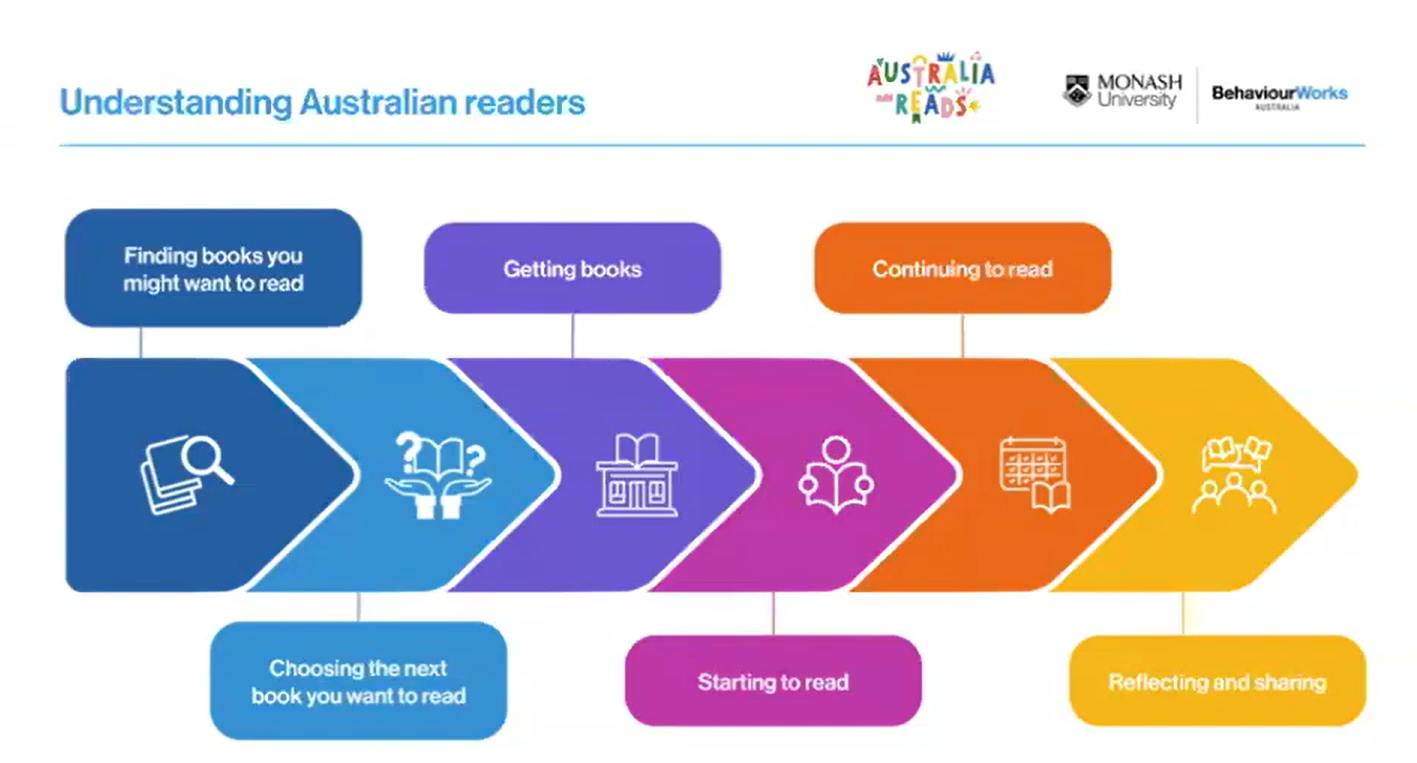
The report also explores the different types of readers, presenting these identities on a spectrum that includes both readers and non-readers. It was interesting to see that reader identity isn’t fixed and that people move between these different stages at different points in their lives. For instance, I would have once identified as an Avid Reader (I was the kind of kid who used to take books with me everywhere!) but now, due to time constraints and work overload, I’d probably fit the Lapsed or Aspirational Reader categories.
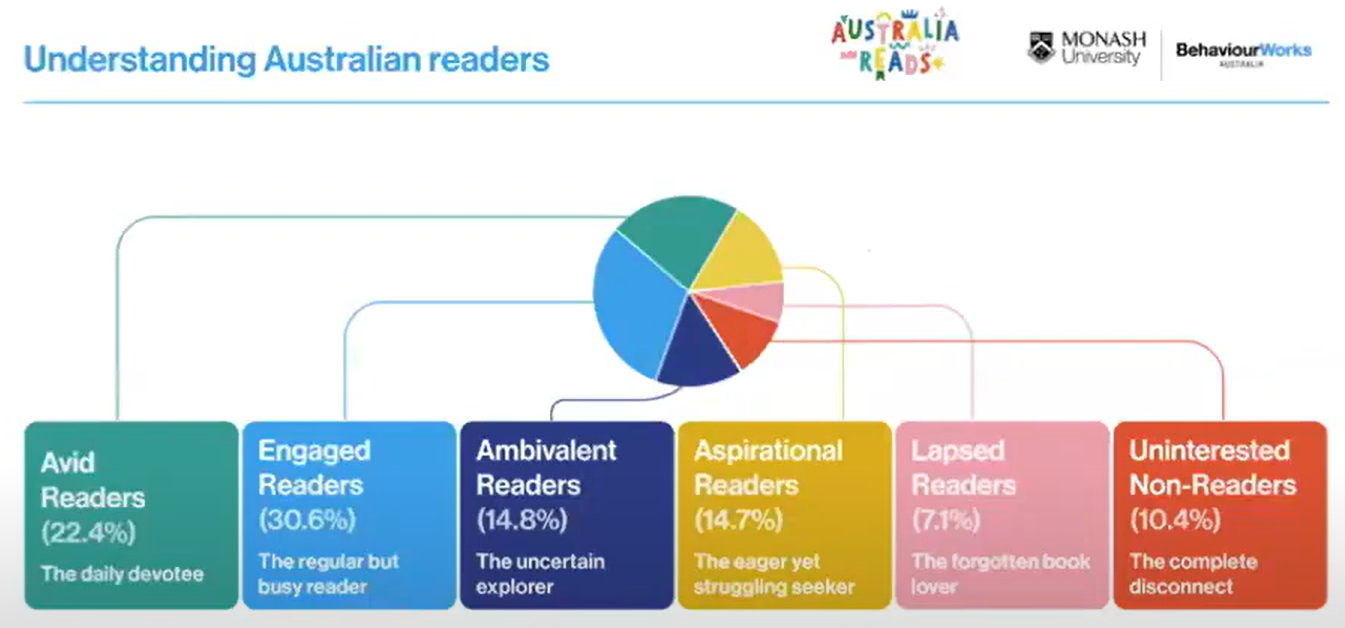
Interestingly, the report also notes that readers on each extreme of this spectrum are less likely to change their reading behaviours and are therefore less effective targets for behavioural interventions. This is a key insight for me as a teacher-librarian, as it helps me understand where my energy is best directed in my lessons. The report concludes that Aspirational Readers are the most impactful group to target, followed by Engaged, Ambivalent, and Lapsed readers.
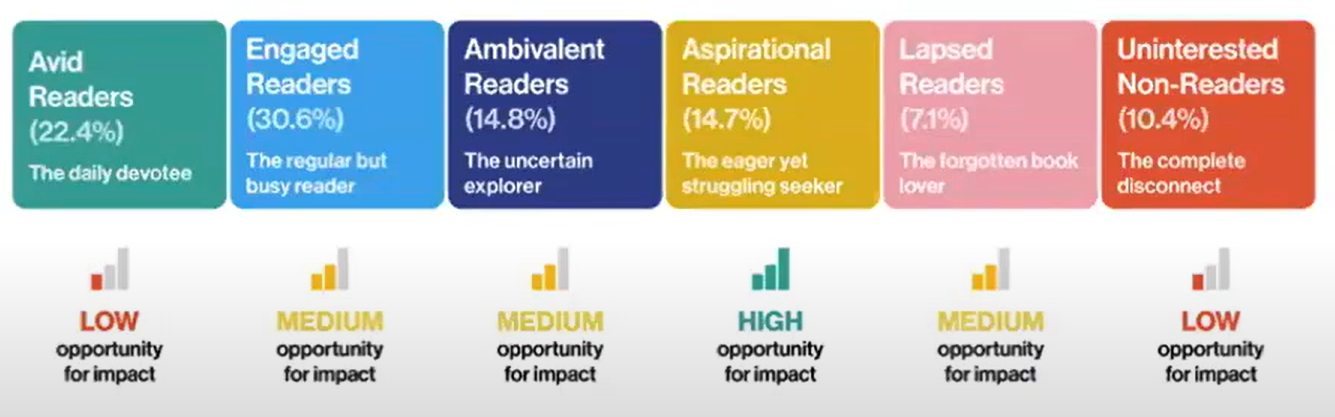
The report has a number of other crucial implications for my work as a teacher-librarian. Firstly, the fact that Uninterested Non-Readers don’t remember a single positive reading experience emphasises the importance of having qualified, well-supported teacher-librarians in schools who can support these formative reading identities in a positive way. Secondly, the report highlights the need to validate everyone’s reading experiences and identities, and the need to avoid judgements around different reading behaviours.

The webinar also gave three quick takeaways to help us moving forward:

  • Focus on the behaviour we want to see, not the behaviour we don’t want – sell the benefits of the product rather than the product itself.
  • Social norms are powerful but we need to make sure that our messages are coming from sources of authority that our audience finds relevent, valuable, and trustworthy.
  • Reduce choice overload to make it easier to connect people with relevent reading materials.

Based on the interventions recommended in the report, I’ve created a table of possible strategies to incorporate into my Wide Reading Program linked to the various stages of the reading journey. This year I’ve chosen 3-4 students from each class to focus on helping them achieve their self-nominated reading goal. These interventions will hopefully provide me something tangible to action in our lessons, and will help me shape my ongoing reworking on my Wide Reading Program scope and sequence.

Intervention TypeFinding BooksChoosing BooksStarting to ReadContinuing to Read
Education: Provide information to increase knowledge of understanding about a behaviour or issueEncourage engagement with social media or other book related content
Target browsing shelves as a worthwhile activity
Highlight value of graphic novels, short stories, novellas, middle grade and picture booksHave influencers or relatable individuals promote the benefits of reading in short, engaging video clips or interviews
Emphasise that reading can be a social activity, not just isolating
Emphasise reading is a restorative activity, not another chore
Highlight that reading habits evolve over time
Model reading habits
Reframe what it means to be a ‘good’ reader
Emphasise that reading confidence emerges from personal engagement and enjoyment, not proficiency
Training: Develop skills required for people to perform a behaviour effectively Provide training on how to find booksCreate tutorial videos or provide live demonstrations showing how to select books
Provide explicit training on how to select books
Use apps to block device notificationsCreate tutorial videos or provide live demonstrations showing how to incorporate reading into your daily routine
Persuasion: Use communication to induce positive feelings and change peoples’ attitudes or beliefsConnect reading to other activities and content they enjoy
Reframe away from the act of reading to engagement with other enjoyable content e.g. becoming a better footy player
Remind students about the enjoyment and benefits of reading
Reinforce message that there’s a book for every mood, and that any mood is a reading mood
Reinforce it’s ok to put down a book that isn’t meeting expectations
Reframe that it’s ok to skip parts or not finish books
Incentivisation: Offer rewards or benefits to motivate people to engage in a desired behaviourEncourage people to log and track their reading habits via apps, providing occasional rewards for continued progress
Modelling: Demonstrate or provide examples of desired behaviours for others to observe and imitateShow role models or peers who can demonstrate that spending a little time finding books can lead to greater reading enjoymentConnect readers with trusted reviews
Use peer-driven content and reviews
Share stories of relatable readers who have made time for reading
Show people they admire who enjoy reading
Enablement: Remove barriers and provide support to help people adopt new behavioursPromote audiobooks, quick reads, visual texts
Encourage people to use platforms like Goodreads to see what’s popular, get personalised recommendations
Encourage expansion of preferences to include digital and audio to increase accessibility
Use curated book lists to reduce effort in choosing books
Provide personalised recommendations 
Encourage use of platforms that give one-click recommendations based on past reading preferences
Encourage placing phones on silent, in other rooms
Pair individuals with reading buddies
Set reading goals
If-then implementation intentions
Create personalised reading schedules
Environmental restructuring: Change the physical or social environment to make desired behaviours more likelyKeeping books in visible spots
Connect readers with relevant books
Use AI reader advisory
Genrefy the collection
Read sample chapters or summariesSetting phone reminders to and timers to read
Encourage readers to keep a book in their bag to read on public transport, in doctor’s surgeries etc.
Encourage book clubs and reading groups to enhance social accountability

Introducing the Wide Reading Program to Students

Last week I posted about the structure of the Wide Reading Program I’ve been trialling for the past few years. This week I thought might be useful to give a bit more detail about how I introduce the program to students.

Activity 1: Brainstorm and Discuss the Benefits of Reading

As we all know, if we simply tell a teenager to do something they’re probably not going to follow our instructions. I’m therefore a big believer in trying to get our students to understand the reasons why we learn certain things, and this is where I start with the Wide Reading Program. In previous years I’ve relied on a class brainstorm and discussion of the benefits of reading for pleasure, but this year I rejigged things to include a Canva presentation which sets things out for my students more explicitly.

This year I found that during the brainstorm and discussion most students were able to easily identify the literacy benefits to reading for pleasure while some said it helped them to learn about things or to relax or escape from their problems. However, I found that very few students recognised the wellbeing benefits. In particular I focus on the idea of reading as developing our ability to empathise with others, since this is inherently relevant to the teen experience. Hopefully seeing the visual in the presentation helped them to recognise the multitude of ways reading can help them in their everyday lives.

My reading lessons are only an hour long, and this year due to the excellent discussion sparked by the Canva visual I found that I didn’t really get to the second and third discussion points regarding why they read or don’t read and what behaviours they count as reading – these ended up being incorporated into subsequent lessons. Next year I’ll likely remove them completely from the lesson to streamline my teaching activities.

Activity 2: Reader Identity Survey

Instead, my priority was to get students to complete the reading habits survey so I could get a better understanding of who they are as readers and how I can best support their reading journey. The first two questions in this survey are based around their reader identity and confidence:

  1. I think I am:
    • A confident reader
    • An OK reader
    • Not a very confident reader
  2. I am:
    • Someone who loves reading
    • Someone who will read if there’s nothing else to do
    • Someone who doesn’t like reading

I’ve previously examined their this year’s results, with most students identifying themselves as OK readers who aren’t that enthusiastic about doing it for fun which is consistent with the research in this area. However, after attending a recent webinar by ALIA on Fostering a Passion for Reading, next year I’ll reword the second question to something like “I really don’t like reading but wish I was better at it” to promote a growth rather than fixed mindset.

The second part of the survey asks students about their reading preferences:

However, this is an indecipherable wall of text for struggling readers and rather difficult to navigate on the devices we used. This screenshot is only capturing half of the options I’ve given them! Next year I’ll therefore either simplify this or remove it; I did actually remove it for our streamed Literacy class and found it worked much better. I originally included it with the intention of using it to find specific books for each student but due to time restraints I haven’t had the opportunity to do this yet and doubt I will find the time in future years.

The third section of the survey is a bit more open-ended and could easily replace this second section to help me get a better idea of who my readers are. It features 3 questions:

  1. What was the last book you remember reading? What did you think of it?
  2. What was the best book you have ever read? Why?
  3. What is your reading goal for 2024? e.g. would you like to read a certain number of books, a certain style of books, books from a specific author or culture etc.?

In future I’d love to work with the classroom teacher to nominate three students each per term to target based on these goals. While this won’t allow us to reach everyone in the class, it will allow us to focus on the kids who might otherwise slip through the cracks.

So there you have it – my first lesson in the Wide Reading Program. If anyone has suggestions on how else I can improve or activities that have worked for you, please leave a comment below! If you’re enjoying these activities, stay tuned for more in coming weeks.

ETL402 2A: Introduction to Children’s Literature

As an English teacher, I am already quite familiar with children’s literature and the benefits of reading for pleasure. Nonetheless, it has been interesting starting this subject to consider recent research and trends in this area.

One thing mentioned in the research that I can definitely back up with anecdotal observation is the trend for interest in reading for pleasure to drop off between the ages of 9-12. The research mentioned that this could be because of competing demands on children’s time as they get older and a growing sense that reading for pleasure isn’t valued as a leisure activity, especially in contrast with competing entertainment platforms such as the internet and gaming. I also think that for many students their identity as ‘non-readers’ and the perception that reading is something ‘nerdy’ only done by a specific type of person has been established by the time they hit high school. This issue seems to be compounded by the limited amount of books relevant to struggling teen readers (especially boys!). If a student has a lower reading ability in high school they are often limited to texts where the content (characters, events, themes) is more relevant for a younger audience; it would be nice if publishers recognised the need for age-appropriate content and cover designs on easy-to-read books. This is perhaps one area where the flexibility of ebooks and audiobooks could be highlighted by school librarians as a potential solution for students who perceive themselves as ‘struggling readers’.

Also supported by my own observations are the statements in the research about the continued popularity of series fiction. The students who regularly borrow from our school library are often borrowing texts from the same authors or series, which shows that once you hook a reader with a specific set of characters or world they are more likely to continue to engage due to the comfort of familiarity. Many of our manga series such as My Hero Academia,  Death Note, Fullmetal Alchemist, and Fairy Tale are incredibly popular and many of the students read them as a friendship group, which increases their cultural capital within that group. Teacher librarians could capitalise on this by promoting Book Clubs where students and staff read from a curated book list and discuss their experiences of reading these texts. These book clubs can also serve the purpose of reframing student perceptions about who counts as a ‘reader’. Series fiction is also incredibly popular, with titles such as the Wings of Fire and Arc of the Scythe series providing students a chance to engage with an imagined world over the course of several books. Teacher librarians can capitalise on the popularity of these texts by promoting fan-fic activities and through displays recommending their next reads based on their previous favourites.

It can be hard to keep up with trends in children’s literature. One strategy that teacher librarians can utilise is to follow websites and blogs such as Goodreads and Booktopia. Another is to use technology and social media platforms as a way of tracking popular resources, such as the #booktok or #bookstagram tags. A third is to regularly visit bookstores and local libraries (either the physical location or their online space) to see which books are popular right now and engage with the people selling and promoting these resources in a different setting. Most important is the need for teacher librarians to carve out time for their own reading of these texts. Not only will this allow us to engage in meaningful conversations with our students about these texts (increasing our own cultural capital i.e. ‘cool’ factor with certain groups of students!) but it will also allow us to show that reading for pleasure is a valuable activity that should be likewise valued by our school community. It’s hard for us to advocate for the importance of reading for pleasure if we aren’t taking the time to walk the walk (or read the read, as the case may be).