CBCA Shadow Judging Scholarship

Exciting news: we’ve been successful in gaining a scholarship for the CBCA Shadow Judging program!

Shadow Judging is a nationwide initiative where students read the titles shortlisted for Book of the Year, discuss them, and ultimately select their own winner, mirroring the official judging process. It’s a fantastic way to build critical reading skills, deepen literary discussion, and give our students a genuine voice in evaluating contemporary Australian literature.

It was a bit nervewracking waiting to see if any kids would sign up. After all, it would be terribly embarrassing for me to have to go back to the CBCA, hat in hands, and explain that we didn’t have any interest! Luckily we have a few voracious readers who put their name down – 11 in total. It was also nerve-wracking to see how long it would take for the books to come in and be processed, but the stars aligned and we had them ready for borrowing this week; we also were fortunate to get the ebooks added to our virtual library courtesy of Wheelers ePlatform.

Next week I’ll have a meeting with the students to finalise our meetings throughout the term, and ensure that they are familiar with the judging criteria and creative response requirements. We’ve got 6 books to read before making our Book of the Year choice by August 6. I’m also planning on hosting a rewards afternoon with the participants during Book Week to thank them for their efforts in taking part in this program.

The shortlisted titles are:

  • Darkest Night Brightest Star by Barry Jonsberg: A moving story of friendship, grief, and resilience as two teens confront loss and search for hope.
  • Golden by Jade Timms: A powerful coming-of-age novel exploring identity, ambition, and the pressures young people face in defining their futures.
  • Of Flame and Fury by Mikayla Bridge: A gripping fantasy filled with rebellion, secrets, and strong character dynamics set in a vividly imagined world.
  • This Stays Between Us by Margot McGovern: A tense and emotional story about friendship, loyalty, and the consequences of hidden truths.
  • We Saw What You Started by Carla Salmon: A compelling, fast-paced novel tackling justice, accountability, and the ripple effects of one pivotal moment.
  • Unhallowed Halls by Lili Wilkinson: A dark, atmospheric tale blending mystery and the supernatural within a haunting school setting.

This year I’ve been working with another staff member to reinvigorate our school’s Staff Book Club. In addition to the four books we’re offering as the term’s reading choices, we’ve also invited staff to read the shortlisted books alongside the students this term. When staff engage with the same texts as our students, it opens up richer conversations across classrooms and year levels, models thoughtful reading practices, and helps foster a shared reading culture within the school.

The scholarship also includes access to a 4 week professional development course, Illuminating Australian Children’s Literature, so I’m looking forward to seeing what gems I can take away from this to implement into my professional practice.

I’m incredibly fortunate to have been given this opportunity and, while I’m nervous since it’s my first time participating in the Shadow Judging program, I’m super excited to see how it helps build a culture of reading in my school community!

Understanding Australian Readers: Summarising the Australia Reads Report

Recently several researchers from Australia Reads released their Understanding Australian Readers report. This report aimed to identify what influences when and how people read, to map out thier reading journey and to uncover drivers and barriers for these reading behaviours across different demographics. While it focused on people aged 16 and over rather than children or teenagers, this was invaluable research which provided some key insights that can apply to my own work in a high school setting.

The researchers also launched the report with an accompanying webinar:

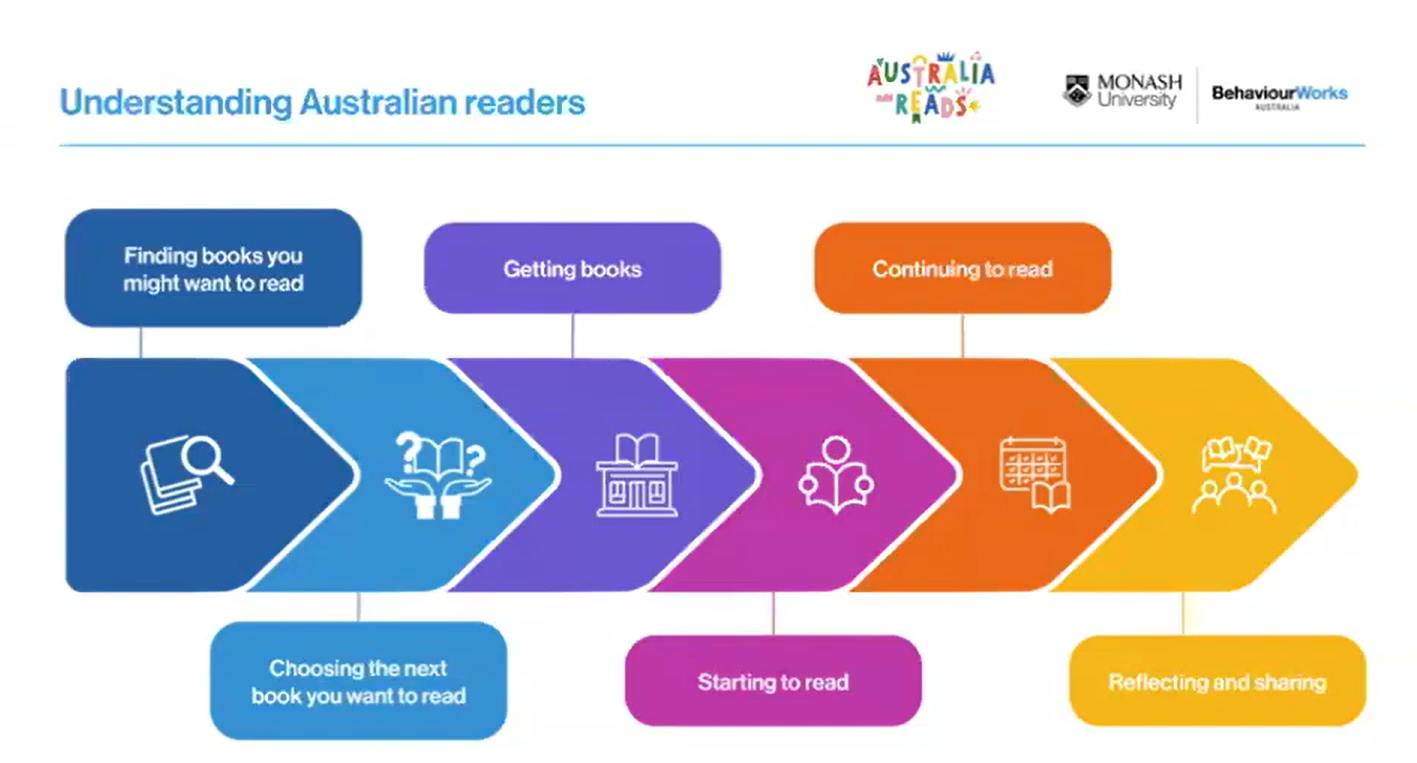
I really liked how the report broke down the different behaviours that make up a reading journey, and how these behaviours aren’t necessarily linear. The report also notes that different groups will exhibit different behaviours in each of these steps of the reading journey and face different barriers; therefore, there’s no one size fits all approach to increasingly Australia’s lagging recreational reading rates.

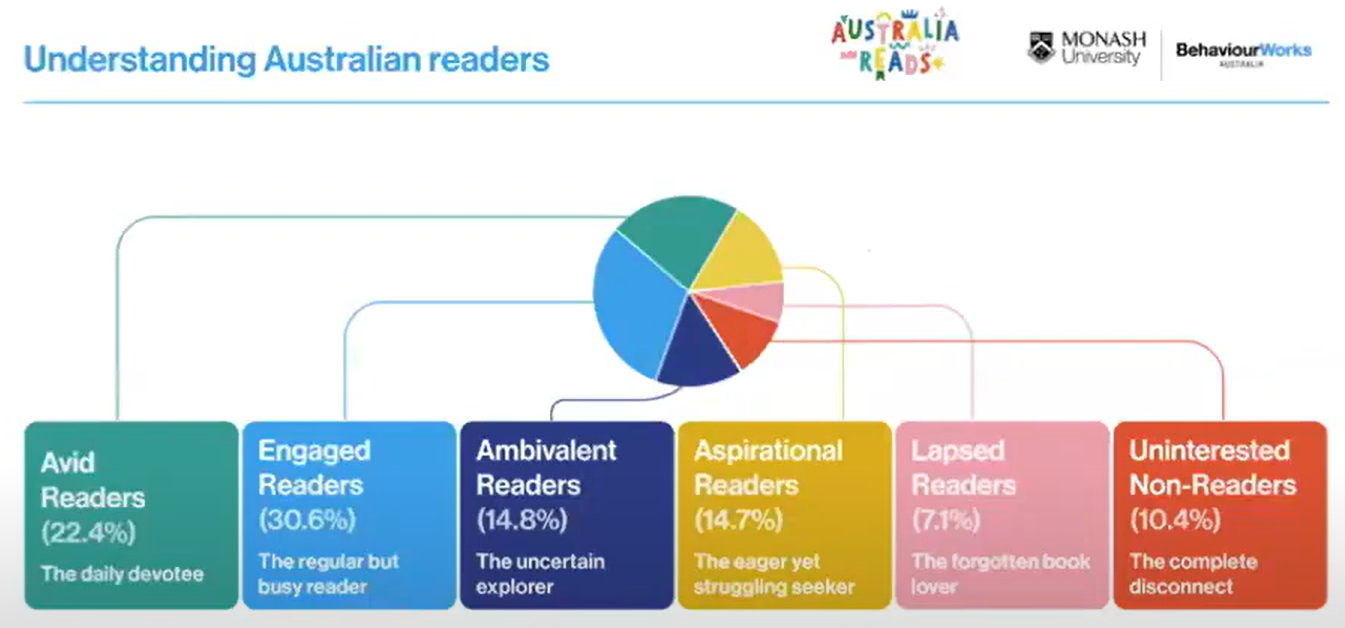
The report also explores the different types of readers, presenting these identities on a spectrum that includes both readers and non-readers. It was interesting to see that reader identity isn’t fixed and that people move between these different stages at different points in their lives. For instance, I would have once identified as an Avid Reader (I was the kind of kid who used to take books with me everywhere!) but now, due to time constraints and work overload, I’d probably fit the Lapsed or Aspirational Reader categories.

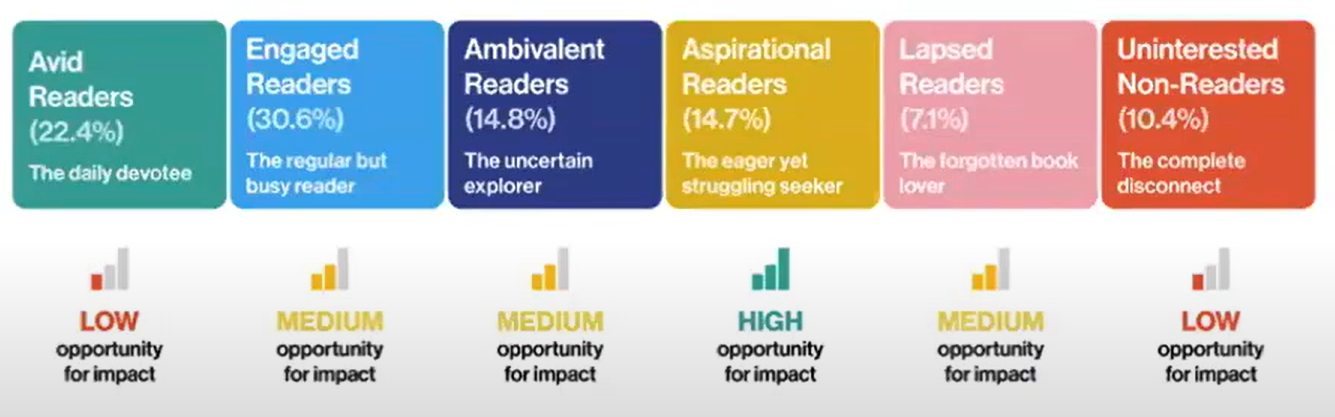
Interestingly, the report also notes that readers on each extreme of this spectrum are less likely to change their reading behaviours and are therefore less effective targets for behavioural interventions. This is a key insight for me as a teacher-librarian, as it helps me understand where my energy is best directed in my lessons. The report concludes that Aspirational Readers are the most impactful group to target, followed by Engaged, Ambivalent, and Lapsed readers.

The report has a number of other crucial implications for my work as a teacher-librarian. Firstly, the fact that Uninterested Non-Readers don’t remember a single positive reading experience emphasises the importance of having qualified, well-supported teacher-librarians in schools who can support these formative reading identities in a positive way. Secondly, the report highlights the need to validate everyone’s reading experiences and identities, and the need to avoid judgements around different reading behaviours.

The webinar also gave three quick takeaways to help us moving forward:

  • Focus on the behaviour we want to see, not the behaviour we don’t want – sell the benefits of the product rather than the product itself.
  • Social norms are powerful but we need to make sure that our messages are coming from sources of authority that our audience finds relevent, valuable, and trustworthy.
  • Reduce choice overload to make it easier to connect people with relevent reading materials.

Based on the interventions recommended in the report, I’ve created a table of possible strategies to incorporate into my Wide Reading Program linked to the various stages of the reading journey. This year I’ve chosen 3-4 students from each class to focus on helping them achieve their self-nominated reading goal. These interventions will hopefully provide me something tangible to action in our lessons, and will help me shape my ongoing reworking on my Wide Reading Program scope and sequence.

Intervention TypeFinding BooksChoosing BooksStarting to ReadContinuing to Read
Education: Provide information to increase knowledge of understanding about a behaviour or issueEncourage engagement with social media or other book related content
Target browsing shelves as a worthwhile activity
Highlight value of graphic novels, short stories, novellas, middle grade and picture booksHave influencers or relatable individuals promote the benefits of reading in short, engaging video clips or interviews
Emphasise that reading can be a social activity, not just isolating
Emphasise reading is a restorative activity, not another chore
Highlight that reading habits evolve over time
Model reading habits
Reframe what it means to be a ‘good’ reader
Emphasise that reading confidence emerges from personal engagement and enjoyment, not proficiency
Training: Develop skills required for people to perform a behaviour effectively Provide training on how to find booksCreate tutorial videos or provide live demonstrations showing how to select books
Provide explicit training on how to select books
Use apps to block device notificationsCreate tutorial videos or provide live demonstrations showing how to incorporate reading into your daily routine
Persuasion: Use communication to induce positive feelings and change peoples’ attitudes or beliefsConnect reading to other activities and content they enjoy
Reframe away from the act of reading to engagement with other enjoyable content e.g. becoming a better footy player
Remind students about the enjoyment and benefits of reading
Reinforce message that there’s a book for every mood, and that any mood is a reading mood
Reinforce it’s ok to put down a book that isn’t meeting expectations
Reframe that it’s ok to skip parts or not finish books
Incentivisation: Offer rewards or benefits to motivate people to engage in a desired behaviourEncourage people to log and track their reading habits via apps, providing occasional rewards for continued progress
Modelling: Demonstrate or provide examples of desired behaviours for others to observe and imitateShow role models or peers who can demonstrate that spending a little time finding books can lead to greater reading enjoymentConnect readers with trusted reviews
Use peer-driven content and reviews
Share stories of relatable readers who have made time for reading
Show people they admire who enjoy reading
Enablement: Remove barriers and provide support to help people adopt new behavioursPromote audiobooks, quick reads, visual texts
Encourage people to use platforms like Goodreads to see what’s popular, get personalised recommendations
Encourage expansion of preferences to include digital and audio to increase accessibility
Use curated book lists to reduce effort in choosing books
Provide personalised recommendations 
Encourage use of platforms that give one-click recommendations based on past reading preferences
Encourage placing phones on silent, in other rooms
Pair individuals with reading buddies
Set reading goals
If-then implementation intentions
Create personalised reading schedules
Environmental restructuring: Change the physical or social environment to make desired behaviours more likelyKeeping books in visible spots
Connect readers with relevant books
Use AI reader advisory
Genrefy the collection
Read sample chapters or summariesSetting phone reminders to and timers to read
Encourage readers to keep a book in their bag to read on public transport, in doctor’s surgeries etc.
Encourage book clubs and reading groups to enhance social accountability

Becoming a Better Version of My Professional Self: PDP 2025

Each year, NSW Department of Education employees are required to formulate a Professional Development Plan where we aim to achieve between 3-5 goals which will improve our professional practice. Our school encourages us to have one goal for ourselves, one for our faculty and one for a whole-school initiative.

This year, I’ve chosen the following goals to work towards. These goals are similar to the ones I worked towards last year, but due to a variety of factors largely out of my control I was not able to achieve them effectively.

Goal 1: Library Strategic Plan

This year I will raise the perceived status, professionalism and value of the school library by ensuring its effective management. I will do this by building on the needs assessment conducted in 2024 and by creating a strategic plan by the end of term 3. This strategic plan will be broken into 1, 3, and 5 year goals which support the SEP with regular reflection periods. I will continue to engage with the wider teacher-librarian community throughout this process through membership of key professional bodies and through regular reflection on my blog.

Goal 2: High Potential, Gifted Education Committee

This year I will support the diverse needs of our students by working to reintroduce school-wide initiatives to develop the capacity of our High Potential and Gifted students. I will do this through membership of the Engaged Students for Learning committee. This support could include initiatives such as Tournament of Minds participation, passion projects, or Guided Inquiry units. I will also engage with research in this area to ensure that our initiatives are evidence-based. I will record this progress and reflect on my professional practice through regular blog posts, ensuring my continuing contributions to professional practice in the wider teacher-librarian community.

Goal 3: Wide Reading Program

This year I will forge strong connections between the library, teaching staff and students by continuing to support the implementation of the new English syllabus. I will achieve this by supporting the development of Stage 4 students’ literacy through the Wide Reading Program. I will formulate a teaching and learning program for this activity to ensure consistency and strong curriculum links. To ensure best practice, I will continue to participate in the wider teacher-librarian community by engaging with new research into reading for pleasure and information and through regular reflection on my professional blog.

Professional Development and Networking: Reflections on the Greater Macarthur Secondary Education Network Day

For the last two years, my school has done something different for our Term 2 Staff Development Day. Rather than work in our own schools, we’ve taken part in a joint learning opportunity with the 7 schools in our local education network – the Greater Macarthur Secondary Education Network (GMSEN). Last year all schools converged on Oran Park High School to work collaboratively with their faculty groups across this network, while this year each faculty area met at a different school. For me and the other teacher-librarians in our area, this meant a day spent once again at Oran Park High School under the impressive leadership of their TL.

The day included a number of professional learning opportunities to help us maximise our potential in supporting our school communities. The first session was delivered by the State Library of NSW, whose expert librarians showed us a variety of different events, exhibitions, conferences and professional learning opportunities. Their resources are free to access once you’ve signed up for a library card, so it’s well worth the time to show our students (especially our seniors). They provide access to a number of useful databases such as JSTOR, Informit, Gale, and ProQuest which can help our staff and students with their research. I personally access these so often I’ve memorised my library card number!

The HSC Subject Focus is also something I can see being useful for our students, with relevant study guides, exam tips and past responses collated in one easy location for students to access.

One thing I didn’t know about prior to this workshop was the Gale in Context: Opposing Views database. This presents different perspectives on key topics relevant to many of our curriculum units and would be a fantastic resource for our debators, High Potential and Gifted Education program, and students doing independent research projects or major works.

The second session was delivered by our local Clickview consultant. This video-sharing resource is expensive but highly relevant to our work as educators, and allows us to legally show video content to our students (after all, most streaming services’ licences are for personal use only!). The inclusion of the new interactive features and data analysis is a game-changer. for staff looking to check their students’ understanding of assigned learning materials. Their new layout is much more appealing and user-friendly too.

Our third session involved an excursion to the local Oran Park Public Library. One of the TLs at our session is due to start as the new youth librarian here shortly, so it was wonderful to get a tour and see what kinds of resources they offer. The most useful resource from this session was the High School Study Help they provide each week for students which I’ve now advertised to our school community on social media.

The final session was an online webinar on the Information Fluency Framework. I’ve previously stated that I wanted to do more to develop information fluency at my school and this was a great short course introducing the newly released framework. Of particular use were the specific ways TLs can work collaboratively with staff to incorporate the framework and develop our students as fluent consumers and creators of information across the elements of Social, Literate, Innovative, Critical and Ethical inquiry learning. I’m already in discussions with some of our teachers to co-teach a Guided Inquiry Design unit again at the end of the year and look forward to integrating this framework into our lessons more effectively.

Teachers know that not all professional development is created equal; however, this opportunity to develop our capacity as TLs with others in our field was fantastic! I took a lot away from the day’s sessions and I’m looking forward to next year’s GMSEN conference!

Professional Development: Overcoming Barriers to Reading for Pleasure

While I’m on school holidays and have a little more time, I thought it would be a good opportunity to watch the videos currently available in the Open University Reading for Pleasure and World Book Day webinar series, Overcoming Barriers to Reading for Pleasure.

The first video, ‘Readers Don’t Always See Genuine Role Models‘, featured some interesting discussion about the importance of being positive reading role models for our students, especially if they’re not seeing these role models elsewhere in their lives. One excellent point they raised was that there’s a difference between encouraging students to read and modelling reading. I think most teachers would do the former quite well, but due to time constraints and high workloads the second probably isn’t as common as it should be. They also referenced research from 2009 which suggests that for most younger children, their reading role models are their parents, but after year 6 this changes to peers and teachers holding this key place for our students. Its therefore vitally important that we offer ourselves as potential reading role models for our high school students, to show that that all reading behaviours count and to help them understand that reading is everywhere and they, too, can count as members of the diverse reading community.

The second video, ‘Overcoming Barriers to RfP’, drew more heavily on current research and professional practice in its lengthier discussion. They explored the 6 key aspects of reading for pleasure, as supported by the evidence provided on the World Book Day website:

  1. Being read to regularly
  2. Having books at home and school
  3. Finding time to read
  4. Having trusted help to find a book
  5. Giving children a choice in what to read
  6. Making reading fun

One key element they discussed as having an important role in overcoming barriers to our students’ reading for pleasure was to identify and discuss the barriers to our own pleasure reading. Discussing these barriers as well as the physical and mental spaces that help or hinder our reading can help normalise and destigmatise some of the feelings and behaviours our students experience, such as feeling they don’t have the time to read, like they’re too distracted to get into a book, or that they simply aren’t enjoying a book and want to put it aside.

Some of the specific barriers to reading explored in this webinar include:

  • lack of access to appropriate, interesting books
  • lack of time to read
  • lack of will (especially due to competing interests and activities)
  • lack of skill
  • peer pressure around what does and doesn’t count as reading
  • distraction
  • tiredness

Teresa Cremin provided a summary of her research, arguing that there are four main factors affecting reading for pleasure:

  1. Intrinsic motivation

Cremin revealed that the research repeatedly shows that intrinsic motivation is far more important than extrinsic (external, reward based) or social motivations when it comes to getting students reading. She said that students with intrinsic motivation read because they care about the subject, relate to the characters, and want to know what happens next. She notes that extrinsic motivation, however, dominates in professional practice where we see reading challenges and certificates promoting reading for others, rather than reading for ourselves.

  1. Choice and agency

Cremin referenced data which suggests that only 14% of students chose a text based on a teacher’s recommendations. This highlights the importance of student choice in their reading material, and we therefore need to deveop their ability to browse and select appropriate, interesting texts and to support their choices without judgement.

  1. Informal book talks

This socially motivates readers, which in turn can develop intrinsic motivation to read and allows students to see themselves as part of a wider community of readers. Cremin noted that talking about fiction is almost as important as reading it in the first place, and that “low key, relaxed blether” about books can allow us to reframe reading as a fun social endeavour which links students to the collective, communal reading journey.

  1. Role models

Cremin and the other presenters all emphasised that building relationships with our students is crucial to developing reading for pleasure as a habit amongst our students, and that we need to know our students and their interests in order to champion their emerging reader identities.

Overall, there was a lot of useful information in these two videos, and a number of suggestions to help us incorporate evidence-based strategies into our practice. The good news is that a lot of what I’m doing with the Wide Reading Program lessons is on the right track. Some of the new strategies I noted as possibly being suitable for my context include:

  • Modelling reading and giving students a break while they develop their stamina by having the teacher read aloud from a novel’s right hand page (usually the first page of a chapter) with students reading from the left hand page. I thought that I could also incorporate ICT with this strategy by using the library’s document camera to project the pages to the class.
  • Having a discussion around the types of barriers both students and staff experience with their own reading.
  • Reading blanket: lay out a selection of books on a blanket and use them as a prompt for an informal book talk and student selection of materials. Another activity that could emerge from this is that students could vote on which books they’d prefer to read, followed by a discussion about why.
  • Students could select a number of books they feel should be highlighted through our library’s dynamic shelving. This could help them to feel a sense of ownership within the space while showing them that staff honour and support their reading choices.
  • Students choose a book for staff to read aloud to the class. Due to the fact that classroom teachers support me in these lessons, we could even split the class to ensure more students are satisfied with their grouping’s choice.
  • Engage parents in pleasure reading and as reading role models through a parents book club, breakfasts, parent teacher night discussions, by giving recommendations and allowing parents to borrow books (one presenter said that The Midnight Library never fails her in this regard!)

This is just the tip of the iceberg regarding the research and strategies offered by the Open University’s Reading for Pleasure program. Their website features a plethora of different resources to help educators like myself develop strong pleasure reading programs in our own schools, and as I move forward with my colleagues to create a school-wide culture of reading for pleasure in our own context I have no doubt I’ll be referring to their work quite frequently!

Research: Creating a School-Wide Reading Culture

A few colleagues and I are interested in developing a school-wide reading culture to support the literacy development of our students. We’re in the early stages of this process and I’ve just started doing some initial research into what works for other schools and how we can proceed within our own setting. From the early responses I’ve received for my inquiries on Facebook and Viva Engage it seems that this is something of interest to a lot of teacher-librarians, but few of us feel that we work in a school with a strong reading culture.

One useful resource I’ve investigated over the last few days is Madison’s Library, who has been on her own journey creating a school reading culture since 2021. I liked how she started her journey by considering how we know whether a school has a reading culture or not, as this forced me to consider my own assumptions about what a reading culture is and what we might already be doing to support pleasure reading and literacy development.

Her examination of organisational culture and climate was also interesting. Some of the research she referenced argues that organisational culture “is the glue that binds people towards a shared vision or goal” (Dearnaley, 2021, paraphrasing Lee, 2020) or “the way things are done in an organisation” (Dearnaley, 2021, paraphrasing Heath, 2021). On the other hand, “If culture is the values, belief systems, motivations and assumptions then climate is the patterns of behaviour, habits and feelings” (Dearnaley, 2021, paraphrasing Randhawa, 2019).

She referenced Katzenbach, Steffan, and Pronely’s 2012 Five Point Strategy for initiating effective cultural change. They argue the need to:

  1. Match the change strategy with the culture
  2. Focus on a few small shifts in behaviour
  3. Honour the strengths of the existing culture
  4. Integrate formal and informal interventions
  5. Measure and monitor cultural evolution

She also refernced Rick’s 2016 CREATE strategy:

  • C – clarify values and organisations culture.
  • R – reinforce the vision, ensuring everyone in the team knows the vision, values and culture code and how these will work towards success.
  • E – empower behaviours that support the values, culture and vision
  • A – align conversations
  • T – target efforts on high impact areas
  • E – emphasise success

She also gave several interesting definitions of what reading culture is, based on current research:

  • A culture of reading is the tangible and visible expression of how all members of the school community value reading and engage with reading (Reading First, 2007)
  • A positive reading culture provides support, encouragement, modelling, resources and opportunities to read for pleasure (Merga & Mason, 2019).
  • Reading is seen and embedded across the school, in all classes, across all areas of the curriculum and the daily life of students (Daniels & Steres, 2011). 
  • A supportive school reading culture is availability, opportunity, encouragement and support for reading (Merga & Mason, 2019).
  • A unique feature of a reading culture is that it promotes reading for leisure, rather than for just academic purposes or educational outcomes (Cochrane et al., 2022)
  • Intrinsic student motivation for reading, reading engagement, autonomy, and student choice are also key features of a strong reading culture (Daniels & Steres, 2011).

She then referenced the work of Daniels and Steres (2011), who suggest three actions towards building a strong reading culture:

  1. Make reading a school-wide goal and priority, allowing time and expectations for reading. 
  2. Provide ongoing support and training to staff to support readers, including how to talk to their students about reading and develop their own reading practices. 
  3. Commit resources, including time and money to ensure access and commitment to reading is evident and supported.

Her conclusion regarding the position of the school library in this cultural change was a profound one for me. She argues that while the library can support a school-wide reading culture, it has to be enacted and owned by all members of the school community. This will be a significant challenge moving forward, since my time-poor teaching colleagues will likely find any initiative proposed in this area as just another thing to add to their workloads, despite their good intentions and understanding of the benefits. Maintaining the momentum, especially with such a time-consuming initiative, will be a challenge for any leader.

References:

Dearnaley, Madison. (2021, October 8). Building a school reading culture – Part 1. Madison’s Library. https://madisonslibrary.com/2021/10/08/building-a-reading-culture-part-1/

Dearnaley, Madison. (2021, October 23). Building a school reading culture – Part 2 organisational culture research. Madison’s Library. https://madisonslibrary.com/2021/10/23/building-a-reading-culture-part-2/

Dearnaley, Madison. (2021, November 3). Building a school reading culture – Part 3 culture change research. Madison’s Library. https://madisonslibrary.com/2021/11/03/building-a-reading-culture-part-3/

Dearnaley, Madison. (2022, June 23). Building a school reading culture – Part 4 what is a reading culture? Madison’s Library. https://madisonslibrary.com/2022/06/23/building-a-reading-culture-part-4/

Dearnaley, Madison. (2022, July 3). Building a school reading culture – Part 5 measuring reading culture. Madison’s Library. https://madisonslibrary.com/2022/07/03/building-a-reading-culture-part-5/

Dearnaley, Madison. (2022, October 6). Building a school reading culture – Part 6 measuring the starting point. Madison’s Library. https://madisonslibrary.com/2023/10/06/building-a-reading-culture-part-6/

Dearnaley, Madison. (2022, October 6). Building a school reading culture – Part 7 reading culture characteristics. Madison’s Library. https://madisonslibrary.com/2023/11/15/building-a-reading-culture-part-7/

Professional Development: Overdrive’s Getting Students Reading Through Social Media

I’ve long been interested in harnessing the power of social media to engage my students, so this week I signed up to Overdrive’s webinar Getting Students Reading Through Social Media. The presenters, Amanda Hunt, KC Boyd and Melanie Wood, were fantastic and I came away from this video with so many wonderful ideas about how to incorporate these tools into my practice! Here’s some of the top tips I took from this webinar.

1. Identify our audience and target their interests and needs

Social media can be a fantastic way to engage students, staff and parents to help promote reading for pleasure. Parents in particular can play a positive role in helping kids understand that reading can be a positive activity. However, we need to be delibrate in how we are using this toolset to achieve our aims.

The presenters suggested engaging parents by showcasing their children in the posts, and to increase audience participation by asking questions and including interactive content such as “Leave a comment about your favourite book!” to avoid our posts becoming invisible in the endless scroll cycle. The presenters also emphasised that we should space out our content to avoid overwhelming our audience. to consider the times when they’re more likely to be online and receptive, and to keep our content short and sweet.

Interestingly, the presenters also made the point that local politicians can be targeted as one of our audiences, highlighting the power of social media as an advocacy tool beyond our immediate communities.

2. Post relevant educational but celebratory content

Celebrating milestones and reading achievement was one tip that resonated with me, since a lot of what I’m trying to achieve is focused around building positive reader identity in my students. For instance, I already have a Readerboard in my library which notes our top borrowers each month and across the year; it wouldn’t be too hard to turn this into a social media post, or to update parents on their students’ progress towards the NSW Premier’s Reading Challenge.

One of the presenters had an Insta-ready background in their library for students to pose in front of with their current reads; I’ve had my eye on this gorgeous CBCA social media frame, and think that this is something I could definitely incorporate into my own practice to promote personal choice reading material, staff favourites, and recommendations for special events like school programs, faculty topics, featured authors, and upcoming holidays and events.

Tutorials and ‘how-to’ videos were another suggestion for engaging students, staff and parents with the library resources. I hate showing my face on social media, but the presenters made a salient point that being visible helps our students recognise us, and gives us a little mini-celebrity status in our community which helps build connections between us and our audience when we don’t see them every day. Scheduling time and setting reminders for regular content creation was also suggested to ensure consistency in our promotions.

3. Learn through experimentation

Personally, I’m not a massive social media fan. I use Facebook regularly to keep in contact with friends and collegial networks, and during while studying to be a teacher-librarian I created an Instagram account, but I’m a rather private person and still feel very much at sea when it comes to content creation and promotion of my work. The presenters suggested using various social media platforms to tap into whatever your target audience engages with, which is honestly an overwhelming prospect! However, one helpful tip they gave was the ‘Five Minute Promise’ – pick one app you wish to become more familiar with and engage with it for 5 minutes each day. This seems fairly achievable and breaks down an otherwise mammoth task into much smaller, manageable chunks.

Some specific content ideas I could try include…

  • Short video recommendations (particularly useful for students who might be too shy to ask for help)
    • I’m reading…
    • If you liked … try …
    • This person loves …
    • Currently trending …
    • New releases …
    • Author highlights
    • Recently recommended 
  • Use fun filters to create themed content e.g. a zombie filter for horror books
  • Interactive scavenger hunts and reading challenges
  • Connections to feeder primary schools and community events
  • Themed and curated book lists
  • Fun memes encouraging positive interaction with reading
  • Use social media to inform, define and promote reading program; tell our unique story

Professional Development: ASLA February Webinar

Last year I had several requests for books such as Icebreaker and the Twisted Love series. These innocent students had seen these blow up on platforms such as TikTok and Instagram and of course wanted to know what the big deal was.

Therefore, earlier this week I registered for ASLA’s February webinar, “But I saw it on BookTok…” with Emily Feetham. This fantastic professional development resource covered the following issues:

  • The main social media platforms and how algorithms work.
  • Content warnings and age recommendations.
  • How do we as library staff navigate this? How do we encourage age-appropriate reading, without having to resort to censorship?
  • What are the benefits of these platforms and how to best utilize them?
  • “Judge a book by its cover” – can you tell if this book is YA or adult just by the cover/blurb?

Having finally found the time to watch it, I’ve taken a couple of ideas for my future practice. I’ve made it a professional goal to create a collection development and maintenance policy this year, and this webinar reinforced the importance of strong policies regarding what is included in the junior and senior fiction collections, as well as ensuring informed parental consent through the use of permission notes. A lot of books that are popular on platforms such as TikTok include extremely problematic content, so one way to tackle this would be to include infographic bookmarks on, say, domestic violence in a book which features a toxic relationship. Likewise, a display promoting healthy relationships could counter this romanticising of abuse. This webinar also highlighted that many parents don’t realise what their children are reading, so a future parent bulletin article outlining ways to help parents select age-appropriate content would be useful.

The rise of these platforms has made finding the balance between access and censorship difficult. However, informed consent should help ensure students aren’t coming across content they’re not ready for or which might be potentially harmful.