
HPGE Initiative: Passion Projects

One of my PDP goals this year was to support our High Potential and Gifted Education (HPGE) students more effectively. As a former ‘gifted’ kid, this is something I’m very passionate about but is sadly something can sometimes get lost amongst the chaos of all the demands placed on teachers. When I was in year 10 I was given the opportunity to participate in an Enrichment Program where we got a week off school to work on any project of our own design. My movie, the now-lost Indiana Phones and the Raiders of the Lost Park, wouldn’t qualify as a cinematic masterpiece by any stretch of the imagination, but it was a fantastic opportunity which extended my little brain and made a huge impact on how I saw myself as valued among our school community. I wanted to provide the same opportunity to our gifted and high potential students, and reworked that old enrichment program experience into a new program suitable for a modern educational context. Thus, I present to you all my Passion Project program.

Program Planning

The first challenge with planning this program was supervision. Back in the day, we were given the whole week off school to work on our projects. Due to modern supervision requirements, this was no longer possible, so I had to organise the program to run in a time where a) I was free to supervise and b) the library space was free for us to use. The calendar at the end of our school year is always chock-full of different programs, excursions, assemblies, and other assorted events, but I eventually settled on a time that worked. To ensure the library could still stay open during the breaks but that I also got my own break, one of our Deputies came up with the solution of combining the Private Study group with the Passion Project students in period 3, which would allow one teacher to supervise both groups.

I worked with the Head Teacher responsible for running our HPGE committee, and we decided to start with Year 7 since we could build their capacity as they moved through high school. We asked teachers to nominate students they felt met the HPGE criteria, though due to work overload only received a response from 2 teachers. Some of the teachers also gave feedback that the form we currently have to identify students is quite onerous for staff to complete, so we may have to revise it in future. Luckily, I am familiar with the year 7 cohort since I teach them all for the Wide Reading Program, and between us we were able to settle on a list of 20 bright young students. Two students chose not to participate, which left us with 18 to work with.

I also worked with the HPGE committee to arrange for a number of staff in different faculty areas to participate in a feedback panel, and encouraged staff from around the school to pop in at various intervals to support the kids with their projects.

Program Organisation

The Passion Project program was organised into three parts, based around the NSW DoE Information Process (ISP) and the Guided Inquiry Design (GiD) learning frameworks.

  • Day 1: Friday Week 6
    • Introducing the Passion Projects and giving time for students to explore their ideas
    • ISP stages: Defining, Locating
    • GiD stages: Open, Immerse, Explore
  • Day 2: Monday Week 8
    • Refining and pitching their project ideas for feedback
    • ISP stages: Selecting
    • GiD stages: Identify
  • Days 3-6: Monday-Thursday Week 9
    • Creating and developing their projects
    • ISP stages: Locating, Selecting, Organising, Presenting
    • GiD stages: Gather, Create
  • Day 7: Friday Week 9
    • Putting the final touches on their projects and sharing their completed work before celebrating and reflecting on their achievements
    • ISP stages: Presenting, Assessing
    • GiD stages: Share, Evaluate

Day 1: Exploring Our Projects

The first day of the program was all about building excitement and curiosity. I started the day with a brief explanation of what the program aimed to achieve, and gave them a number of brain warm-ups to help them think creatively and outside the box. I then gave them time to look broadly into a variety of potential project ideas that might interest them, and to consider what skills they already have and what they’d need to develop to complete these ideas.

Day 2: Writing our Proposals and Getting Feedback

This day was originally booked for Monday Week 8. However, I’d had my wisdom teeth out the previous week and experienced some complications, meaning I needed another week to heal. As a result, the Proposal Day was postponed.

We finally got to run it on Monday Week 9, but because of the postponement weren’t able to have the planned HPGE committee for the feedback panel. To make up for this I instead used the other students as a feedback panel.

In their proposals, students had to discuss:

  1. The general and specific questions which are guiding their inquiry
  2. Why they’ve chosen this project
  3. What their project will achieve and produce at the end of week 9
  4. What research they’ve done so far
  5. What skills they have to help them, what they’ll need to develop, and where
    they can go in future

Week 9: Project Week

This week was pretty straight forward, with the kids working solidly on their projects. There were a few points, especially towards the mid-point of the day where we have two solid hours of class, where students started to get a bit restless or distracted. To combat this, I gave students the option of having a brain break, such as a walk outside. In order to keep them focused and accountable, at the end of each day I gathered the students together to get them to reflect as a group on their progress so far. I selected from these questions each day:

  1. How has your thinking about this topic changed since you started?
  2. What strategies helped you find the information you needed?
  3. Which part of the inquiry cycle (questioning, researching, creating, reflecting) did you find easiest? Most fun? Why?
  4. Which part was the most challenging? What helped you get through it?
  5. What were the most useful sources you found, and why?
  6. How did you check that your information was trustworthy?
  7. What did you discover that surprised you?
  8. What risks did you take in your learning?
  9. What feedback did you receive, and how did it help?
  10. Who might benefit from what you’ve learned or created?
  11. What part of your project are you most proud of?
  12. What is one thing you’d still like to learn about your topic?
  13. If you had unlimited time or resources, how would you extend your project?

It was great to see the kids reflecting on their work, and they had some very interesting discussion. Perhaps unsurprisingly given what we know about gifted children, the best discussion points came from some of the more distracted students.

Final Day: Presentations and Reflections

Due to my absences, the presentations had to be pushed back to Monday Week 10. We spent the morning putting the final touches on the projects and began the presentations in Period 4. I wasn’t sure how long they’d take but wasn’t surprised when we ended up needing Period 5 as well. Every kid had something to present and, with the exception of one student, took the process seriously. Some of the projects the kids presented include:

  • A PowerPoint on the Fibonacci sequence
  • An electrically engineered device to pull washing back inside when it starts to rain
  • A Leukaemia Foundation fundraiser plan
  • A game designed using Roblox Studio
  • A choose-your-own-adventure story
  • A crochet scarf
  • A series of poems with a cake designed to reflect their symbolism
  • A website to help students access mental health support
  • A working piston and gear box built out of Lego
  • An experiment testing the benefits of carbon-plated shoes
  • A series of clothes made from second hand material which reflect women’s changing fashion in the 1960s
  • A poster exploring the ways plants and animals have evolved to defend themselves against predators

Reflection

At the end of the first day I gave the students a survey to see what their project ideas were, what skills they had and needed to develop, and what they thought of the program so far. Most students had a solid idea for their projects by this point, and enjoyed the creativity, independence, and freedom that the program provided. I also gave them the opportunity to give suggestions on how we could run the program in future. Three students gave feedback:

  1. Give people ideas if they don’t know what to do
  2. Do less of the brain game things at the start, only do like 30-60 minutes. Instead, explain what we are doing more and give more ideas on what we should do or brainstorm on.
  3. make a bit more prac time

The first and second pieces of feedback showed that even though I had suggested ideas in the booklet I gave them at the start, and walked around to give suggestions, I might need to incorporate more explicit strategies to help kids who are overwhelmed by the freedom of choice. Now that we’ve had one lot of students complete the program, we can provide their projects as examples of the types of projects that future students can complete.

The second and third pieces of feedback show that the kids would have preferred less time on the brain warm-ups, and more time to work on their projects.

At the end of the presentations I gave students another opportunity for feedback. Unfortunately I was only able to get feedback from 14 of the 18 students. On a scale of 1-5 students rated how they enjoyed the Passion Projects (one being “not at all” and five being “a lot”):
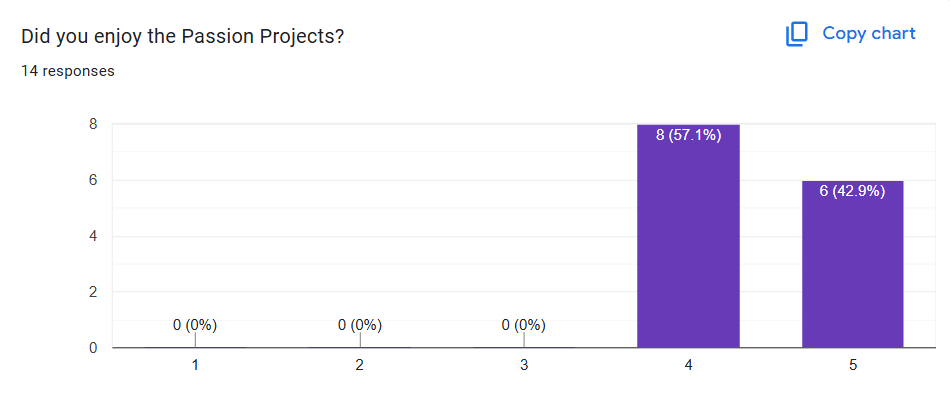
Some of their reasons for giving this response include:

4: “Because it was a fun challenge to set on us, only that it was stressful from the lack of time and the amount of days being taken off.”

4: “It was a good experience and I learnt a lot but it was limited time so it was hard to fully achieve the project.”

4: “Because it was fun and exciting but i probably could of achieved more if I had more help from other faculties”

4: “I chose four because it was a fun experienc but I wish we had more help from faculty’s to assist in the passion project.”

5: “It was fun to do a project that i want to do, because most projects given by teachers have set requirements and set information”

5: “I got to study and make something of my own passion and imagination.”

Lack of time and lack of help from other faculties are two things we could potentially look at improving in future.

I also asked students what they found easy and what they found most difficult while completing their projects. Most students said that the brainstorming and creating stages were the easiest, while planning, researching, and completing the projects within the time frame were cited as the most difficult parts of the program. This is in-line with the research on inquiry learning, so no surprises here!

The students were very keen to give feedback for their favourite parts of the program, stating that they enjoying learning about topics of their own choosing, being able to work with friends, creating their projects, and working with staff to complete their projects.

When asked to describe the Passion Projects, students gave the following responses:

Its was interesting and a fun opertunity
Fun cool and different
Wonderful, a Project that put our minds to the limit and trying to make the best project to impress possible.
A good opportunity to learn more about things you like.
Engaging
Fun, exciting and it’s good if you have passions that you want to explore
The passion project was an amazing fun enrichment program that allows students to embrace there passions to the best of their abilities through the school. The passion project gives opportunities to students that they usually wouldn’t get.
A program that helps students talents flower
Fun, thinking out side of the box, doing what you like
Fun, engaging, creative thinking, thinking outside the box, any thing you want to do.
Fun and challenging
A fun, exciting week of education, brainstorming and imagination.
I would describe it as an opportunity to share each others passions and imaginations together.
A place where you can help improve your talents and passions. A fun safe place

100% of students wanted to participate in the program if it gets to run again in future. When asked what we could do in the future to improve the program, the consensus was overwhelmingly focused on:

  1. Giving more time
  2. Getting more staff involvement from different faculties

Future Directions

Overall, despite some challenges I feel that the Passion Project program was largely a success. In future I’d love to incorporate some of the feedback from the students to improve, in particular around giving more time and getting more involvement from different staff.

In future, I’d love to expand this program to run one for each year group from years 7-10. However, I’ll have to be mindful of the work involved in supervising, since expanding the program to four year groups would mean at least 5 weeks of full time supervision, which would impact my ability to run the Wide Reading Programs, library break activities, and complete library management tasks such as ordering, accessioning, stocktake and shelf stricting. One solution would potentially be to run one year group each term, though this would be difficult due to the fact the library is often used for exams like the Year 12 Trials and NAPLAN. Another potential solution would be to utilise other staff, thus implementing one of the requests from this year’s students; however, this creates another challenge around funding of their release time.

I’d also love to incorporate the Informtion Fluency Framework into this project to track how our students are developing their information fluency across stages 4 and 5. We can then use this information, as well as our observations from their participation and their assessment results to create Individual Education Plans (IEPs) for our HPGE students. The original nomination form was designed to assist with this, so now that I’ve seen these kids in action I should be able to use this as another assessment tool to help formulate these IEPs. As a school we spend a lot of time writing plans to support our students with learning difficulties, and I think that our HPGE students (some of who are twice exceptional with additional diagnoses such as Autism or dyslexia) would benefit immensely from similar levels of support.

Finally, in future I’d love to acknowledge these students publicly for their participation on the program. Not only does this allow the students to see their contributions and skills as valued, but it also builds a culture of achievement amongst the school where it isn’t seen as a shameful thing to be a high achiever.

Not only did this Passion Project program allow our HPGE students an opportunity to deepen their knowledge and skills in an area of personal interest, but it allowed us to meet their unique learning needs and validate their experiences as HPGE students. It also allowed me to advocate for the library and my role as a leader in inquiry learning to our school community. It was a lot of work but totally worth it!

PDP Half-Yearly Reflection 2025

This has been an absolutely crazy busy term so I’ve been a bit lax in posting updates to this blog. It’s a bit late, but here’s my half-yearly reflection for my PDP.

Goal 1: Library Strategic Plan

This year I will raise the perceived status, professionalism and value of the school library by ensuring its effective management. I will do this by building on the needs assessment conducted in 2024 and by creating a strategic plan by the end of term 3. This strategic plan will be broken into 1, 3, and 5 year goals which support the SEP with regular reflection periods. I will continue to engage with the wider teacher-librarian community throughout this process through membership of key professional bodies and through regular reflection on my blog.

This year I’ve been working on creating a strategic plan for the library. It’s been difficult to find the time in amidst the chaos of the school day, but I’ve managed to create a draft including a variety of goals for various elements of library administration and to support the school plan. I’m waiting for my superviser to meet with me to refine the plan and narrow down my goals but here’s what I’ve created so far.

MISSION STATEMENT: The Elderslie High School library aims to be the heart of our school community, creating a vibrant learning environment and safe space which fosters the creativity, collaboration, critical thinking, and communication skills of its students and staff to empower them to be their best selves.

VISION STATEMENT: The Elderslie High School library envisions a future where every student is an empowered, curious, and informed learner. We aspire to be a hub of innovation, inclusivity, and inspiration – a place where reading is celebrated, knowledge is shared, and all members of our community feel supported in discovering their passions, expanding their thinking, and shaping a better world.

FOCUS AREA2026
1 year goal
2028
3 year goal
2030
5 year goal
Strategic Direction 1: Student growth and attainment
A. Information literacy and study skillsProvide targeted research lessons to Stage 6 HSIE subjects
– Ancient History
– Modern History
– Society and Culture
– History Extension

Update Senior Reference collection to be relevant to new syllabi
Increase number of  Stage 6 research lessons to other KLAs e.g.CAFSMusic


Expand research lessons to Stage 5 HSIE
Embed information literacy into Stage 4 programs across KLAs 

Include at least one regular, term-wide Inquiry Unit in a KLA’s program

Present to Year 12 Elevate
B. Reading for pleasure: WRP

Trial use of student initial survey data to select 3 students to help achieve their goals

Create a series of measurable outcomes

Create distinctive Year 7 and 8 activities


Expand use of student initial survey data to help students achieve their goals 

Incorporate Goodreads as social element to Wide Reading Program

Establish connections with local libraries, booksellers, author talks
C. Reading for pleasure: PromotionTeachers Favourite Books display

Post student reviews and shelf talkers
Improve recommendation process:
– On blog
– Through flicker books
– Via posters
Reading medals and Legacy trophy for top readers
D. HPGEIntroduce Passion Projects for identified Stage 4

Introduce Writing Club
Publish all HSC Major works in a school-based journal publicationCommunity of Schools – connections with primary libraries
E. Supporting staffForm positive connections with pre-service teachers as Placement Coordinator

Present library resources and services to new and early career staff 

Increase promotion of resources and services to staff via:
– Sentral posts
– Monthly email updates
– Show and tells at staff/faculty meetings
Build up, promote Teacher Reference collection

Run PD to all staff on:
-How to make library bookings
– Accessing the ecatalogue
Run targeted workshops designed to upskill staff in information literacy
Strategic Direction 2 Enhancing WellbeingHost regular Nerdvana Days (once per term)Re-establish library competitionsCreate a Library committee to assist with policy creation, resource purchase + promotion, social events, design of space, competitions
Collection Development and Maintenance
A. Stocktake and weedingConduct a yearly stocktake rotating through collectionsAdd PRC stickers to all PRC books

Remove outdated audiovisual resources
Have the average year of publication to within 10 years
B. Catalogue recordsFix up catalogue issues with books in cupboardSemi-genrefy fiction collection, beginning with Romance and Horror/MysteryGenrefication of entire fiction collection
C. Resource managementIncorporate consistent reshelving, stricting of collections

Increase frequency and streamline processes around reservations
Improve signage for all collectionsOrganise cupboards under the stairs
D. Virtual libraryFix library page on existing EHS websiteCreate library website to expand online presence and increase accessibility to resourcesCreate dedicated library instagram
Operations folderCreate a Role Statement

Create a Collection Development Policy
Create processes and procedures for:
– Ordering
– Processing books
– Loans and reservations
Create a:
– Copyright policy
– Challenge policy
– ICTpolicy
– Privacy and security policy 

Goal 2: HPGE Committee

This year I will support the diverse needs of our students by working to reintroduce school-wide initiatives to develop the capacity of our High Potential and Gifted students. I will do this through membership of the Engaged Students for Learning committee. This support could include initiatives such as Tournament of Minds participation, passion projects, or Guided Inquiry units. I will also engage with research in this area to ensure that our initiatives are evidence-based. I will record this progress and reflect on my professional practice through regular blog posts, ensuring my continuing contributions to professional practice in the wider teacher-librarian community.

My progress towards this goal has been slowed by the fact that we only have committee meetings twice a term, and unfortunately I was away for one of the days. However, I’ve been working closely with the Head Teacher responsible for the HPGE committee to organise a trial of the Passion Projects in Term 4. I’ve put a call out to staff to nominate students they think would be suitable for the program and will examine their nominations next term to come up with my final list of participants.

I also supported the Camden Cup incursion, where a variety of local primary and high schools sent teams of 4 students to complete a variety of challenges. The first part of the day saw pairs race against the clock to complete as many short term challenges as they could, and the second part of the day saw them working in mixed teams to design and build a game. It was a fantastic day and amazing to see so many HPGE kids extending themselves, making new connections with likeminded students, and intrinsically motivating themselves to complete the set challenges.

Goal 3: Wide Reading Program

This year I will forge strong connections between the library, teaching staff and students by continuing to support the implementation of the new English syllabus. I will achieve this by supporting the development of Stage 4 students’ literacy through the Wide Reading Program. I will formulate a teaching and learning program for this activity to ensure consistency and strong curriculum links. To ensure best practice, I will continue to participate in the wider teacher-librarian community by engaging with new research into reading for pleasure and information and through regular reflection on my professional blog.

This year I’ve been working in my limited planning periods to consolidate and refine the Wide Reading Program lesson sequence. Originally I had 5 lessons planned for each term, but due to the number of interruptions to the program I’ve cut this back to 3.

Term 1: Orientation and Reading Behaviours

  1. How can the library help you?
  2. Why do we read?
  3. What are the benefits of reading?

Term 2: Reader Identity

  1. Who is a reader?
  2. What counts as reading behaviour?
  3. What sort of reader and I?

Term 3: Barriers to Reading

  1. What barriers prevent us from reading? How do we overcome them?
  2. How do we find the right book?
  3. How do my experiences compare with other reading experiences?

Term 4: Social and Deep Reading

  1. How can reading be a social activity?
  2. How can we improve our reading stamina and frequency?
  3. How can we get the most out of our reading experiences?

Becoming a Better Version of My Professional Self: PDP 2025

Each year, NSW Department of Education employees are required to formulate a Professional Development Plan where we aim to achieve between 3-5 goals which will improve our professional practice. Our school encourages us to have one goal for ourselves, one for our faculty and one for a whole-school initiative.

This year, I’ve chosen the following goals to work towards. These goals are similar to the ones I worked towards last year, but due to a variety of factors largely out of my control I was not able to achieve them effectively.

Goal 1: Library Strategic Plan

This year I will raise the perceived status, professionalism and value of the school library by ensuring its effective management. I will do this by building on the needs assessment conducted in 2024 and by creating a strategic plan by the end of term 3. This strategic plan will be broken into 1, 3, and 5 year goals which support the SEP with regular reflection periods. I will continue to engage with the wider teacher-librarian community throughout this process through membership of key professional bodies and through regular reflection on my blog.

Goal 2: High Potential, Gifted Education Committee

This year I will support the diverse needs of our students by working to reintroduce school-wide initiatives to develop the capacity of our High Potential and Gifted students. I will do this through membership of the Engaged Students for Learning committee. This support could include initiatives such as Tournament of Minds participation, passion projects, or Guided Inquiry units. I will also engage with research in this area to ensure that our initiatives are evidence-based. I will record this progress and reflect on my professional practice through regular blog posts, ensuring my continuing contributions to professional practice in the wider teacher-librarian community.

Goal 3: Wide Reading Program

This year I will forge strong connections between the library, teaching staff and students by continuing to support the implementation of the new English syllabus. I will achieve this by supporting the development of Stage 4 students’ literacy through the Wide Reading Program. I will formulate a teaching and learning program for this activity to ensure consistency and strong curriculum links. To ensure best practice, I will continue to participate in the wider teacher-librarian community by engaging with new research into reading for pleasure and information and through regular reflection on my professional blog.

Strategic Planning for Library Success: Using AI to Get My Head Around the Process

This year one of the goals on my Professional Development Plan (PDP) was to raise the perceived status, professionalism, and value of the school library by creating a strategic plan with 1, 3, and 5 year goals which align with my school’s broader Strategic Improvement Plan (SIP). This is a complex task which requires a significant investment of both time and mental energy. Since I’m currently still off work due to my aforementioned kneecap dislocation I figured that there’s no time like the present to get started on this gargantuan mission.

My first port of call was to investigate the process of creating a strategic plan, and to do this I revisited the ETL504 Teacher Librarian as Leader readings. After re-examining my notes I decided to run them through ChatGPT to create a simplified summary of the process:

1. Preparation and Planning

A. Form a Planning Committee

  • Include diverse stakeholders: librarians, teachers, administrators, students, and parents.
  • Define roles and responsibilities.

B. Conduct a Needs Assessment

  • Survey students, staff, and parents to gather input on current library services and desired improvements.
  • Analyze usage data (e.g., check-out statistics, digital resource usage).
  • Review current library policies, resources, and programs.

C. Set Clear Objectives

  • Define the purpose and goals of the strategic plan.
  • Ensure alignment with the school’s overall mission and educational goals.

2. Environmental Scan

A. Internal Analysis

  • Evaluate current library resources, staff capabilities, and technology.
  • Assess the library’s strengths, weaknesses, opportunities, and threats (SWOT analysis).

B. External Analysis

  • Examine trends in education, technology, and library services.
  • Identify potential partners and resources in the community.

3. Developing the Strategic Plan

A. Vision and Mission Statements

  • Craft or revise the library’s vision and mission statements to reflect long-term goals and core values.

B. Strategic Goals and Objectives

  • Set specific, measurable, achievable, relevant, and time-bound (SMART) goals.
  • Focus on areas such as resource acquisition, technology integration, literacy programs, staff development, and community engagement.

C. Action Plans

  • Outline specific actions needed to achieve each strategic goal.
  • Assign responsibilities and set deadlines.

4. Implementation

A. Develop a Timeline

  • Create a detailed timeline for implementing each action plan.
  • Prioritize tasks based on importance and feasibility.

B. Allocate Resources

  • Budget for necessary resources, including materials, technology, and professional development.
  • Seek funding opportunities through grants, donations, and partnerships.

C. Communication

  • Communicate the plan to all stakeholders.
  • Use various platforms (meetings, newsletters, website) to keep the school community informed.

5. Evaluation and Adjustment

A. Monitoring Progress

  • Establish key performance indicators (KPIs) to measure progress toward goals.
  • Regularly review and assess the implementation process.

B. Feedback Mechanism

  • Collect ongoing feedback from users and staff.
  • Adjust the plan as needed based on feedback and changing circumstances.

C. Reporting

  • Provide regular updates to stakeholders on the progress and outcomes.
  • Celebrate successes and acknowledge contributions.

This will be my guide for the next few weeks as I move through the strategic planning process. Already there are some roadblocks arising from the fact that I’m working from home and not on site, such as the difficulty in forming a library committee of interested stakeholders or conducting an environmental scan of the library space. However, one piece of research I found in this initial exploratory stage of my investigation argues that strategic plans are vitally important for a variety of reasons:

  • To develop a flexible roadmap to guide the library’s strategic priorities
  • To clarify your library’s purpose 
  • To set strategic priorities and initiatives 
  • To tailor services to meet the specific needs of your community 
  • To cultivate devoted and enthusiastic champions for your library 
  • To inform resource allocation and where to focus efforts 
  • Use the plan for fundraising, community relations, and attracting employees

I therefore need to do what I can to the best of my ability and try not to worry about the things I can’t control! And now that I have a plan to make my plan, all I have to do is … plan!

Term 1 2024 Reflections

Term 1 for 2024 has wrapped up, so it’s a good time to pause and reflect on my practice so far this year.

Supporting Teaching and Learning

Supporting teaching and learning across the school is a vital aspect of the teacher-librarian’s role and helps us showcase our value to our colleagues. During Term 1 I was able to display this in four key ways: first, through supporting the NAPLAN testing running in the library; second, through supporting the ongoing programming, implementation, and resourcing of the new 7-10 English syllabus; third, through the provision of one-on-one senior mentoring and assessment assistance; and fourth, through the expansion of the Teacher Reference collection.

However, reflecting on my practice in this area reveals that there’s more I could be doing to support teaching and learning across other curriculum areas, especially if I wish to raise the library’s profile amongst the teaching staff. I have recently conducted a significant weeding of our non-fiction resources, so could restock this collection with more relevant, updated texts to support current teaching units across the school. At the moment my information literacy and research skill lessons are one-off bookings, so I could also approach different faculties to embed these skills into their assessment tasks, or create pathfinders to support staff as they guide students through the research process.

I’ve previously put out surveys to my colleagues asking for feedback on what they teach and what resources they’d like to see from me, as well as asked staff to send me their assessment notifications so I can support their faculties with informative displays and assessment help. However, staff responses are always limited, revealing that when teachers are under the pump and feeling the pressure of heavy workloads they’re unlikely to prioritise such surveys even if they see their value. It therefore might be more effective to visit different staffrooms in person, either by attending different faculty meetings or by booking in time with each Head Teacher to see how best I can support the teaching and learning in their specific curriculum areas. I could also use this time to promote our Teacher Reference section, which isn’t getting much love from our time-poor staff.

Action moving forward: Speak with Head Teachers in person to determine how I can support teaching and learning in their faculties.

Developing a Whole-School Reading Culture

As I’ve discussed previously, some of my colleagues and I are in the early stages of planning a new whole-school reading culture initiative. We’ve made some small progress in this space over the last term and have begun putting together a strategic proposal (inspired by the work I completed during my degree) which we plan to eventually present to the Senior Executives at our school. One of the teachers has also taken the initiative to create a ‘Current Reads’ poster for the English staffroom windows which has already launched several conversations with students about reading for pleasure.

Action moving forward: Collaboratively develop the reading culture initiative proposal.

On my end, I’ve been working on developing a culture of pleasure reading in a number of different ways. This term I’ve been working on developing the Wide Reading Program for years 7 and 8, with all classes bar one participating. As always seems to be the case, these lessons experienced significant interruptions in Term 1, with 51% of lessons needing to be cancelled because of other programs using the library space, staff illness, public holidays, and other whole-school events. As a result, four of the ten participating classes have less than 50% program attendance, with two of those classes having had only one lesson to access the library and its resources.

To ameliorate the impacts of my absences when I was sick, I supported the classroom teachers in running the program themselves by providing the lesson materials. However, staff feedback suggests that the program runs best when I’m at the helm, reinforcing the value of a trained teacher-librarian’s expertise and skill in spreading a passion for reading!

Student feedback so far this term has also been positive. I’ve placed a significant emphasis on trying to build excitement around reading and on highlighting different reading behaviours in an attempt to get students to self-identify as readers. As such, we’ve played a variety of games such as Never Have I Ever and an adapted mad-libs game inspired by Cards Against Humanity which I’m calling Books Against Humanity. In this game students must obtain a variety of quotes from the book they’re reading and in small teams choose the best quote to complete the prompt I give them. There were a lot of laughs at this one, and it was great to see even reluctant readers engage with the task!

In large part due to the Wide Reading Program, our loans stats are strong so far this term. While this is not a hard and fast indication of reading culture, it does give some indication regarding the number of books ending up in student (and staff) hands. During Term 1 we loaned out 1140 resources from our physical and digital collections, surpassing the total loans for some previous years in their entirety. However, this is compared to the 1250 resources we loaned during the same time last year; the down-turn is due in part to falling student enrolments, the number of interruptions leading to the library’s closure, as well as a decrease in digital loans from our virtual library. Another pertinent fact emerging from this data is the increasing popularity of our magazines, with 31 loaned this term compared to only 2 in the same time last year.

Another way I’m trying to build a reading culture is by celebrating reading achievements in our school. I’m updating our Readerboard every month to show the students with the highest number of loans, and giving these students both merit certificates and house points in their roll calls to visibly highlight their achievement and show that we value reading. I’m also in the early stages of planning a celebratory afternoon for the students who finished the Premier’s Reading Challenge last year – they’ve chosen a movie afternoon as their reward, so hopefully other students will see their reward and want to get in on the action too! Another way I can increase participation is by embedding the challenge into the Wide Reading Program through read-alouds, book talks and activities such as the CBCA Shadow Judging.

Action moving forward: Embed PRC resources into the Wide Reading Program and continue developing activities to develop enthusiasm around reading.

Fostering Positive Wellbeing

Our school’s strategic plan has a strong focus on wellbeing; this is therefore an area where I can support the school community while advocating for the value of the library. I recently bought some of Margaret Merga’s books on this topic and intend to add them to our Teacher Reference collection, and can’t wait to read them to gain some more ideas on how to be active in this space.

So far this year, I’ve continued to support social-emotional learning through the provision of social clubs during the breaks. I’ve encouraged students to form their own clubs with my support, and as a result we’ve now added a Trading Card Game Day and Origami Club into our schedule, alongside our regular offerings of the Nintendo Switch Club and Dungeons and Dragons. While the Nerdvana Day didn’t get off the ground this term due to time constraints, this has previously been a great success with students and I will endeavour to make it a priority in Term 2. I have also discussed the possibility of a Year 12 Reading Retreat during their Trial exams to help them relax during this otherwise stressful period.

Action moving forward: Organise the Nerdvana Day and Year 12 Reading Retreat in Term 2.

These clubs and activities have had a significant impact on our daily visitor numbers, with an average 138 students visiting each break. Our biggest day was a whopping 334 students! While these increased visitor numbers contribute to a lot of noise and chaos in the library, they also represent an opportunity for students to be exposed to the reading culture I’m attempting to build, with several students who wouldn’t normally identify as readers borrowing books that they wouldn’t have come into contact with had they not been in the library space. However, the data suggests that our daily visitors and loans were trending down towards the end of term; this is no doubt due to the number of interruptions affecting the library’s ability to open in those later weeks, such as the fact that I’m not replaced when I’m absent. Ensuring continued access to the space is therefore an area for improvement in future.

Action moving forward: Advocate for the library space to be covered like any other playground duty in my absence.

Our Library Monitor program is also expanding, with several students approaching me throughout the term asking if they can join the program. Early in Term 2 I will incorporate these new students into the program and develop their skills as junior librarians in training. Their assistance is vital in helping maintain the library collections, especially as our loans increase.

Action moving forward: Train the incoming library monitors.

Maintaining Effective, Relevant Collections

Collection management is one of the biggest, most underappreciated aspects of our role as teacher-librarians, largely because so much of it is done behind the scenes and is therefore invisible to the majority of our school community. We’ve had an influx of student requests, so in addition to my plans to replace many of the outdated resources weeded over the last few years I’ve had to dedicate a significant portion of my budget to fulfilling these requests. As a result, there’s not a huge amount of money left for future purchases! A more balanced allocation of funds might be prudent in future years. However, one benefit of ordering so much so early in the year has been that we are getting a steady arrival of new resources to process in our systems as stock becomes available. This will hopefully allow us to spread out the accessioning process and reduce the number of orders we need to chase up at the end of the year.

Over the past few years I’ve invested a significant amount of time in updating our collection to ensure it’s relevant to the learning and recreational needs of our school community. When I first started, the fiction and non-fiction collections hadn’t been weeded for several years and the median date of publication was 1981. Last year our average date of publication was 2006, and I’m happy to report that due to my efforts last term this date is now 2010, while our median date is now 1995. While this is still not as up-to-date as I’d like, it’s a significant improvement.

I’m also in the process of cleaning up our catalogue and moving some items to locations where our students and staff are more likely to find them. I’ve set myself the goal of cleaning up 10 catalogue records a day, and while this isn’t always achievable it has made a significant impact on the number of resources with outdated or incorrect catalogue metadata.

Action moving forward: Complete catalogue clean-up.

Progressing with my Professional Development Plan

In NSW Department of Education schools, we are required to have a Professional Development Plan (PDP). This year I’ve set myself three somewhat ambitious goals.

Goal 1: To raise the perceived status, professionalism and value of the school library by ensuring its effective management. This will be achieved by conducting a needs assessment and creating a strategic plan aligned to the school’s Strategic Improvment Plan by the end of Term 3.

This is a huge goal with multiple steps, which is why I’ve set its completion at the end of Term 3. This term I asked for planning time and was knocked back, so have asked for time again in Term 2. I’ve submitted a proposal through my Head Teacher for this planning time to be during the HSC Trial exam period when the library would normally be closed; hopefully my line managers will see the value of this goal and understand my attempts to support the school while minimising disruption.

Action moving forward: Gain approval for planning time in week 9.

Goal 2: To support the diverse needs of our students by working with the Engaged Students for Learning committee to reintroduce a school-wide High Potential and Gifted (HPGE) education initiative.

This is another area where I’ve sadly made limited progress, largely due to the restrictive nature of our committee meeting schedule which has meant we’ve only had one official meeting last term. We were supposed to deliver a presentation during a staff meeting on how to identify and support HPG students, but beyond informal conversations with staff there’s been no movement in this space for me yet.

Action moving forward: Conduct an evaluation of existing HPGE activities with the committee.

Goal 3: To forge strong connections between the library, teaching staff and students by supporting the implementation of the new English syllabus through the expansion of the Wide Reading Program and engagement with research into reading for pleasure and for information.

I feel that this is one area where I have successfully achieved my professional goal. The new English syllabus explicitly references reading for pleasure and our English faculty has embedded the Wide Reading Program into their units as a result of my continued advocacy over the past two years. I’ve also posted previously about my research into reading for pleasure, though more could be done in the information literacy space.

Action moving forward: Continue research into reading for pleasure and information; continue using data and feedback from students and staff to plan engaging activities which provide access and time for self-selected, socially supported reading with the Wide Reading Program.