One of my professional goals this year was to ensure the ongoing success of the library by creating a strategic plan to guide our operations over the next few years. While I’m a little behind schedule, I’ve finally managed to conduct a SWOT analysis with my lovely library assistant. This was something I’d initially been introduced to during the ETL504 Teacher-Librarian as Leader unit, but not something I felt particularly confident completing without a bit of guidance. I therefore created a planning sheet based on some questions I’d found online and took about half an hour to consider our strengths, weaknesses, opportunities and threats.
This year I signed up to be part of the ALIA Mentoring Scheme (which is free for members) and I’ve got another meeting this Wednesday with my mentor where I’ll go through this in further detail. I still need to add specific elements from the staff feedback I analysed earlier in the year, but this is a great starting place for me to consider our plan of action moving forward.
A few weeks ago I gave staff a survey to assess what they want out of their school library. I had 21 responses which, while not representative of the entire staff body, is more than I expected given the chaotic nature of Term 2. It took a while, but I’ve finally analysed their responses and identified several actions I can take moving forward to ensure that the library is effectively supporting teaching and learning.
Library Usage
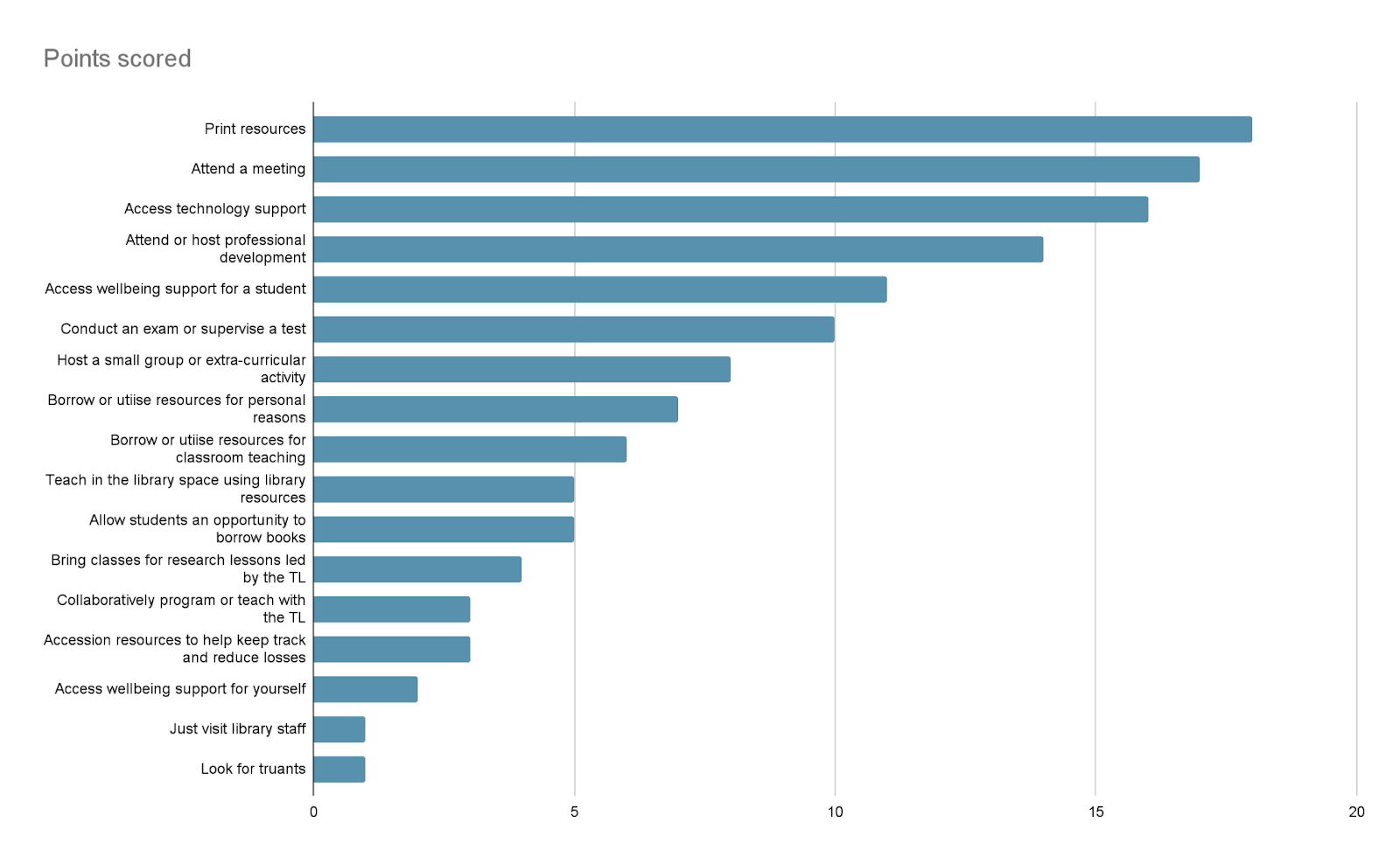
Usage from most to least common activities (compulsory question)
This data suggests that the most common ways the library is used are:
For printing (85%) and technology support (76%)
As a spare space for activities (66% and 38%), meetings (80%), and exams (47%)
To access wellbeing (52% for a student, 9% for staff)
Disappointingly, activities utilising the library resources or teacher-librarian’s expertise are not currently as popular. However, the most commonly used aspects of the library requiring the teacher-librarian’s expertise are:
Borrowing for personal reasons, classroom teaching, students (33%, 28%, 23% respectively) – requires the TL’s expertise in collection development
Using the library space with its resources for teaching (23%) – requires the TL’s expertise in collection development and space management
Research lessons led by the teacher-librarian (19%) – requires the TL’s expertise in information fluency
Collaboratively programming or teaching with the teacher-librarian (14%) – requires the TL’s leadership skills and expertise in reading for information and pleasure
Accessioning faculty resources (14%) – requires the SAO’s expertise in collection management
I’d be very interested to know how many teachers of Stage 4 English responded to this survey, since I teach 10 of the 11 classes for year 7 and 8. If these teachers didn’t respond to the survey, then that could explain the low numbers for responses around reading for pleasure and collaborative teaching.
Moving forward:
Ideally, the aspects of the library requiring teacher-librarian expertise should be developed over the next few years to ensure greater value from this role for the school community. This requires active promotion from the TL about their services and developing relationships, especially with new staff, to ensure all staff are aware of what the library offers them.
Barriers to staff usage
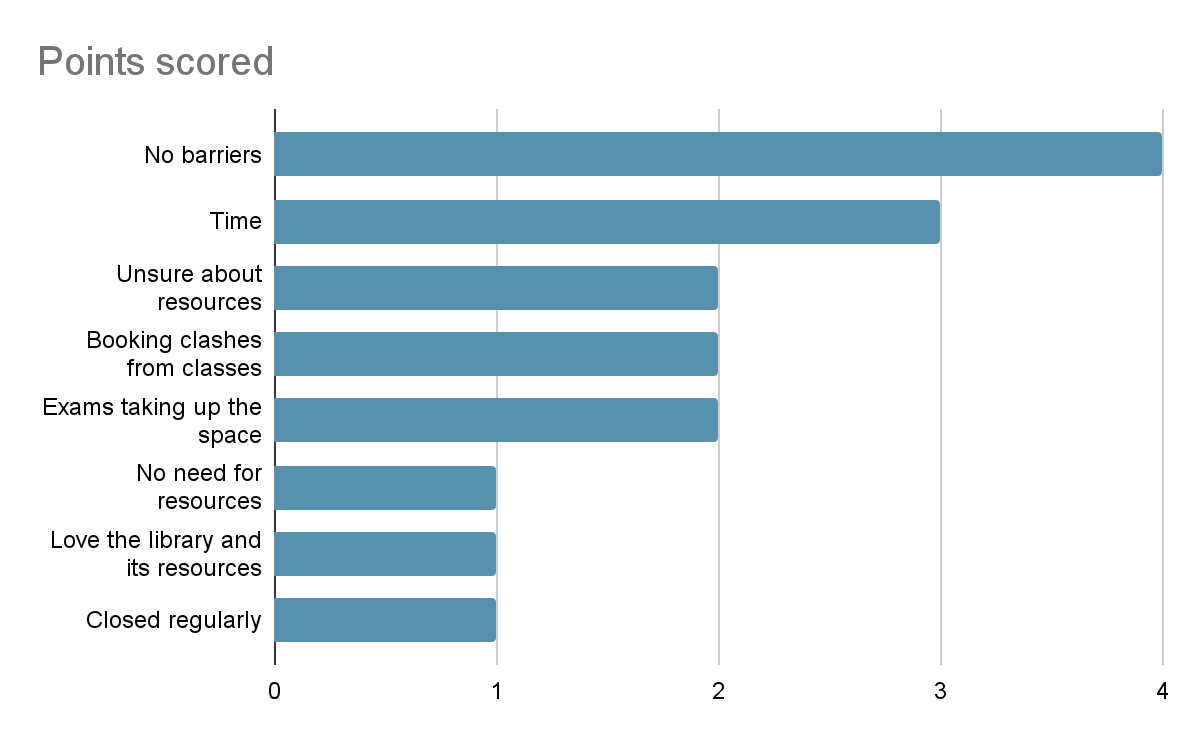
Responses to this voluntary question varied. Most respondents stated they had no barriers, but the most common barriers responders when mentioned were:
Time
Being unsure about the resources
Being unable to access the space due to other classes, exams, or unspecified closures
Moving forward:
While the TL can do little about the time constraints facing staff, it is possible for the TL to better educate staff about the resources available, including professional development on how to make bookings and access the ecatalogue, as well as promotion of resources to support faculty teaching and learning. The teacher-librarian could also use these responses from staff to advocate for an end to whole year exams closing the library for several weeks at a time.
Resource and Curriculum Support Evaluation
Evaluating library resources
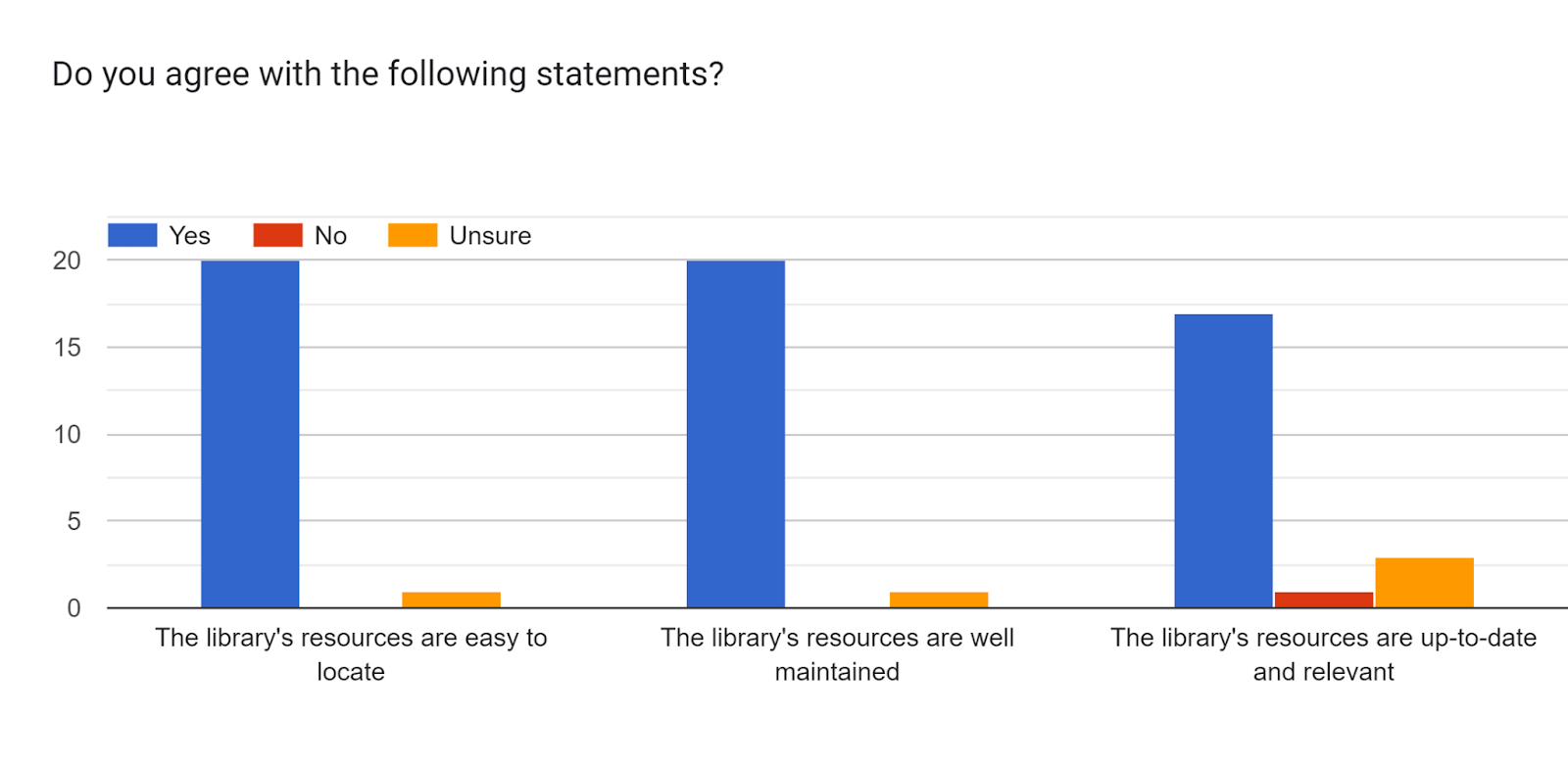
Overall, the responses to this question revealed that staff were satisfied with the accessibility, maintenance, and currency of library resources. However, there was one respondent who felt the library resources were out of date or irrelevant, with 3 others unsure.
Moving forward:
Frequent promotion of library resources would help staff determine the relevance of library resources.
Requested resources
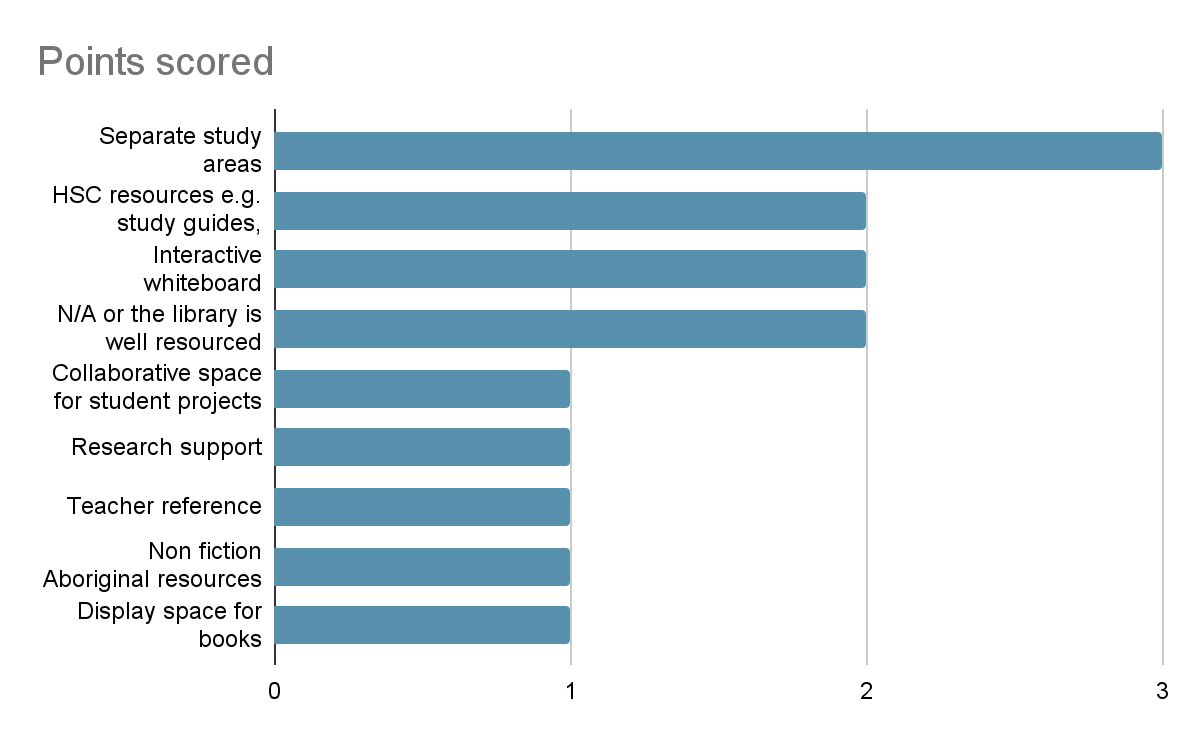
The most frequent request for this voluntary question was for separate study areas, especially for seniors. The next most popular requests were for HSC resources (including study guides, revision, past exams, ARC samples), and an interactive whiteboard.
Pleasingly, two respondents noted that there was nothing else they felt the library needed.
Moving forward:
It is entirely possible that the TV in the library is already an interactive whiteboard, and this will need to be investigated. Working with the secondary studies teacher, Teaching and Learning faculty, and First Nations co-ordinator, it should be possible to gain extra funds to better resource the existing HSC and Teacher Reference collections while improving the amount of First Nations non-fiction in our collection. Promotion of our existing First Nations non-fiction resources would also support staff in this area.
Separate student study areas – or walling off and staffing supervision of the senior study area during breaks – would be a long term project with significant benefits for the school community. This would also prevent noise from different areas of the library affecting other classes within the space during lesson time.
Collaborative projects for students to work on throughout the term have been trialled before and due to poor student discipline have not worked, though the Nintendo Switch club allows for some collaboration between students and might need to be promoted to staff to ensure they’re aware of this service.
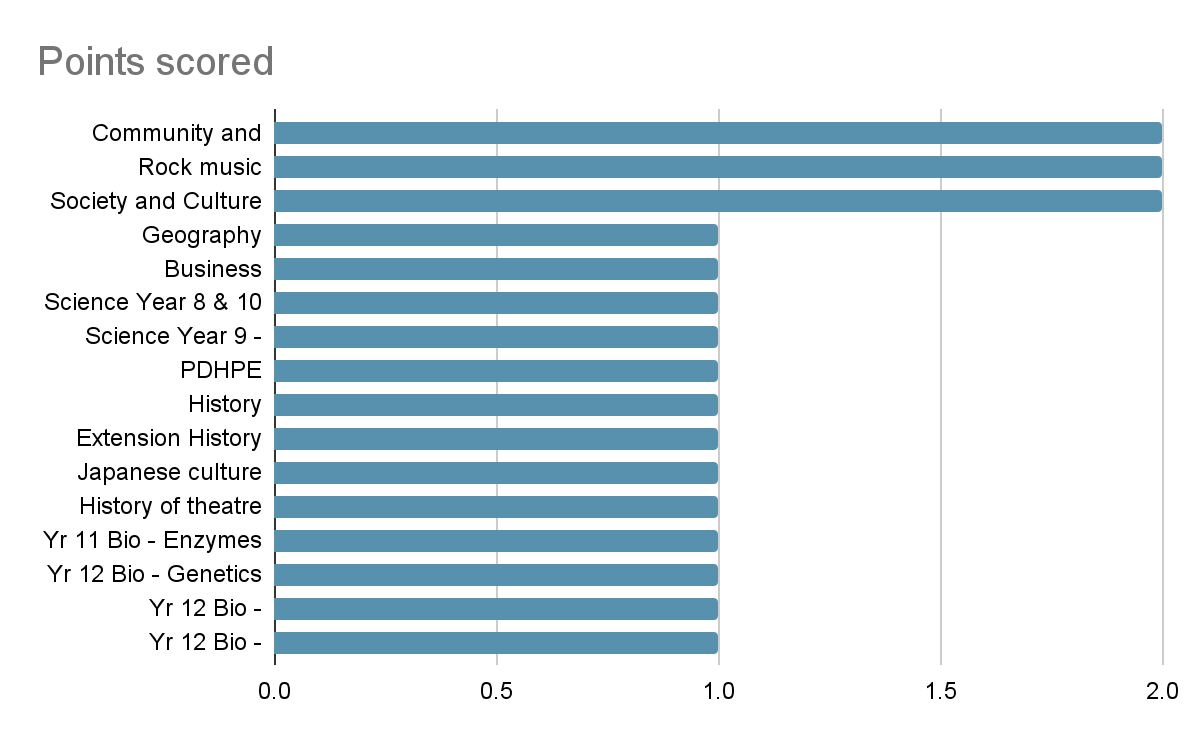
Subject area research tasks
Many staff provided their research topics for this voluntary question. Community and Family Studies, Music and Society and Culture were the most frequently cited subjects with research projects, especially in Stage 6. HSIE and Science also have a number of tasks requiring students to complete independent research. Disappointingly, one respondent did not give their topic but stated the task was “internet based”, revealing a lack of understanding about how modern school libraries can support teaching and learning beyond the provision of books.
Moving forward:
The introduction of several new Stage 6 syllabus documents provides an opportunity for the TL to support time-poor staff implementing research tasks. The TL should therefore reach out to specific faculty heads to ensure their subject areas are supported and resourced, and should promote their resources to staff.
It would be worthwhile investigating and trialling Learn Path as a way to support staff with their research tasks, and to show that the TL role is not limited to books.
It would also be worthwhile to showcase the Guided Inquiry unit taught with English to show staff other ways the TL can support their work as an information expert.
Syllabus changes
Staff identified that the following changes have taken place recently which will likely affect our need for updated resources:
PDHPE
CAFS
Dance and Drama texts
Senior Geography
Moving forward:
Money should be requested in the 2025-2027 budget submissions to account for these changing needs.
Supporting teaching
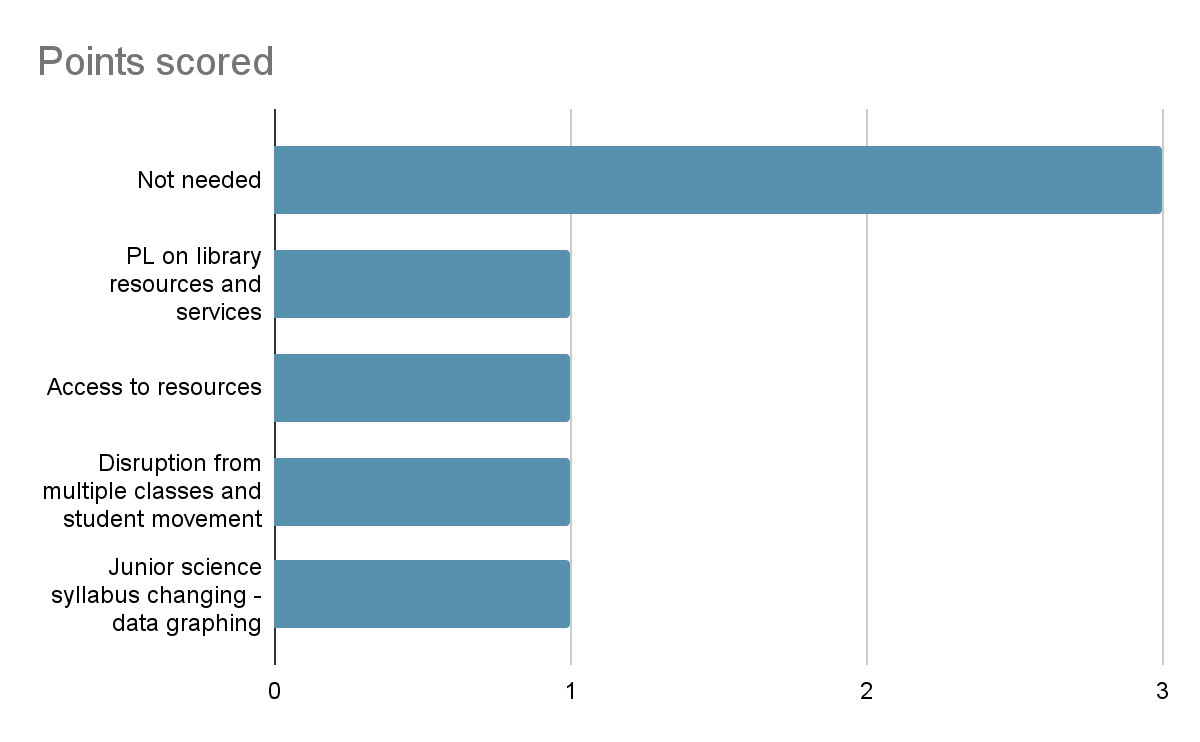
Pleasingly, most staff who responded were happy with the way the library supports their teaching and had no further suggestions for improvement. Professional development on the library resources and services was again identified as a way for the TL to support teachers, as was increased access to the resources. The “chaotic” nature of the library was referenced by one respondent who attributed this to “constant turnaround and movement due to learning support and private study”.
Moving forward:
The TL should make professional development and promotion of resources a high priority to ensure staff are aware of the library’s resources and services. Presenting at a staff meeting and/or visiting specific faculties would assist in this.
The aforementioned walling off of the senior study space would assist in reducing the chaotic feel of the library.
Services Evaluation
Useful services (compulsory question)
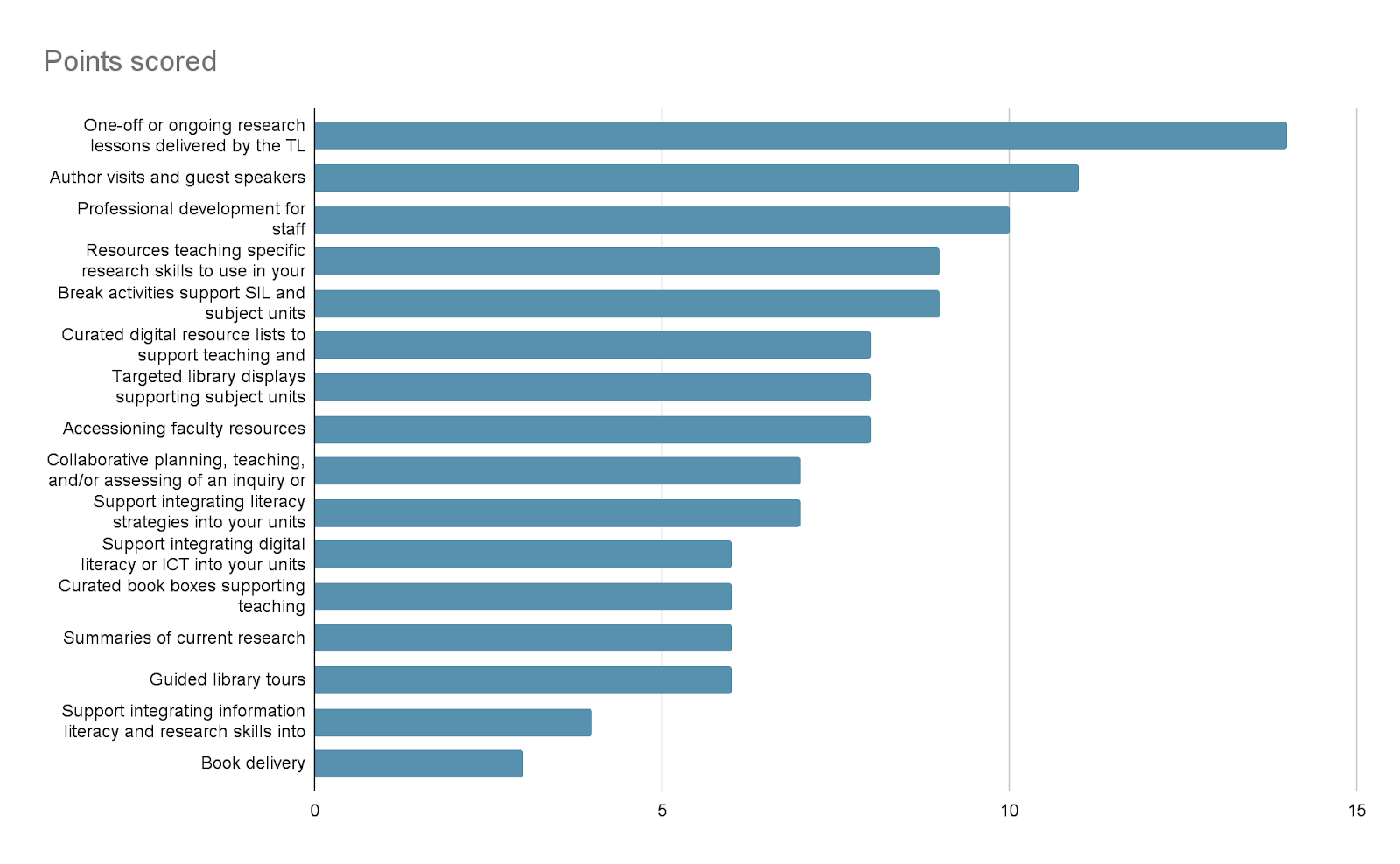
The breakdown of services identified as useful according to aspects of the TLs role is:
Taking advantage of the TL’s role as information fluency expert and curriculum support
One-off or ongoing research lessons (66%)
Research skill resources (42%)
Digital research pathfinders (38%)
Collaboratively planning, teaching, and/or assessing of an inquiry unit (33%)
Support integrating digital literacy or ICT into units (28%)
Support integrating information literacy and research skills into units (19%)
Taking advantage of the TL’s role as literacy leader and pleasure reading advocate
Author visits and guest speakers (52%)
Targeted library displays supporting subject units (38%)
Support integrating literacy strategies into units (33%)
Curated book boxes (28%)
Book deliveries (14%)
Taking advantage of the TL’s development of the library as a wellbeing space
Break activities to support social-emotional learning and subject units (42%)
Taking advantage of the TL’s skills in collection development and management
Accessioning faculty resources (38%)
Guided library tours (28%)
Taking advantage of the TL’s role as leader and innovative practicioner
Professional development for staff (47%)
Summaries of current research (28%)
The top 5 services respondents identified as being most useful to them are:
One-off or ongoing research lessons (66%)
Author visits and guest speakers (52%)
Professional development for staff (47%)
Research skill resources (42%)
Break activities to support social-emotional learning and subject units (42%)
These results reflect the varied nature of the TLs work and wide-ranging value to the school community.
Moving forward:
The strategic plan should prioritise the top 5 services identified by staff.
Overall Satisfaction
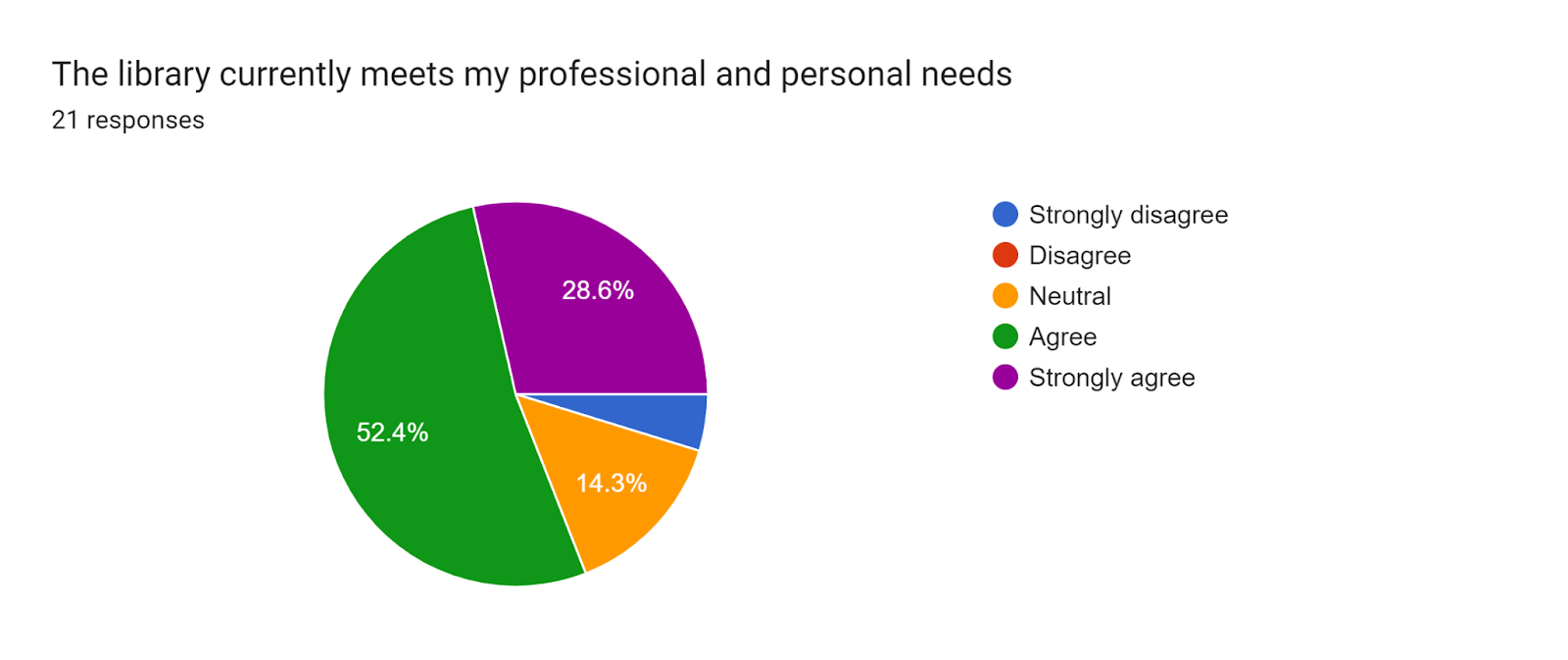
Library currently meets professional and personal needs (compulsory question)
Overall, staff appeared to be satisfied with the library. In total, 17 respondents (81%) identified that they either agreed or strongly agreed that the library meets both their professional and personal needs, while only one respondent strongly disagreed.
Moving forward:
Without knowing the specific individuals and reasons behind the ‘neutral’ and ‘strongly disagree’ categories, it is difficult to assess how to improve library services to ensure their needs are being met. In future surveys it might be beneficial to provide an opportunity for respondents to explain their answer. It is also possible that the person who selected ‘strongly disagree’ misread the options, since this was the first one presented.
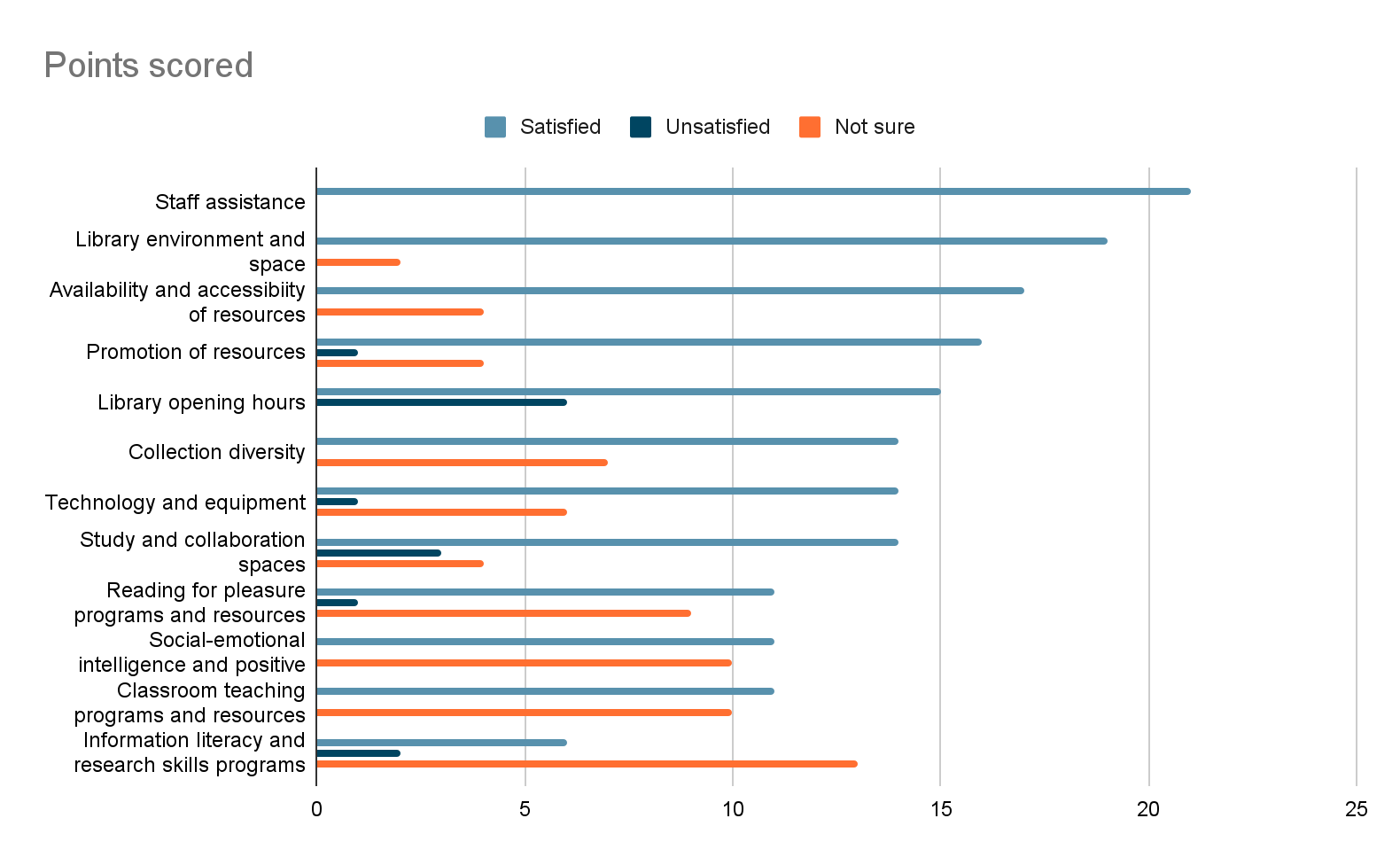
Satisfaction with the library resources and services (compulsory) question
The top elements of library operations staff were satisfied with are:
Staff assistance (100%)
Library environment and space (90%)
Availability and accessibility of resources (80%)
This reflects the hard work of library staff over the last few years in creating a welcoming, accessible environment. No respondents were unsatisfied with these elements, though some (10% and 20% respectively) were unsure about the space and accessibility of resources, indicating that they might not use the library frequently or that resources need greater promotion. Overall, over 50% of respondents were satisfied with all elements of the library, with the exception of information literacy and research skills programs and resources (28%).
The least satisfactory elements of library operations as identified by staff are:
Library opening hours (28%)
Study and collaboration spaces (14%)
Information literacy and research skills programs and resources (9%)
This reflects the fact that library opening hours are limited to break times only due to supervision issues, the lack of private study spaces, and a need for improved focus on information literacy.
Staff also identified several areas of library operations that they were unsure about, including:
Information literacy and research skills programs and resources (61%)
Social-emotional intelligence and positive wellbeing programs (47%)
Classroom teaching programs and resources (47%)
Reading for pleasure programs and resources (42%)
Collection diversity (33%)
This indicates that the library would benefit from greater promotion of its resources and services.
Moving forward:
To improve satisfaction with library opening hours, library staff should investigate the possibility of opening before and after school – this would require either additional staff on supervision or the provision of time-in-lieu for the supervising teacher-librarian.
To improve satisfaction with the limited study and collaboration spaces, library staff should investigate the possibility of walling off the senior study area and implementing a separate break supervision so senior students can utilise the space without disruption from the lower levels of the library.
To improve satisfaction with information literacy and research skills programs and resources, the teacher-librarian should work with specific faculties to support their research assessments and create resources to support the development of students’ information fluency which can be uploaded to Google Drive for staff to access and a centrally located library website for students to access.
Increased promotion of all resources and services would benefit library operations in future. This could take the form of a monthly newsletter emailed to all staff, Sentral posts highlighting new resources, show and tells at faculty or staff meetings. Further investigation needs to occur to ensure efficient communication to staff which doesn’t overwhelm or frustrate them by adding to their increasing workloads.
Additional feedback
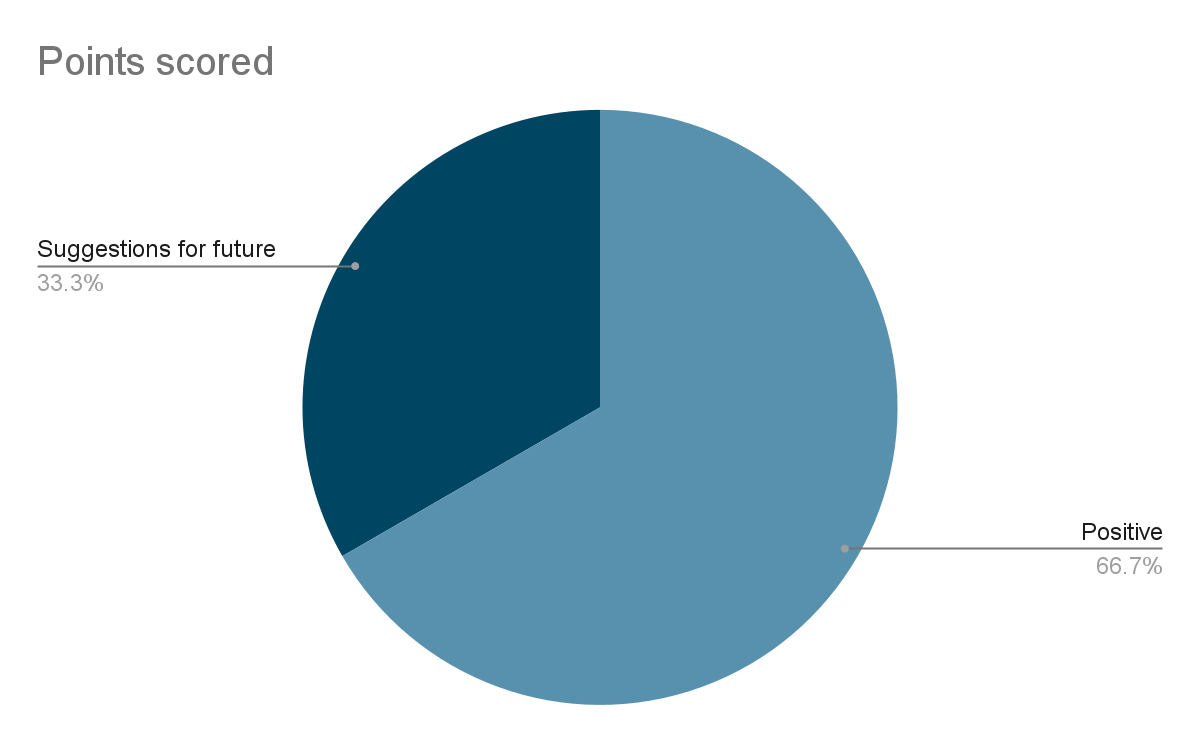
Nine of the 21 respondents chose to give additional feedback for this voluntary final question. Of these responses, 66% provided positive comments about how staff enjoy the library, while 33% provided practical suggestions for the future. Interestingly, all three suggestions revolved around opening hours and increasing student access to the library:
“It would be nice for the library to be open at 8 or 8:15 in term 2 and 3 for the students who get to school early and it’s cold in the mornings.”
“Maybe integrating a duty to support students printing in early mornings when assessments are due. Allowing quieter spaces/silent zones for senior study.”
“Library lunch times closed off for exclusive gamers, perhaps more supervision so library is open to all”
These suggestions reflect the value the library space and resources have for our school community, and the important role the teacher-librarian plays in providing this important ‘third space’.
Moving forward:
In order for the library to be open before and/or after school to provide a social space and access to resources such as printing, either additional supervision would have to be provided by another staff member or time-in-lieu provided to the teacher-librarian.
The library is currently only closed Friday at lunch for an exclusive gaming group – this is so participating students can eat while they play Dungeons and Dragons due to the 30 minute break limit and so that I can run a game. It is possible that this staff member misunderstood the social clubs schedule and believes that all breaks are only open to participants in these clubs; clearer promotional materials would clear this up. If it’s not a misunderstanding, then an additional playground duty would have to be created to ensure effective supervision while I run a game.
The need for a quiet study space for seniors was again raised, indicating the importance of walling off the senior study area and implementing a new supervision in this area.
As part of my strategic planning process, I have to conduct a needs assessment to see how the school library is currently viewed and used by my colleagues. As such, I created a survey using Google Forms with 11 questions focused on four areas:
general library usage
evaluation of resources and curriculum support
evaluation of services
overall satisfaction
Survey Questions
In the last 12 months have you used the library to (please select all that apply):*
Borrow or utilise resources for personal reasons
Borrow or utilise resources for your classroom teaching
Bring classes for research lessons led by the teacher-librarian
Teach in the library space using the library resources
Allow students an opportunity to borrow books
Collaboratively program or teach with the teacher-librarian
Accession resources to help keep track and reduce losses
Attend a meeting
Attend or host professional development
Host a small group or extra-curricular activity (including those run by external providers)
Conduct an exam or supervise a test (including NAPLAN, Check In, exam catch ups)
Print resources
Access technology support
Access wellbeing support for a student
Access wellbeing support for yourself
Other
What, if anything, stops you from using the library space, resources, and services?
Do you agree with the following statements? Yes/No/Unsure
The library’s resources are easy to locate
The library’s resources are well-maintained
The library’s resources are up-to-date and relevant
What resources would you like to see in the library?
Does your subject area have any research-based assessment tasks? If so, on what topics?
Has your senior syllabus changed in recent years? Do we need to update our senior study guides to reflect these changes?
How can the library better support your teaching?
Would you be interested in the following services offered by library staff (select all that apply)?*
One-off or ongoing research lessons delivered by the teacher-librarian
Resources teaching specific research skills to use in your classrooms
Collaborative planning, teaching and/or assessing of an Inquiry or Project Based Learning unit
Support integratign literacy strategies (e.g. Super Six, literary learning) into your units
Support integrating information literacy and research skills into your units
Support integrating digital literacy or ICT strategies into your units
Curated book boxes to support your classroom teaching
Curated digital resource lists or pathfinders to support your classroom teaching and assessments
Targeted library displays which support your subject units
Accessioning faculty resources into the library catalogue to assist with resource management
Summaries of current research in an area of your choosing
Professional development for staff
A guided tour of the library, its resources and how it can support you
Personal ‘Uber Books’ delivery or requested magazines or books
Author visits and guest speakers
Break activities developing social-emotional intelligence or to support curriculum learning
The library currently meets my professional and personal needs.* Strongly disagree/Disagree/Neutral/Agree/Strongly Agree
How satisfied are you with the following aspects of the library?* Satisfied/Unsatisfied/Unsure
Collection diversity
Availability and accessibility of resources
Promotion of resources
Technology and equipment
Study and collaboration spaces
Library environment and ambience
Staff assistance and support
Library opening hours
Programs and resources to develop reading for pleasure
Programs and resources to develop information literacy and research skills
Programs and resources to develop social-emotional intelligence and positive wellbeing
Programs and resources to support classroom teaching
Do you have any other feedback for library staff?
Thoughts So Far
While there were eleven questions in total, only four were required: questions 1, 8, 9, and 10. The rest provide space for optional feedback should staff wish to provide it.
One thing I love about Google Forms as a platform for surveys is that it not only collects the data, but exports to Google Sheets and also formats the data to make analysis easier:
As you can see, I’ve currently got a few responses with interesting feedback which I can’t wait to analyse more fully! I’m already seeing some discussion points which can inform my strategic planning – but that in-depth analysis will have to wait for another post!
This year one of the goals on my Professional Development Plan (PDP) was to raise the perceived status, professionalism, and value of the school library by creating a strategic plan with 1, 3, and 5 year goals which align with my school’s broader Strategic Improvement Plan (SIP). This is a complex task which requires a significant investment of both time and mental energy. Since I’m currently still off work due to my aforementioned kneecap dislocation I figured that there’s no time like the present to get started on this gargantuan mission.
My first port of call was to investigate the process of creating a strategic plan, and to do this I revisited the ETL504 Teacher Librarian as Leader readings. After re-examining my notes I decided to run them through ChatGPT to create a simplified summary of the process:
1. Preparation and Planning
A. Form a Planning Committee
Include diverse stakeholders: librarians, teachers, administrators, students, and parents.
Define roles and responsibilities.
B. Conduct a Needs Assessment
Survey students, staff, and parents to gather input on current library services and desired improvements.
Analyze usage data (e.g., check-out statistics, digital resource usage).
Review current library policies, resources, and programs.
C. Set Clear Objectives
Define the purpose and goals of the strategic plan.
Ensure alignment with the school’s overall mission and educational goals.
2. Environmental Scan
A. Internal Analysis
Evaluate current library resources, staff capabilities, and technology.
Assess the library’s strengths, weaknesses, opportunities, and threats (SWOT analysis).
B. External Analysis
Examine trends in education, technology, and library services.
Identify potential partners and resources in the community.
3. Developing the Strategic Plan
A. Vision and Mission Statements
Craft or revise the library’s vision and mission statements to reflect long-term goals and core values.
B. Strategic Goals and Objectives
Set specific, measurable, achievable, relevant, and time-bound (SMART) goals.
Focus on areas such as resource acquisition, technology integration, literacy programs, staff development, and community engagement.
C. Action Plans
Outline specific actions needed to achieve each strategic goal.
Assign responsibilities and set deadlines.
4. Implementation
A. Develop a Timeline
Create a detailed timeline for implementing each action plan.
Prioritize tasks based on importance and feasibility.
B. Allocate Resources
Budget for necessary resources, including materials, technology, and professional development.
Seek funding opportunities through grants, donations, and partnerships.
C. Communication
Communicate the plan to all stakeholders.
Use various platforms (meetings, newsletters, website) to keep the school community informed.
5. Evaluation and Adjustment
A. Monitoring Progress
Establish key performance indicators (KPIs) to measure progress toward goals.
Regularly review and assess the implementation process.
B. Feedback Mechanism
Collect ongoing feedback from users and staff.
Adjust the plan as needed based on feedback and changing circumstances.
C. Reporting
Provide regular updates to stakeholders on the progress and outcomes.
Celebrate successes and acknowledge contributions.
This will be my guide for the next few weeks as I move through the strategic planning process. Already there are some roadblocks arising from the fact that I’m working from home and not on site, such as the difficulty in forming a library committee of interested stakeholders or conducting an environmental scan of the library space. However, one piece of research I found in this initial exploratory stage of my investigation argues that strategic plans are vitally important for a variety of reasons:
To develop a flexible roadmap to guide the library’s strategic priorities
To clarify your library’s purpose
To set strategic priorities and initiatives
To tailor services to meet the specific needs of your community
To cultivate devoted and enthusiastic champions for your library
To inform resource allocation and where to focus efforts
Use the plan for fundraising, community relations, and attracting employees
I therefore need to do what I can to the best of my ability and try not to worry about the things I can’t control! And now that I have a plan to make my plan, all I have to do is … plan!
One of the big lessons I took from my TL degree was around the importance of promoting our work as a way of advocating for our value to our communities. There’s no point having an efficiently managed collection or killer programs if no one knows they’re available. Even worse, a lack of visibility means that our hard work goes unnoticed, and our often isolated positions within schools makes us especially vulnerable if we’re not getting out there and spreading the good word. NSW Department of Education schools have recently been hit with new budget cuts, making it even more important that I ensure that my work is understood and valued by those around me, especially by those who hold the power and purse-strings in the school.
In addition to my displays, social media posts, and Annual Reports (which ended up receiving positive feedback from my Principal), in Term 1 I advocated for the library to our wider community in a number of other ways. Last term we moved to a new website platform for our school newsletter, which allowed me to be a bit more creative than our old pdf offerings. I now have an entire page dedicated to library events and news, and used it as an opportunity to promote the Premier’s Reading Challenge as well as our virtual library. Due to the interactive nature of the new platform, I was also able to include a digital presentation, which I’m also aiming to project onto our library display TV using our Apple TV device during the day for visitors to the library space to see.
We do have a school website but it’s controlled by one person, so every time I need to send an update I need to send the info to her then wait for it to be changed which isn’t all that efficient. One of my Head Teachers raised the idea of having a library website that I control linked to our official school site, featuring study guides, video tutorials, and literacy activities. During the ETL512 subject we had a virtual visit with the teacher-librarians from Lake Tuggeranong College who had a similar library website that I found very inspirational. I think this will be a fantastic opportunity to further share my work and showcase my value, and will definitely be a goal of mine in future.
How can we take the perception of the TL’s role from the keeper and stamper of books in the quiet place to something different?
I think it’s fair to say that as a profession teacher-librarians have an image problem. Way back at the start of this degree I wrote about Bonanno’s keynote speech in which she described teacher-librarians as an ‘invisible profession’ (Lysaught, August 29 2021a) and the misconception that the library is purely about books (Lysaught, August 29 2021b). A 2021 study revealed that in the US, teacher-librarian numbers declined 20% in the past decade (Ingram, July 19, 2021), and this trend of shrinking school libraries is being replicated in Australia (Tidball, February 10, 2023) alongside stagnating or declining budgets, staffing levels, and staff engagement or support (Softlink, 2022, p.6-7).
Maybe, like a good dancer, we make our work look effortless. Maybe too much of what we do is in the background of busy teachers’ days. One thing that’s for sure is that we need to work on improving our visibility and perceived value to our school community if we are to ensure the future of our profession (Weisburg, 2020).
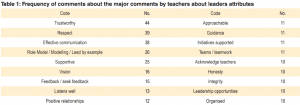
Moir, Hattie and Jansen (2014, p.37) identified a number of key attributes that teachers perceived as important for leaders:
They also state that “Trust is often best developed in team environments, as then there is opportunity for collaboration and shared decision-making, especially when there is a common focus on improving teaching and learning” (p.39). Bush and Glover (2014, p.554) also discuss the idea of leadership as influence rather than stemming from formal authority, which suits teacher-librarians since we often lack official leadership positions in school hierarchies. Both discussions relate beautifully to the work of the teacher-librarian as literacy expert and information specialist, and they highlight a key way that teacher-librarians can both improve their visibility and their perceived value to their school community through collaborative programming, teaching, and assessment which supports the work of time-poor classroom teachers.
The work of Crippen and Willows (2019, p.174) highlights the 10 characteristics of servant-leaders, and teacher-librarians are uniquely placed to assist healing for colleagues overburdened by heavy workloads, administrivia, and poor student behaviour: “Through their actions as servant leaders they are facilitating a healing process and followers often look to them for support when times are difficult or something traumatic has occurred (Barbuto and Wheeler, 2007).” Teacher-librarians can also exhibit the persuasion trait of servant-leaders: “Supovitz (2018) also describes how teacher leaders use strategies such as leading by example, earning their colleagues trust and encouraging and collaborating with their peers.”
Another area where teacher-librarians can shift the perception of the school community is in the space surrounding emerging or rapidly changing technologies. A 2016 article notes that “By virtue of their training, relationships, systems knowledge, and instructional roles … teacher librarians are ideally suited to lead, teach, and support students and teachers in 21st century schools” (Digital Promise, 2016). Digital literature has the potential to move students from passive consumers to active creators of content while engaging them with the process and ethics of digital content creation (Lysaught, October 4 2022), and Artificial Intelligence is another emerging space where teacher-librarians can position themselves as experts to increase their visibility and perceived value (Lysaught, March 5 2023). It is imperative that we stay current with new and developing technologies to best position ourselves as experts in this field. Our expertise in copyright and the ethics of digital tools alongside our ability to connect the General Capabilities to specific learning programs is invaluable – however, we need to ensure that we’re promoting our abilities in this area and marketing collaborative teaching and planning as a benefit to time-poor teachers rather than just another thing to add to their plates.
Weisburg (2020) argues that while there are numerous barriers to showcasing our value, as a profession we have no other option. We must make it a priority to develop our visibility and promote our value to our school community or we run the risk of becoming obsolete. Weisburg suggests that teacher-librarians should start by looking for ways to showcase what we’re already doing; social media posts, visible displays, and staff emails can promote this work among the school community, while annual library reports can increase the perception of our professionalism and showcase for senior leaders much of the behind the scenes work that goes into running a library (Lysaught, March 5 2023). Weisburg’s suggestion about speaking at P&C meetings is another interesting one which links well to our aforementioned technology expertise. The most crucial aspect of Weisburg’s article for me was the concept of “chopportunities” – “challenges that can be turned into an opportunity.” So much of what affects the library is decided without our input and while it can be tempting to fall into the “why bother?” disheartened state of mind, for our own protection (and sanity!) reframing these issues as “chopportunities” can be a way to reclaim some sense of agency and showcase the benefits we provide to our school communities.
References:
Bush, T. & Glover, D. (2014). School leadership models: What do we know? School Leadership and Management, 34(5), 553-571. https://doi.org/10.1080/13632434.2014.928680
Crippen, C. & Willows, J. (2019). Connecting teacher leadership and servant leadership: A synergistic partnership. Journal of Leadership Education, 18(2), pp. 171-180. https://journalofleadershiped.org/jole_articles/connecting-teacher-leadership-and-servant-leadership-a-synergistic-partnership/
Digital Promise (2016). The new librarian: Leaders in the digital age. In SCIS Connections, (96). https://www.scisdata.com/connections/issue-96/the-new-librarian-leaders-in-the-digital-age/
Moir, S., Hattie, J. & Jansen, C. (2014). Teacher perspectives of ‘effective’ leadership in schools. Australian Educational Leader, 36(4), 36-40.
Softlink (2022). 2022 Australian and New Zealand school library survey report. https://www.softlinkint.com/resources/reports-and-whitepapers/
Weisburg, H. K. (2020). Leadership: There is no other option. Synergy, 18(1). https://slav.vic.edu.au/index.php/Synergy/article/view/369/364